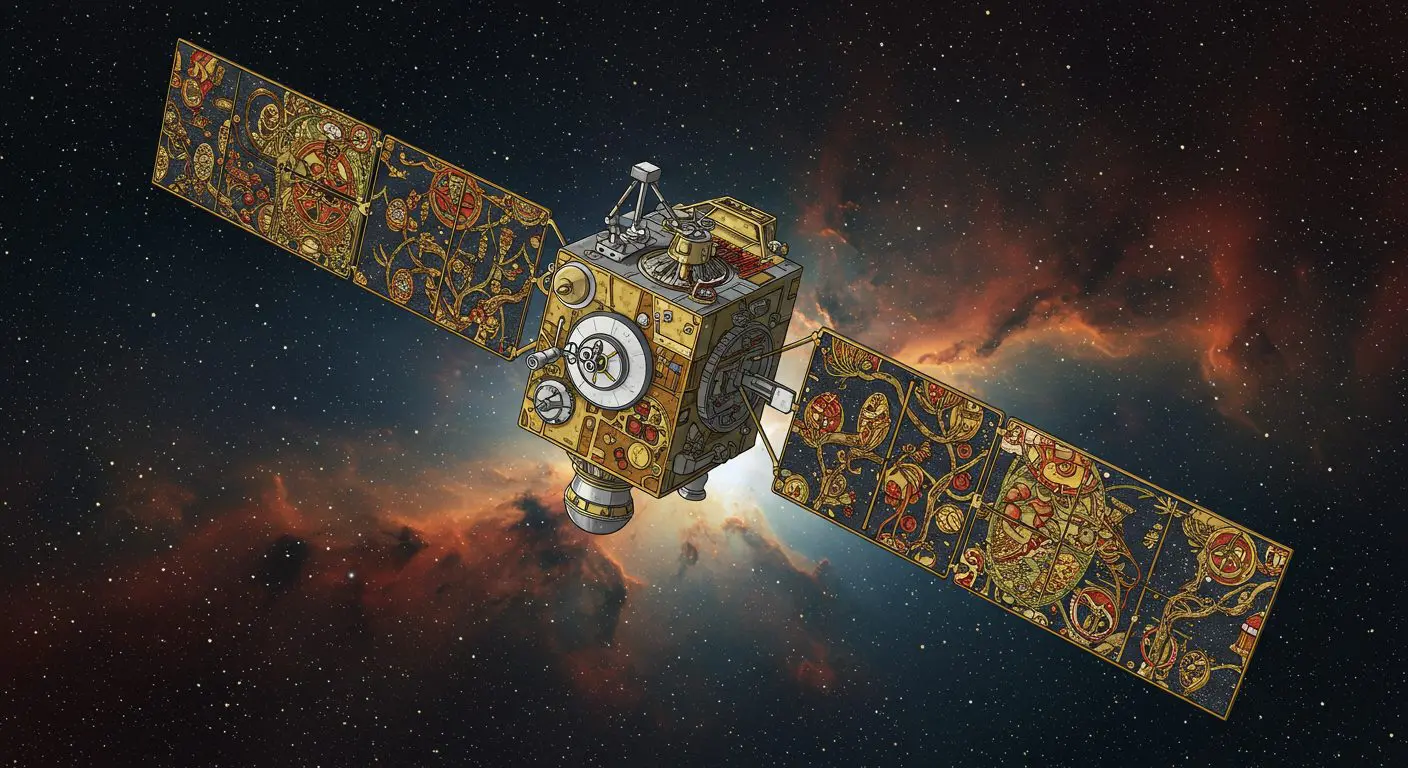
Researchers demonstrate Kirchhoff-Law-Johnson-Noise (KLJN), a novel approach to satellite communication security. KLJN utilises standard electronic components and classical physics, offering unconditional security with reduced cost and complexity compared to quantum key distribution (QKD). It proves resilient to environmental noise, making it suitable for space-based systems.
The escalating demand for secure satellite communications necessitates innovative approaches to data protection, particularly in light of advancing computational capabilities. Researchers are now investigating methods beyond traditional cryptography, focusing on protocols offering unconditional security – meaning security based on the laws of physics rather than computational difficulty. A team led by Lucas Truax and Sandip Roy of Stephenson Stellar Corporation, alongside Laszlo B. Kish from Texas A&M University, details a novel technique in their paper, “Unconditionally Secure Wireless-Wired Ground-Satellite-Ground Communication Networks Utilizing Classical and Quantum Noise”. Their work introduces the Kirchhoff-Law-Johnson-Noise (KLJN) method, a system leveraging fundamental physical principles to establish secure communication links between ground stations, satellites, and wired networks, offering a potentially more robust and cost-effective alternative to established quantum key distribution (QKD) systems. KLJN utilises thermal noise – the random electrical signal generated by the movement of electrons in a conductor – as a security feature, making eavesdropping detectable due to the disturbance it creates in the signal.
Quantum key distribution (QKD) currently faces escalating challenges stemming from advances in computational power, motivating investigation into alternative secure communication protocols. The Kirchhoff-Law-Johnson-Noise (KLJN) principle presents a potential solution, particularly for securing satellite communications, by relying on fundamental physical laws rather than computationally intensive algorithms. Recent research confirms the feasibility of KLJN, achieving unconditional security independent of assumptions about an adversary’s computational capabilities and circumventing vulnerabilities present in post-quantum cryptography, which aims to develop algorithms resistant to quantum computers.
KLJN achieves this unconditional security by exploiting the
KLJN achieves this unconditional security by exploiting the inherent randomness of thermal noise, also known as Johnson-noise, present in all electrical circuits due to the thermal agitation of charge carriers. This randomness forms the basis of a secure communication channel, as any attempt to intercept the signal introduces detectable disturbances. Researchers position KLJN as a pragmatic alternative to QKD, which necessitates specialised and fragile components such as single-photon detectors and dedicated optical fibre links. This simplification translates to reduced implementation costs and logistical complexities. Furthermore, KLJN exhibits resilience to environmental and radiation-induced noise, common in space environments, making it particularly suitable for strategic ground-to-satellite networks.
The study demonstrates KLJN’s robustness against environmental and radiation-induced noise, a critical factor for reliable operation in the harsh conditions of space. This resilience stems from the inherent nature of thermal noise, which is already present in the system and difficult to distinguish from any noise introduced by an eavesdropper. Researchers show that KLJN integrates seamlessly with existing communication infrastructure, requiring minimal modifications to current systems. This offers a more practical solution for many scenarios, prioritising cost-efficiency, simplicity, and resilience in challenging environments.
Researchers propose further investigation into optimising KLJN system parameters, including noise levels and circuit design, to enhance both performance and security. Exploration of integration with existing communication protocols and infrastructure is also recommended to facilitate widespread adoption. Future research will concentrate on developing practical implementations of KLJN systems and conducting field tests to validate performance in real-world scenarios.
Researchers highlight the potential of KLJN extending beyond
Researchers highlight the potential of KLJN extending beyond satellite communications, encompassing diverse applications such as smart grids, vehicular networks, and sensor networks. This versatility demonstrates KLJN’s adaptability and broad applicability in securing critical infrastructure and data transmission across various sectors.
🗞 Unconditionally Secure Wireless-Wired Ground-Satellite-Ground Communication Networks Utilizing Classical and Quantum Noise
🧠 DOI: https://doi.org/10.48550/arXiv.2506.10147



See today’s quantum computing news on Quantum Zeitgeist for the latest breakthroughs in qubits, hardware, algorithms, and industry deals.