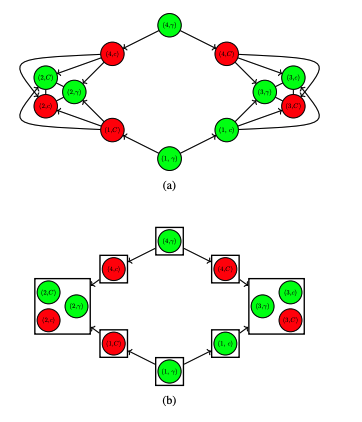
Research demonstrates the contextual correlations arising from quantum measurements necessitate a minimum of 2 bits of memory for Mermin’s pentagram, utilising three qubits. However, employing all two-qubit Pauli observables requires at least 3 bits, exceeding the system’s classical memory capacity and confirming quantum contextuality.
The fundamental principles governing quantum mechanics permit correlations between measurement outcomes that have no classical analogue – a phenomenon known as contextuality. These correlations imply that a system’s properties are not predetermined prior to measurement, but rather are brought into being by the act of measurement itself. A long-standing question concerns the resources required to reproduce these quantum correlations using classical systems. Recent research, detailed in the article ‘Memory cost of quantum contextuality with Pauli observables’ by Stefan Trandafir, Colm Kelleher, and Adán Cabello, alongside their respective institutions – the Universidad de Sevilla and the Universit´e Marie et Louis Pasteur – investigates the minimum ‘memory’ – essentially, the amount of stored information – needed to simulate contextual behaviour arising from specific quantum measurements. Their analysis, building on prior work, demonstrates a quantifiable disparity: simulating contextuality generated by Mermin’s pentagram requires only a few bits of memory, whereas replicating contextuality from all two-qubit Pauli observables demands memory exceeding the capacity of the simulated system itself.
Quantum Contextuality: Limits of Classical Description
Recent research actively investigates quantum contextuality, a fundamental property of quantum mechanics that challenges classical notions of realism and locality. This work demonstrates that certain quantum correlations cannot be explained by systems possessing pre-defined properties independent of measurement; instead, measurement outcomes fundamentally depend on the context – the specific combination of compatible observables being measured. Researchers are currently quantifying the degree of contextuality, establishing metrics for its strength and providing insights into the unique capabilities of quantum mechanics.
Investigations utilise mathematical frameworks, notably graph theory, finite geometry, and symplectic geometry, to analyse the structure of contextual correlations and reveal underlying principles governing contextuality. For example, studies connect Mermin’s pentagram – a specific configuration of quantum measurements – to geometric structures like ovoids within projective spaces. Projective spaces are generalisations of Euclidean space where parallel lines meet at infinity, and ovoids are specific geometric shapes within them. This connection potentially facilitates the application of contextuality in quantum technologies.
A key focus lies in determining the computational resources required to simulate contextual correlations classically. Previous findings established that simulating the contextuality arising from a three-qubit Mermin’s pentagram requires only a limited number of bits of memory. Researchers now demonstrate that simulating contextuality generated by all two-qubit Pauli observables – a complete set of quantum operators describing spin – demands significantly more memory, exceeding the classical capacity of the system under consideration. This highlights the potential for quantum systems to outperform classical computation in tasks reliant on contextual correlations.
Experimental implementations continue to verify and explore contextuality across diverse physical systems, confirming the robustness of this phenomenon with state-independent contextuality using photons and trapped ions. State-independent contextuality means the effect is not reliant on the specific quantum state being measured. This contributes to a growing understanding of the limits of classical descriptions of reality and the unique capabilities of quantum mechanics.
Current investigations refine mathematical formalisms to characterise contextual systems, moving beyond initial demonstrations towards a deeper, more nuanced comprehension of the phenomenon. Researchers develop metrics to assess the degree of contextuality, enabling comparative analysis between different systems, and establish quantifiable limits on the memory required to classically simulate contextual correlations.
Recent work reveals that simulating even relatively simple quantum systems requires memory capacities exceeding the inherent limitations of the system itself. This research programme represents a vibrant and interdisciplinary field at the intersection of quantum physics, mathematics, and computer science, promising to refine our fundamental understanding of reality and unlock new possibilities for quantum technologies and computation.
👉 More information
🗞 Memory cost of quantum contextuality with Pauli observables
🧠 DOI: https://doi.org/10.48550/arXiv.2506.06869