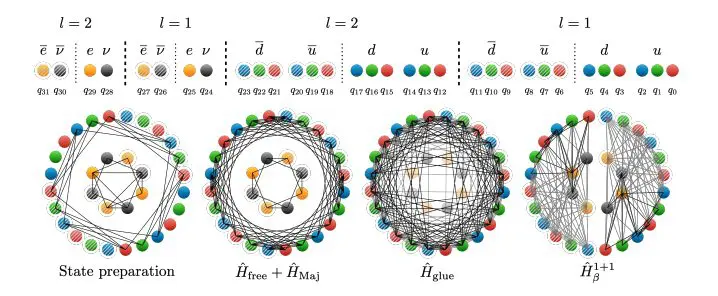
Researchers simulated neutrinoless double-beta decay, a process violating lepton number conservation, using a 36-qubit trapped-ion quantum computer. The simulation, employing co-designed circuits and error mitigation, observed this decay in real time, demonstrating potential for high-resolution study of nuclear reaction pathways at the yoctosecond scale.
The search for physics beyond the Standard Model receives a novel contribution from a collaborative investigation into neutrinoless double beta decay – a hypothesised process that, if observed, would confirm neutrinos are Majorana particles and violate lepton number conservation. Researchers have, for the first time, simulated this decay in real time using a quantum computer, offering a pathway to explore nuclear processes at unprecedented temporal resolution. The work, detailed in a forthcoming publication, leverages the all-to-all connectivity and native gate set of IonQ’s Forte-generation trapped-ion quantum computer. The simulation, mapping electrons, neutrinos, and quarks to 36 qubits, was undertaken by Ivan A. Chernyshev (Los Alamos National Laboratory), Roland C. Farrell (California Institute of Technology), and Marc Illa, Martin J. Savage, and a team from IonQ Inc. including Andrii Maksymov, Felix Tripier Sereville, Aharon Brodutch, Claudio Girotto, Ananth Kaushik, Martin Roetteler, Miguel Angel Lopez-Ruiz, Andrew Arrasmith, and Yvette de. The study is titled “Pathfinding Quantum Simulations of Neutrinoless Double-Decay”.
Quantum Simulation Reveals Real-Time Dynamics of Neutrinoless Double Beta Decay
Researchers have, for the first time, simulated neutrinoless double beta decay in real time using a quantum computer, observing a violation of lepton number – a fundamental conservation law – within the simulation. The work, conducted by Ruiz et al., demonstrates a novel approach to modelling complex nuclear processes and offers a pathway to investigate physics beyond the Standard Model.
The simulation, executed on IonQ’s Forte trapped-ion device, maps the interactions of electrons, neutrinos, and quarks onto 36 qubits. Neutrinoless double beta decay is a hypothetical process where a nucleus decays, emitting two electrons but no neutrinos. Its observation would confirm that neutrinos are Majorana particles – their own antiparticles – and violate lepton number conservation. This violation is a key prediction of several extensions to the Standard Model of particle physics.
The team constructed a quantum model of the decay, representing weak interactions – responsible for radioactive decay – using a four-fermion interaction. This interaction induces the lepton-number violation through the inclusion of a Majorana neutrino mass. Crucially, the simulation was designed to exploit the specific capabilities of the IonQ Forte processor. The device’s all-to-all qubit connectivity – meaning any qubit can directly interact with any other – and native gate set allowed for optimisation of the quantum circuit, minimising errors inherent in quantum computation.
Addressing the significant challenge of error mitigation was central to the study. The researchers implemented a multi-tiered strategy, beginning with non-linear filtering to reduce bias in the results. This was followed by post-selection, where only simulation runs satisfying a specific total charge constraint were retained. Finally, they incorporated ‘flag gadgets’ – additional qubits used to detect and flag errors – for enhanced error detection. Each mitigation step demonstrably improved the accuracy of the simulation output.
To quantify the uncertainty in the results, the team employed a bootstrapping method. This involved generating a distribution of simulation outputs by repeatedly sampling different circuit variants and measurement outcomes. This statistical approach provides a robust estimate of the simulation’s precision. Experimental results obtained under varying levels of mitigation clearly demonstrate the impact of each refinement step.
While the study showcases the potential of co-design – tailoring the simulation to the hardware – the researchers acknowledge limitations. The bootstrapping method may overestimate uncertainty due to the intentional structure of the circuit variant selection, designed to cancel biases. Despite this, the work represents a significant advance. Benchmarking circuits, incorporating up to 2,356 two-qubit gates, informed the development of these methods, enabling precise extraction of observables.
The simulation achieves a level of temporal resolution promising yocto-second (10-24 seconds) insights into reaction pathways, opening new avenues for exploring the dynamics of nuclear processes and potentially revealing subtle details of fundamental particle interactions. This work establishes a promising pathway for simulating complex quantum systems on near-term hardware, highlighting the importance of hardware-aware algorithm design.
👉 More information
🗞 Pathfinding Quantum Simulations of Neutrinoless Double- Decay
🧠 DOI: https://doi.org/10.48550/arXiv.2506.05757




See today’s quantum computing news on Quantum Zeitgeist for the latest breakthroughs in qubits, hardware, algorithms, and industry deals.