Researchers identified the mechanisms causing qubit state transitions during high-speed measurement of superconducting qubits. The dominant process involves partial absorption of the readout photon by the qubit, alongside contributions from unwanted mode excitation, defect-mediated decay, and resonance activation within the qubit spectrum.
The fidelity of quantum computations hinges on the accurate and repeatable measurement of qubit states without disturbing them – a principle known as non-demolition measurement. However, enhancing the speed of these measurements in superconducting qubits often introduces unwanted state transitions, compromising the integrity of quantum information. A collaborative team from Yale University, comprising Thomas Connolly, Pavel D. Kurilovich, Vladislav D. Kurilovich, Charlotte G. L. Bøttcher, Sumeru Hazra, Wei Dai, Andy Z. Ding, Vidul R. Joshi, Heekun Nho, Spencer Diamond, Daniel K. Weiss, Valla Fatemi, Luigi Frunzio, Leonid I. Glazman, and Michel H. Devoret, have undertaken a detailed investigation into these measurement-induced transitions. Their work, detailed in “Full characterization of measurement-induced transitions of a superconducting qubit”, identifies several mechanisms responsible for these transitions, including partial photon absorption, excitation of parasitic modes, decay via defects, and activation of resonances, offering a comprehensive analysis of state transitions caused by strong drive signals in superconducting qubits.
Dispersive Readout Limitations in Superconducting Qubits: Identifying and Mitigating Transition Mechanisms
Superconducting qubits, a leading platform for quantum information processing, exhibit sensitivity to environmental noise, leading to decoherence – the loss of quantum information – and limiting computational fidelity. Current research concentrates on suppressing this noise and extending qubit coherence times, with particular attention paid to the processes occurring during qubit readout. This work presents a detailed analysis of unwanted state transitions induced during dispersive readout of transmon qubits, identifying several contributing mechanisms and outlining strategies for mitigation.
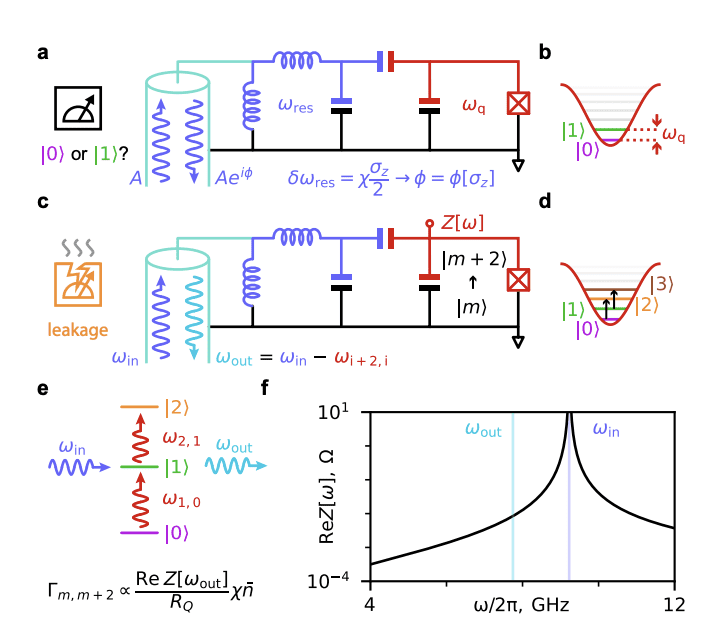
Dispersive readout, a non-destructive measurement technique, relies on probing the qubit state by measuring a shift in the frequency of a microwave tone reflected from a coupled resonator. However, experiments reveal that this process induces unwanted transitions, degrading the fidelity of the measurement and hindering the implementation of quantum error correction protocols.
A primary source of these transitions is the partial absorption of the incoming readout photon by the qubit, followed by re-emission of a lower-frequency photon into the transmission line. This process, alongside excitation of unwanted electromagnetic modes within the circuit packaging, decay pathways originating from material defects within the superconducting materials, and activation of higher-order resonances in the qubit’s energy spectrum, all contribute to the observed transitions. The relative significance of each mechanism varies depending on the qubit’s operating frequency and the power of the applied drive signal.
To understand these interactions, researchers have developed a theoretical model describing the qubit-filter circuit interaction. This model decomposes the total energy of the system into contributions from the qubit, the filter circuit, and their mutual interaction. This allows for a quantitative assessment of how the filter modifies the qubit’s susceptibility to noise.
A significant focus is placed on mitigating ‘quasiparticle poisoning’. This occurs when unpaired electrons – quasiparticles – within the superconducting material induce random transitions in the qubit’s state. Researchers characterise the noise spectrum associated with these quasiparticles as Lorentzian – meaning noise power decreases with increasing frequency. The qubit’s decoherence rate is then calculated by integrating this noise spectrum, weighted by the frequency-dependent coupling between the noise and the qubit. By carefully tailoring the circuit’s frequency response, researchers aim to suppress the low-frequency noise that predominantly causes quasiparticle excitation and subsequent decoherence.
This study provides a comprehensive understanding of the physical origins of readout-induced transitions, informing the development of strategies to mitigate these effects through optimised circuit design, careful material selection, and refined pulse shaping techniques. Reducing these transitions directly improves the performance of quantum error correction schemes and enhances the overall fidelity of quantum computations.
Future work will focus on quantifying the contribution of each identified mechanism under varying conditions and exploring methods to suppress or compensate for these transitions. Researchers are also investigating advanced filtering techniques and dynamic decoupling sequences – a method of applying a series of precisely timed pulses to the qubit – as potential solutions. Extending this analysis to different qubit designs and materials will broaden the applicability of these findings and accelerate progress in the field of superconducting quantum computing. This detailed characterisation of noise sources and their impact on qubit coherence represents a crucial step towards building more robust and reliable quantum computers.
👉 More information
🗞 Full characterization of measurement-induced transitions of a superconducting qubit
🧠 DOI: https://doi.org/10.48550/arXiv.2506.05306