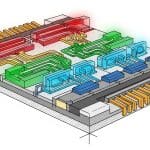
A new algorithm, two-dimensional Gaussian MERA (GMERA), compresses circuits simulating entangled materials, achieving exponential reductions in circuit depth. Validated on the Haldane model, it accurately represents diverse quantum states including insulators and semimetals. A novel fermion-to-qubit encoding facilitates scalable fermionic rotations using constant Pauli weight.
The accurate simulation of complex materials relies on effectively representing the quantum entanglement within their ground states – a task that rapidly becomes intractable for classical computers as dimensionality increases. Researchers are therefore actively pursuing methods to compress the quantum information needed to describe these states, reducing the computational resources required for simulation. A new approach, detailed in the paper “Entanglement renormalization circuits for Gaussian Fermion States” by Sing Lam Wong and Andrew C. Potter (University of British Columbia) and Andrew C. Potter (Quantinuum), presents a circuit compression algorithm based on the multi-scale entanglement renormalization ansatz (MERA). This technique, termed two-dimensional Gaussian MERA (GMERA), demonstrably reduces the circuit depth needed to approximate highly entangled states, and is validated through simulations of the Haldane model, a system exhibiting diverse topological phases. The work also introduces a novel fermion-to-qubit encoding scheme, potentially simplifying the implementation of fermionic simulations on emerging quantum hardware.
Quantum Simulation Advances with Compressed Circuitry
Researchers have developed a new algorithm that substantially reduces the computational resources required to simulate quantum materials on quantum computers. The core challenge lies in efficiently representing fermions – particles that obey Fermi-Dirac statistics and are fundamental constituents of matter – using qubits, the basic units of quantum information.
The team’s approach centres on a circuit compression algorithm termed two-dimensional Gaussian MERA (GMERA). MERA, or multi-scale entanglement renormalization ansatz, is a tensor network technique used to efficiently represent the entanglement structure of many-body quantum systems. GMERA applies this principle to compress the quantum circuits needed for simulation, thereby reducing the demands on qubit count and circuit depth – a measure of the number of quantum operations.
A key innovation is the use of an encoding scheme based on expanding topological order. Traditional methods struggle with the exponential scaling of resources when representing fermions on qubits. Topological order refers to a state of matter characterised by robust, non-local entanglement, and this encoding leverages that robustness to achieve a more compact representation.
Validation of the GMERA algorithm involved simulations of the Haldane model, a paradigmatic system exhibiting topological properties. The simulations accurately reproduced the ground states of the model, including the distinct topological phases it exhibits. This demonstrates the algorithm’s ability to capture complex quantum behaviour.
The method relies on stabilizer circuits – quantum circuits composed of operations that commute with the system’s Hamiltonian – to preserve the topological order throughout the simulation. This ensures the integrity of the fermionic encoding and the accuracy of the results. Stabilizer circuits are crucial for error mitigation in quantum computation.
Furthermore, the research establishes empirical upper bounds on the resources – number of qubits and circuit depth – required to prepare free fermion states. Free fermions are particles that do not interact with each other, and establishing resource limits for their simulation provides a benchmark for more complex interacting systems. These bounds offer practical guidance for designing future quantum simulations of materials.
The work represents a significant step towards simulating complex quantum materials on current and near-term quantum computers, offering a more scalable and efficient method for representing fermionic systems.
👉 More information
🗞 Entanglement renormalization circuits for Gaussian Fermion States
🧠 DOI: https://doi.org/10.48550/arXiv.2506.04200