Researchers developed a method to automatically correct errors in Hausa text using transformer models and a synthetic dataset of 450000 noisy-clean sentence pairs. Evaluation using metrics including F1, BLEU and CER demonstrates improved text quality and advances natural language processing capabilities for low-resource languages.
The quality of digital text in many languages relies on consistent orthography, yet automated processing of texts in low-resource languages frequently encounters inconsistencies arising from transcription errors or variations in writing practice. Addressing this challenge for Hausa, a Chadic language spoken by over 70 million people, researchers have developed a method to automatically correct common writing anomalies. Ahmad Mustapha Wali and Sergiu Nisioi, from the University of Bucharest, detail their approach in “Automatic Correction of Writing Anomalies in Hausa Texts”, presenting a technique that leverages the power of transformer-based models – a type of neural network particularly effective in natural language processing – and a newly created, large-scale dataset of noisy and corrected Hausa sentence pairs. Their work demonstrates improvements across multiple metrics, including precision and recall (F1 score), translation quality (BLEU and METEOR scores), and error rates in character and word recognition (CER and WER), offering a valuable resource for enhancing natural language processing capabilities for Hausa and potentially other under-represented languages.
Robust Hausa Language Models with Synthetically Noisy Data
Researchers are actively evaluating the performance of language models processing Hausa text containing realistic errors, such as misspellings and incorrect spacing. This work addresses a critical need for robust Natural Language Processing (NLP) technologies in low-resource languages – languages with limited digital linguistic resources. The study details experiments utilising synthetically generated noisy text, mirroring errors found in real-world Hausa writing, and assesses the ability of several transformer-based models to correct these anomalies.
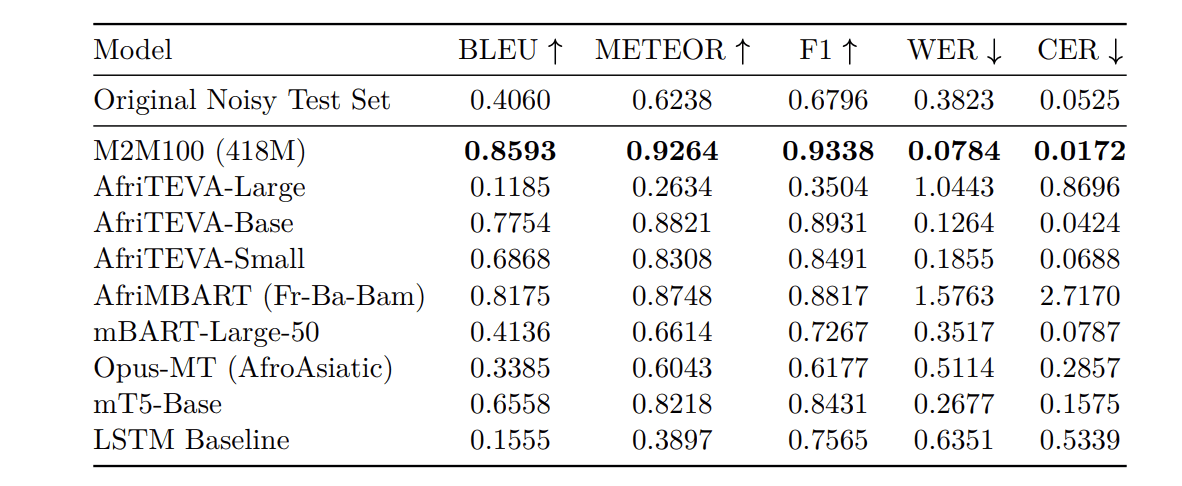
A key component of this research is a newly created parallel dataset of over 450,000 Hausa sentence pairs, comprising both noisy and corrected versions. This provides a substantial resource for training and evaluating language models, and encourages collaboration within the research community. Researchers fine-tuned several multilingual and African-focused models – M2M100, AfriTEVA, mBART, and Opus-MT – using SentencePiece tokenisation, a subword tokenisation algorithm, to perform the correction task.
Evaluation metrics including F1-score (harmonic mean of precision and recall), BLEU (Bilingual Evaluation Understudy – measures translation quality), METEOR (Metric for Evaluation of Translation with Explicit Ordering), Character Error Rate (CER), and Word Error Rate (WER) demonstrate significant improvements in text quality following fine-tuning, confirming the effectiveness of the approach.
Detailed analysis reveals specific error types that challenge the models, highlighting the complexities of Hausa linguistics and the need for tailored solutions. Morphological complexity – the study of word formation – within the Hausa language frequently causes difficulties, as does accurate Named Entity Recognition (NER) – identifying and classifying named entities such as people, organisations, and locations. These demand sophisticated algorithms capable of handling intricate grammatical structures and identifying key entities. The models sometimes struggle with contextual understanding, leading to incorrect interpretations of ambiguous words, emphasising the importance of semantic analysis and reasoning. Instances of code-switching, where English words appear within Hausa text, also present challenges, requiring models to handle multiple languages simultaneously.
This research builds upon previous work by Shamilov et al. (2023) and utilises methodologies detailed by Bakar et al. (2023), providing a robust framework, a publicly available dataset, and effective models for improving Hausa text quality. The findings highlight the importance of addressing morphological analysis, named entity recognition, and contextual understanding to build more resilient Hausa language models. This work offers transferable insights applicable to other low-resource languages facing similar challenges in NLP.
The successful adaptation of several pre-trained models highlights the potential of transfer learning in addressing data scarcity issues common in African languages, demonstrating the effectiveness of leveraging existing knowledge. This resource facilitates further research in Hausa NLP and provides a transferable framework for creating training data for other low-resource languages.
Future work should investigate the impact of different noise generation strategies on model robustness, exploring alternative methods for creating synthetic data and assessing their effectiveness. Exploring the incorporation of morphological and syntactic information into the noise generation process may further enhance the realism of the synthetic data. Additionally, research could focus on developing models specifically tailored to handle code-switching and borrowing, to improve performance in mixed-language contexts. Finally, extending the evaluation to a wider range of NLP tasks, such as machine translation and sentiment analysis, would provide a more comprehensive assessment of the methodology and its potential applications.
👉 More information
🗞 Automatic Correction of Writing Anomalies in Hausa Texts
🧠 DOI: https://doi.org/10.48550/arXiv.2506.03820