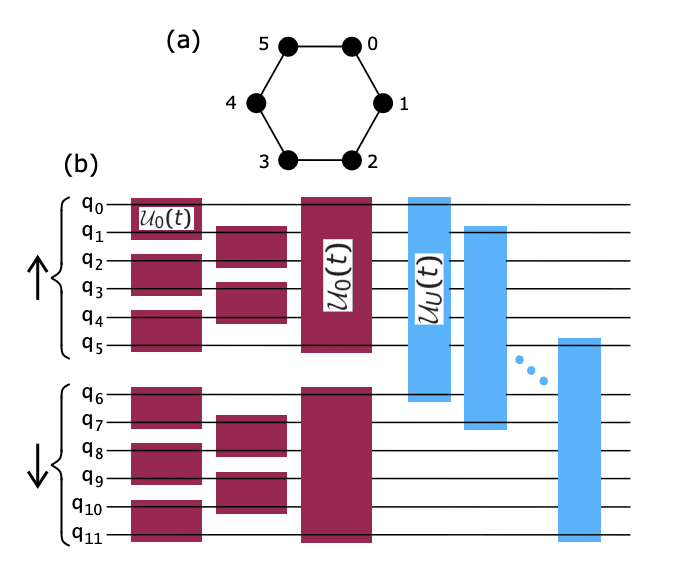
Simulations of the Hubbard model on a graphene hexagon, utilising quantum algorithms, accurately determined ground-state properties when performed without noise, validating the approach against exact diagonalization. However, simulations incorporating realistic hardware noise revealed significant discrepancies, demonstrating current devices limit accurate physical predictions of correlated materials.
Understanding the behaviour of electrons in materials is central to advances in many areas of physics and materials science. The Hubbard model, a simplified representation of interacting electrons, provides a framework for investigating strongly correlated electron systems – materials where electron interactions dominate. Researchers are now utilising quantum computers to simulate these complex systems, offering a potential route to designing materials with novel properties. A team led by Mohammad Mirzakhani and Kyungsun Moon, from Yonsei University and the Institute of Quantum Information Technology, detail their investigation into simulating the Hubbard model on a graphene hexagon, employing iterative phase estimation and adiabatic evolution algorithms. Their work, entitled ‘Quantum simulation of the Hubbard model on a graphene hexagon: Strengths of IQPE and noise constraints’, assesses the capabilities and limitations of current quantum hardware in accurately modelling these systems.
Quantum Simulation Advances Understanding of Correlated Electron Systems
Quantum computing is establishing itself as a valuable technique for simulating materials, particularly those where strong electron correlation dictates behaviour. Electron correlation refers to the interactions between electrons in a material, moving beyond the simplified independent electron model. These interactions are fundamental to understanding a material’s complex physical properties, but are computationally expensive to model using classical computers.
Recent research details the application of quantum algorithms to simulate the Hubbard model, a simplified representation of interacting electrons in a solid, using a six-site graphene hexagon as the test system. Researchers employed two distinct quantum algorithms: Iterative Phase Estimation (IQPE) – a quantum algorithm used to estimate the eigenvalues of a unitary operator – and adiabatic evolution, a method that slowly evolves a simple initial quantum state into the ground state of the system. The simulations aimed to determine the ground-state properties – the lowest energy state – of the model.
Simulations performed on a noiseless simulator accurately reproduced ground-state energies, charge densities (the probability of finding an electron at a given location) and spin densities (the distribution of electron spin). These results validated the precision of the quantum simulation approach when compared against exact diagonalization, a classical method for solving the Schrödinger equation for small systems. This confirms the potential of quantum computation to model strongly correlated electron systems, which are intractable for classical computation beyond a limited size.
However, the study acknowledges the limitations of current quantum hardware. Researchers utilised the Qiskit Aer simulator, incorporating a custom noise model to mimic realistic errors. This model accounted for depolarizing gate errors (where quantum information is lost), thermal relaxation (loss of quantum coherence due to interaction with the environment), and readout noise (errors in measuring the quantum state). The simulations revealed that hardware noise degrades the fidelity of the results, creating a discrepancy between ideal theoretical predictions and practical implementations on existing quantum devices.
Preliminary runs on actual quantum hardware further exposed these limitations, demonstrating a gap between the simulated noise models and the characteristics of real quantum backends – the physical quantum processors. This highlights the need for more sophisticated noise characterisation and mitigation methods to improve the reliability of quantum simulations.
The research leveraged software tools including Qiskit, Qiskit Nature (a module for quantum chemistry and materials science), and QuSpin (a tensor network package for strongly correlated systems). This work builds upon decades of materials science research, notably the 2007 Nobel Prize-winning discovery of graphene – a single-layer sheet of carbon atoms – and subsequent investigations into its electronic and magnetic properties. The focus on graphene magnetism, as detailed in works by Yazyev (2010) and de Oteyza & Frederiksen (2022), underscores the material’s potential for spintronic applications – utilising electron spin for information storage and processing – and provides a crucial context for understanding the motivations behind this computational work.
👉 More information
🗞 Quantum simulation of the Hubbard model on a graphene hexagon: Strengths of IQPE and noise constraints
🧠 DOI: https://doi.org/10.48550/arXiv.2506.05031


See today’s quantum computing news on Quantum Zeitgeist for the latest breakthroughs in qubits, hardware, algorithms, and industry deals.