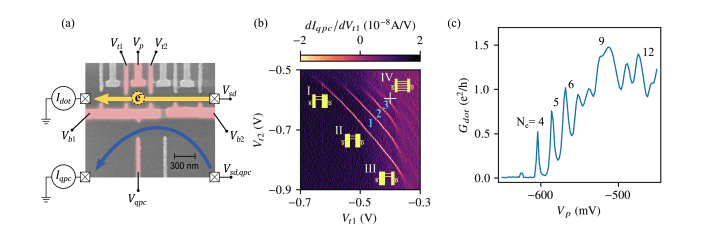
Electron transport through a quantum dot exhibits Kondo effect characteristics for between seven and eleven electrons. Analysis reveals a multi-orbital Kondo impurity influenced by Hund’s rule exchange interaction, modelling Hund’s metals where orbital interactions create complex electronic states and zero-bias anomalies.
The behaviour of electrons in confined quantum systems continues to reveal nuanced interactions between fundamental physical phenomena. Researchers are increasingly focused on understanding how localised electron spins within nanoscale structures, such as quantum dots, interact with surrounding conductive materials. This interplay gives rise to the Kondo effect – a resonance arising from the coupling of these spins with conduction electrons – and can be further complicated by the presence of multiple electron orbitals and their mutual interactions, as dictated by Hund’s rule. A team led by Olfa Dani, Johannes C. Bayer, and including Timo Wagner, Gertrud Zwicknagl, and Rolf J. Haug, from institutions including Leibniz Universität Hannover and Technische Universität Braunschweig, detail their investigation into these effects in a new study titled ‘Interplay between Hund’s rule and Kondo effect in a quantum dot’. Their work examines electron transport within a specifically engineered GaAs quantum dot, revealing unexpected characteristics in the Kondo resonance that necessitate a multi-orbital description incorporating Hund’s rule exchange interactions, offering a model system relevant to the behaviour of ‘Hund’s metals’ – materials exhibiting complex electronic states due to local ferromagnetic interactions.
Modelling Quantum Dot Behaviour with the Resonant Impurity Slave Boson Approximation
Quantum dots, semiconductor nanocrystals exhibiting quantum mechanical properties, are intensely studied for their electronic behaviour, particularly when displaying the Kondo effect – a phenomenon where a localized magnetic moment interacts with conduction electrons. The Resonant Impurity Slave Boson (RISB) method provides a computationally tractable approach to modelling these strongly correlated electron systems, where traditional single-particle descriptions break down.
The RISB method addresses the many-body problem via a mean-field approximation. This involves representing complex electron interactions using slave bosons – auxiliary particles introduced as a mathematical tool to simplify the calculations. The method calculates expectation values for these bosons, effectively replacing the intricate interactions with an average field. This leads to a modified Hamiltonian incorporating a non-interacting Anderson impurity model – a simplified representation of an impurity atom within a host material.
A key feature of RISB is the incorporation of renormalized parameters – Λνσ and ˜Vνσ – which account for the effects of strong electron-electron interactions. These parameters shift the energy levels and modify the hybridization strength – the coupling between the quantum dot and the surrounding electronic reservoir – to accurately reflect the influence of correlations. Validation of the RISB approach relies on comparison with results from Numerical Renormalization Group (NRG) calculations, a highly accurate, though computationally demanding, benchmark method for these systems.
Recent analysis extends the RISB method to model multi-orbital Kondo impurities within the dot, incorporating Hund’s rule exchange interaction – a quantum mechanical rule governing the arrangement of electrons in atoms – to accurately represent the system’s electronic structure. This allows for successful description of the maximum in addition energy – the energy required to add an electron to the dot – observed at half-filling of the dot’s shell, aligning with experimental observations. This capability positions the quantum dot as a useful analogue for Hund’s metals – materials exhibiting strong local ferromagnetic interactions and complex electronic states.
To achieve optimal agreement with NRG calculations, a scaling of the hybridization strength – effectively doubling the parameter value derived from RISB – is necessary. This suggests that the RISB approximation inherently underestimates the coupling strength between the quantum dot and its surrounding electronic reservoir. The method effectively captures the interplay between localized spins and conduction electrons, crucial for understanding phenomena like zero-bias anomalies – unexpected changes in electrical current at zero voltage – observed in experimental setups.
Researchers are actively exploring the potential of RISB to model a wider range of nanoscale systems and investigate their dynamic response, including time-dependent phenomena. Future work plans to extend the RISB method to investigate the effects of increased electron correlation and stronger Coulomb repulsion – the electrostatic force between electrons – within the quantum dot. This ongoing development promises to refine our understanding of quantum dot behaviour and facilitate the development of novel quantum devices, unlocking new insights into the behaviour of correlated electron systems.
👉 More information
🗞 Interplay between Hund’s rule and Kondo effect in a quantum dot
🧠 DOI: https://doi.org/10.48550/arXiv.2505.21675
See today’s quantum computing news on Quantum Zeitgeist for the latest breakthroughs in qubits, hardware, algorithms, and industry deals.