Researchers demonstrated energy transfer between observers in a theoretical framework utilising an interacting quantum field theory known as the Nambu-Jona-Lasinio model. Energy appears to be extracted at a later time via measurement and classical information exchange, without the physical movement of particles, validated through circuit simulations.
The transfer of energy, typically constrained by the laws of thermodynamics and the speed of light, is being re-examined through the lens of quantum mechanics. Researchers are now investigating scenarios where energy appears to be ‘teleported’ – not via physical transport, but through correlations established by quantum measurement. A new study by Fidele J. Twagirayezu from the University of California, Los Angeles, et al., detailed in their paper “Timelike Quantum Energy Teleportation in the Nambu-Jona-Lasinio Model”, demonstrates a protocol for such energy transfer within a specific theoretical framework. The team utilises the Nambu-Jona-Lasinio (NJL) model – a theory describing interacting fermions, fundamental particles with half-integer spin – to show how an initial measurement by one observer can enable a second observer to extract energy at a later time, relying solely on classical communication. This work explores the potential of interacting quantum field theories to facilitate energy transfer beyond conventional limitations, offering a pathway towards potential hardware implementations.
Timelike Quantum Energy Teleportation Demonstrated in Theoretical Framework
Researchers have detailed a protocol for timelike quantum energy teleportation (QET), demonstrating energy transfer between observers separated in time without physical particle transport. The process relies on the exchange of classical information. It is realised within the established framework of the Nambu-Jona-Lasinio (NJL) model – a theory describing the interactions of fermions, fundamental particles with half-integer spin. The NJL model provides the theoretical basis for this work. Crucially, the model’s inherent structure, specifically the chiral condensate – a non-zero vacuum expectation value of fermion-antifermion pairs – facilitates the energy transfer. This condensate creates a complex vacuum structure that is essential to the process.
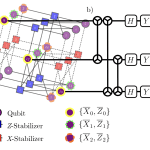
The protocol utilises Unruh-DeWitt detectors – theoretical tools representing accelerated observers – coupled to the fermionic field. These detectors enable one observer to extract energy based on measurements performed by another observer at a different point in time. The energy transfer is not instantaneous; it requires the exchange of classical information between the observers, establishing a temporal link. To validate the theoretical framework, researchers performed circuit simulations on a lattice-regularized version of the NJL model. These simulations confirmed the feasibility of the QET protocol and yielded quantitative data on energy transfer efficiency. The simulations employed the Trotterization method – a mathematical technique used to approximate the time evolution operator – to model the system’s dynamics accurately.
This work establishes a connection between quantum information theory and high-energy physics, demonstrating how concepts from quantum teleportation – traditionally applied to quantum states – can be extended to understand energy dynamics within relativistic quantum field theory. It offers a pathway to understanding energy transfer in complex quantum systems and may have implications for future technologies. Specifically, the findings suggest potential applications in developing novel quantum technologies for energy management and transfer, although these remain speculative at this stage. Furthermore, this research provides a theoretical foundation for potential experimental realisation of QET protocols on dedicated quantum hardware. In essence, this research presents a theoretical and simulated demonstration of a unique method for transferring energy in time using quantum principles, opening up avenues for further investigation and potential technological development.
👉 More information
🗞 Timelike Quantum Energy Teleportation in the Nambu-Jona-Lasinio Model
🧠 DOI: https://doi.org/10.48550/arXiv.2505.22794