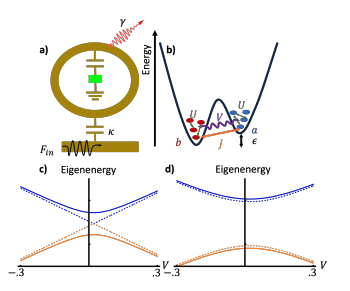
The search for novel states of matter exhibiting exotic properties relies on the precise detection of subtle symmetry breakages within materials. Researchers are now demonstrating a new approach utilising the unique capabilities of superconducting circuits to identify instances where time-reversal symmetry – the principle that the laws of physics should remain the same if time were reversed – is broken. A team led by Nicolas Dirnegger, Marie Wesson, Arpit Arora, Ioannis Petrides, Jonathan B. Curtis, Emily M. Been from the University of California, Los Angeles, in collaboration with Amir Yacoby from Harvard University, and Prineha Narang from UCLA, detail their findings in a new study titled ‘Nonlinear superconducting ring resonator for sensitive measurement of time reversal symmetry broken order’. Their work proposes a multimode superconducting ring resonator, exploiting strong nonlinear interactions between its modes, to sensitively probe these symmetry-breaking phenomena, potentially offering a new avenue for materials discovery.
Researchers have developed a novel method for detecting violations of time-reversal symmetry (TRSB) using a two-mode superconducting ring resonator. The device offers a sensitive platform for investigating exotic states of matter where time symmetry may be broken, potentially advancing fields such as topological quantum computing and materials science.
Time-reversal symmetry posits that the laws of physics remain consistent if time is reversed. Violations of this fundamental symmetry are predicted in certain materials exhibiting unusual properties, such as high-temperature superconductors and topological insulators. Detecting these violations, however, requires highly sensitive measurement techniques.
The newly developed resonator exploits strong nonlinear interactions
The newly developed resonator exploits strong nonlinear interactions between its resonant modes – essentially, the natural frequencies at which the resonator oscillates. These interactions, quantified by ‘self-Kerr’ and ‘cross-Kerr’ nonlinearities, modulate the frequency of microwave photons circulating within the resonator based on their intensity and interactions between the modes.
Researchers introduce a complex parameter, J, to characterise the TRSB coupling. Crucially, the imaginary component of J (Im[J]) directly signals the presence of TRSB. A non-zero Im[J] indicates a violation of time-reversal symmetry, signifying that the system behaves differently when time is reversed.
Through steady-state analysis – examining the stable operating conditions of the resonator – scientists systematically varied key parameters to map the device’s response. They found that asymmetric self-Kerr terms amplify the resonator’s sensitivity to TRSB. Visualisations, presented as 2D cross-sections of 3D parameter spaces, reveal how the population of each resonant mode shifts and splits in response to changes in Im[J], providing a measurable signature of TRSB.
The resonator’s sensitivity stems from its ability to achieve symmetric configurations in mode populations, even with differing initial conditions. Introducing a TRSB coupling breaks this symmetry, creating a detectable signal even with weak TRSB parameters. The imaginary component of the TRSB parameter remains the primary indicator of non-reciprocity – the property of a system behaving differently depending on the direction of signal propagation – and is crucial for accurate detection.
The resonator’s behaviour is governed by several parameters,
The resonator’s behaviour is governed by several parameters, including the decay rate (κ), detuning (Δ), dissipation (γ), drive amplitude (Fin), and cross-Kerr coupling. These parameters influence the resonator’s resonant frequencies and the strength of the interactions between the modes.
Researchers demonstrate that superconducting microwave resonators, traditionally employed in quantum information processing, can function as sensitive probes of exotic states of matter.
Future work will focus on expanding the model to incorporate more resonant modes, potentially enhancing the resonator’s capabilities and providing a more comprehensive understanding of TRSB. Investigations into the impact of dissipation and decoherence – processes that degrade quantum coherence – on device sensitivity are also planned. Optimising the resonator design and exploring different materials are key areas for further development, with the ultimate goal of realising applications in areas such as topological quantum computing and the discovery of new materials with exotic properties.
🗞 Nonlinear superconducting ring resonator for sensitive measurement of time reversal symmetry broken order
🧠 DOI: https://doi.org/10.48550/arXiv.2505.21614




See today’s quantum computing news on Quantum Zeitgeist for the latest breakthroughs in qubits, hardware, algorithms, and industry deals.