The convergence of quantum computing and machine learning represents a potentially significant development in computational capability. Researchers are actively exploring how quantum algorithms can enhance, or even redefine, established machine learning techniques, particularly as classical machine learning approaches increasingly demand substantial computational resources. A collaborative team, comprising M. Emre Sahin, Edoardo Altamura, Oscar Wallis, Stefano Mensa from the Hartree Centre, STFC, alongside Stephen P. Wood, Anton Dekusar, Declan A. Millar, Takashi Imamichi and Atsushi Matsuo from IBM Quantum, details their work in a new publication titled ‘Qiskit Machine Learning: an open-source library for quantum machine learning tasks at scale on quantum hardware and classical simulators’. The team present a Python-based library designed to bridge the gap between quantum computation and machine learning, offering both accessibility for novice users and customisation options for experienced quantum computational scientists.
Quantum Machine Learning Library Facilitates Hybrid Computation
The public release of a new machine learning (ML) library represents a notable development in the field of quantum computing, offering a Python-based interface designed to integrate quantum techniques with established machine learning methodologies. The project addresses a key challenge: translating theoretical quantum algorithms into practical applications. The library provides a high-level application programming interface (API) that simplifies interaction with both classical simulation environments and genuine quantum hardware. This accessibility broadens participation in quantum machine learning, empowering researchers and non-specialists alike to explore and implement quantum algorithms.
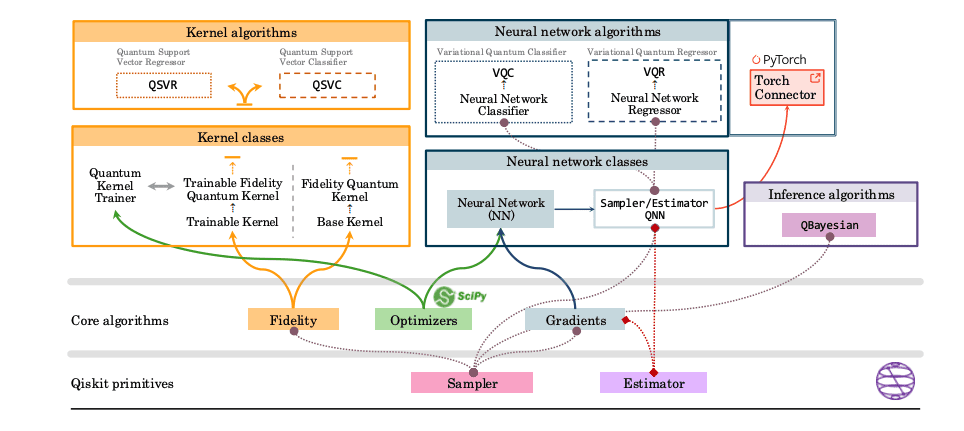
The library’s development prioritises modularity and usability, enabling rapid prototyping and experimentation while retaining extensibility for advanced users. Its flexible architecture supports a diverse range of quantum algorithms and machine learning models, fostering innovation in hybrid quantum-classical approaches.
Distributed under the Apache 2.0 license, the library’s open-source nature ensures broad accessibility, encourages community contributions, and promotes transparency. The substantial number of contributors highlights the collaborative spirit driving development and the growing interest in quantum machine learning.
The library’s architecture supports several quantum algorithms, including variational quantum eigensolvers (VQEs) – algorithms used to find the lowest energy state of a quantum system – quantum support vector machines (QSVMs), and quantum neural networks (QNNs). These algorithms enable exploration of applications in areas such as drug discovery, materials science, and financial modelling.
The API is designed for intuitive use, providing a high-level interface that abstracts the complexities of quantum programming. Users can define quantum circuits and machine learning models using a concise syntax, allowing them to concentrate on the core logic of their algorithms. Seamless integration with popular machine learning frameworks, such as TensorFlow and PyTorch, leverages existing tools and workflows. This interoperability reduces the barrier to entry for machine learning practitioners.
Researchers are actively investigating new applications of quantum machine learning in areas including drug discovery, materials science, financial modelling, and image recognition. Collaboration with industry partners aims to develop and deploy quantum machine learning solutions. Future development will focus on improving the library’s scalability and robustness, enabling it to handle larger datasets and more complex computations. Techniques such as data compression and distributed computing are under consideration. Comprehensive documentation and tutorials are planned to facilitate wider adoption and accelerate the development of quantum machine learning applications.
Researchers are also investigating techniques to mitigate the effects of noise and decoherence – phenomena that degrade the accuracy of quantum computations – thereby improving the reliability of quantum machine learning algorithms. The development team is committed to providing ongoing support and maintenance, ensuring the library’s long-term viability and usability. This includes performance monitoring, bug fixing, and the incorporation of new features. The open-source contributors represent a collaborative effort from researchers and developers with expertise in quantum algorithm design, machine learning theory, and software engineering. This collaborative spirit is crucial for driving innovation and accelerating the development of quantum machine learning technologies.
👉 More information
🗞 Qiskit Machine Learning: an open-source library for quantum machine learning tasks at scale on quantum hardware and classical simulators
🧠 DOI: https://doi.org/10.48550/arXiv.2505.17756



See today’s quantum computing news on Quantum Zeitgeist for the latest breakthroughs in qubits, hardware, algorithms, and industry deals.