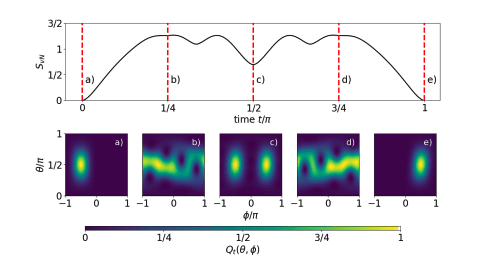
Researchers mapped the dynamic behaviour of multiple quantum bits (qubits) to sound using sonification techniques and phase space analysis. Applying this to both predictable and chaotic quantum systems – the one-axis twisting model and a kicked rotor – revealed correlations and behaviours through auditory representation of the system’s state and entropy.
The complex interplay of quantum entanglement, where multiple particles become linked and share the same fate, presents a considerable challenge for intuitive understanding and visualisation. Researchers are now exploring alternative methods to interpret quantum behaviour, moving beyond traditional visual representations. A team led by Juliette Tudoce, Marcin Płodzién, Maciej Lewenstein, and Reiko Yamada, all at the ICFO–Institut de Ciencies Fotoniques in Barcelona, detail a novel approach in their paper, ‘Sonification of entanglement dynamics in many-qubit systems’. They present a procedure for translating entanglement evolution in systems of multiple quantum bits – or qubits – into audible sound, utilising phase space methods and the von Neumann entropy as key parameters to map quantum states to sonic representations. This allows for an alternative perception of dynamic correlations, potentially offering new insights into complex quantum behaviours.
Sonification Reveals Dynamics of Many-Qubit Entanglement
Researchers are employing sonification – the conversion of data into sound – to investigate the complex behaviour of multi-qubit systems. Traditional visualisation methods struggle to represent the correlations inherent in these systems, particularly as the number of qubits increases. This work focuses on understanding how entanglement – a key quantum phenomenon where two or more particles become linked and share the same fate, regardless of distance – develops dynamically in systems comprising multiple qubits.
The team utilises phase space methods and von Neumann entropy to characterise the evolution of these systems. Phase space provides a geometrical representation of all possible states of a system, while von Neumann entropy quantifies the degree of entanglement. Researchers aim to explore quantum correlations through an auditory interface by mapping these parameters onto audible sound.
Specifically, the investigation examines two models: the one-axis twisting model – a theoretical construct used to study many-body quantum systems – and a kicked-rotor system, which can exhibit both predictable (regular) and unpredictable (chaotic) behaviours. The researchers developed a detailed procedure to translate the phase-space representation of a many-qubit state and its associated von Neumann entropy into sound. Results indicate that sonification enhances the perception of dynamic processes, offering both intuitive and aesthetic insights into the underlying quantum phenomena. The human auditory system’s sensitivity to subtle variations in frequency and amplitude allows for a nuanced understanding of entanglement generation and the behaviours exhibited by both regular and chaotic quantum systems. This approach provides a complementary method to conventional analytical techniques, potentially revealing patterns obscured by traditional visualisation.
The research builds upon a strong foundation in quantum metrology and sensing. The team systematically investigated foundational papers on utilising entangled states to improve measurement precision. This included consideration of noise and practical limitations inherent in real-world quantum systems.
Key papers informing the work include those by Giovannetti et al., which demonstrate the potential for quantum-enhanced sensing, extending beyond fundamental physics to applications such as biological sensing. The team also considered the work of Cirac and Zoller on quantum control of atomic collisions, suggesting potential avenues for experimental realisation of the many-qubit systems under investigation. Furthermore, the inclusion of research by Demkowicz-Dobrzanski et al. on the impact of noise on entangled states highlights a commitment to addressing practical challenges in quantum sensing. This holistic approach ensures the sonification process is a carefully calibrated method, informed by a deep understanding of the limitations and potential of quantum systems.
👉 More information
🗞 Sonification of entanglement dynamics in many-qubit systems
🧠 DOI: https://doi.org/10.48550/arXiv.2505.11159




See today’s quantum computing news on Quantum Zeitgeist for the latest breakthroughs in qubits, hardware, algorithms, and industry deals.