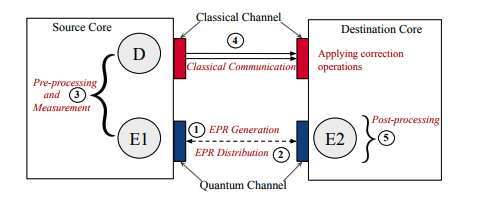
A decentralised quantum teleportation framework demonstrably reduces communication latency and circuit depth in multi-core quantum architectures. Researchers achieved a 40% reduction in end-to-end communication latency using synthetic benchmarks and 30% with real applications, alongside a 24% decrease in circuit depth, compared to conventional centralised teleportation. This optimised ‘two-way’ teleportation strategy offers a scalable solution for interconnecting qubits within future large-scale quantum processors, improving overall system performance. Teleportation, in this context, transfers quantum states between qubits without physically moving them.
The increasing demand for computational power necessitates the development of quantum architectures capable of integrating a substantial number of qubits. A key challenge lies in efficiently transferring quantum information between processing units within these systems. Researchers are now investigating methods beyond conventional centralised interconnection schemes, focusing on distributed approaches to facilitate qubit transfer via quantum teleportation – a process exploiting entanglement to transmit quantum states. A team comprising Rajeswari Suance P S and John Jose from the Indian Institute of Technology Guwahati, alongside Ruchika Gupta of Chandigarh University and Maurizio Palesi from the University of Catania, detail a novel decentralised framework for teleportation in multi-core quantum systems in their paper, ‘Decentralized Framework for Teleportation in Quantum Core Interconnects’. Their work demonstrates a significant reduction in communication latency – up to 40% for synthetic benchmarks – and circuit depth using an optimised two-way teleportation strategy, offering a potentially scalable solution for future quantum computing architectures.
Modular quantum computers represent a promising pathway toward scaling qubit numbers and overcoming limitations inherent in single-processor architectures, but efficient communication between processing cores remains a significant challenge. Researchers actively investigate quantum teleportation as a primary method for inter-core communication, yet traditional schemes often introduce latency and increase circuit complexity, hindering overall performance. This research demonstrates a substantial improvement through the implementation of a decentralised, two-way quantum teleportation protocol, offering a compelling solution to these challenges and paving the way for more scalable quantum systems.
The investigation employed SeQUeNCe, a discrete-event simulator, to model and analyse communication strategies within a multi-core quantum computer, allowing researchers to evaluate performance without constructing physical hardware. Discrete-event simulation models a system’s behaviour by tracking discrete events occurring over time, providing a flexible and cost-effective means of exploring complex scenarios. Through this simulation, researchers characterised inter-core qubit traffic patterns, revealing valuable insights into optimising data transfer and identifying potential bottlenecks.
Benchmark tests demonstrated a 40% reduction in end-to-end
Benchmark tests demonstrated a 40% reduction in end-to-end communication latency for synthetic workloads and a 30% reduction for real-world quantum algorithms when utilising the two-way teleportation scheme, compared to baseline methods. Latency directly impacts the speed of quantum computation, and reducing it allows for faster execution of complex algorithms. Circuit depth, representing the number of quantum gates required to perform a computation, also significantly influences computational efficiency, and the observed reduction in circuit depth further enhances the benefits of the decentralised approach.
The decentralised framework distinguishes this work from previous approaches that often rely on centralised interconnection mechanisms, promoting scalability and enabling parallel communication. This parallel communication proves crucial for handling the increasing demands of larger quantum systems, allowing multiple cores to operate simultaneously and accelerating the overall computation. The observed 24% decrease in circuit depth underscores the potential for simplifying quantum algorithms and reducing computational complexity, making quantum computation more accessible and efficient.
Researchers actively explore network topology to optimise communication performance, investigating different interconnection networks between cores beyond the configurations tested in this study. This exploration aims to identify configurations that minimise communication latency and maximise throughput, further enhancing the scalability and efficiency of modular quantum computers. Incorporating more realistic noise models into the simulation represents another crucial step toward assessing the viability of the proposed scheme in practical implementations.
Noise, arising from environmental factors and imperfections in quantum hardware, disrupts quantum states and introduces errors, necessitating accurate modelling to evaluate the robustness of any communication scheme. Expanding the range of benchmarked quantum algorithms proves essential to establish the general applicability of the observed performance improvements, ensuring that the benefits extend beyond specific use cases. Future research will focus on hybrid communication strategies, combining two-way teleportation with other data transfer techniques to yield even more substantial gains in performance and scalability.
This research establishes the benefits of a decentralised, two-way communication scheme for modular quantum computers, demonstrating that employing two-way quantum teleportation significantly reduces communication latency and circuit depth when transferring quantum information between processing cores. Specifically, benchmark tests reveal a 40% reduction in end-to-end communication latency for synthetic workloads and a 30% reduction for real-world quantum algorithms, compared to baseline teleportation strategies. This improvement directly addresses a critical bottleneck in scaling quantum computation beyond single-processor limitations, opening new avenues for exploring complex quantum algorithms.
The investigation employed a discrete-event simulator, SeQUeNCe, to
The investigation employed a discrete-event simulator, SeQUeNCe, to model and evaluate the performance of different communication strategies within a multi-core quantum architecture, providing a flexible and cost-effective means of exploring complex scenarios. Through this simulation, researchers characterised inter-core qubit traffic patterns, providing valuable insights into optimising data transfer and identifying potential bottlenecks. The results confirm that communication overhead constitutes a substantial impediment to overall system performance, highlighting the necessity for efficient communication protocols.
The adoption of a decentralised framework for quantum teleportation distinguishes this work from previous approaches that often rely on centralised interconnection mechanisms, promoting scalability and enabling parallel communication. This decentralisation proves crucial for handling the increasing demands of larger quantum systems, allowing multiple cores to operate simultaneously and accelerating the overall computation. The observed 24% decrease in circuit depth further underscores the potential for simplifying quantum algorithms and reducing computational complexity, making quantum computation more accessible and efficient.
Future work should focus on exploring the impact of network topology on communication performance, investigating different interconnection networks between cores beyond the configurations tested in this study. This exploration aims to identify configurations that minimise communication latency and maximise throughput, further enhancing the scalability and efficiency of modular quantum computers. Additionally, extending the simulation to incorporate more realistic noise models and qubit characteristics will enhance the fidelity of the results and provide a more accurate assessment of the proposed scheme’s viability in practical implementations.
Expanding the benchmark suite to include a wider range of quantum algorithms and applications proves essential to establish the general applicability of the observed performance improvements, ensuring that the benefits extend beyond specific use cases. Research into hybrid communication strategies, combining two-way teleportation with other data transfer techniques, may yield even more substantial gains in performance and scalability, paving the way for more powerful and efficient quantum computers. This research represents a significant step toward realising the full potential of modular quantum computing, offering a promising pathway toward scalable and efficient quantum computation.
🗞 Decentralized Framework for Teleportation in Quantum Core Interconnects
🧠 DOI: https://doi.org/10.48550/arXiv.2505.11195




See today’s quantum computing news on Quantum Zeitgeist for the latest breakthroughs in qubits, hardware, algorithms, and industry deals.