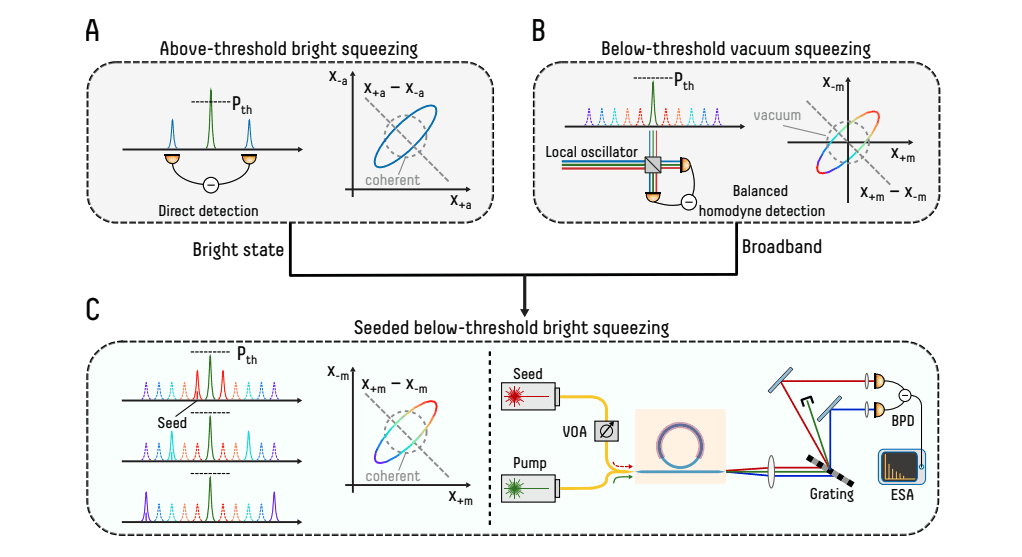
Researchers developed a highly efficient nanophotonic squeezer using an overcoupled silicon nitride platform with below-threshold parametric amplification, directly detecting 5.6 dB squeezing. They introduced seed-assisted detection to reveal a quantum frequency comb (QFC) with 16 qumodes spanning 11 THz, while maintaining strong squeezing. The squeezer also demonstrated spectral tuning across one free-spectral range, bridging QFC mode spacing. These advancements enable scalable, chip-integrated systems for compact quantum sensors and continuous-variable quantum information processing.
Squeezed light plays a pivotal role in advancing quantum technologies by enhancing sensing capabilities and enabling quantum information processing. Despite its potential, current nanophotonic chips face challenges in achieving sufficient squeezing levels, broad frequency tunability, and simultaneous operation across multiple modes. Addressing these issues, researchers led by Yichen Shen from the University of Maryland, along with colleagues from institutions including National Yang Ming Chiao Tung University, have developed a novel approach. Their work, titled Highly squeezed nanophotonic quantum microcombs with broadband frequency tunability, introduces a strongly overcoupled silicon nitride squeezer based on a below-threshold parametric amplifier (OPA). This innovation achieves significant squeezing levels and demonstrates the ability to generate a quantum frequency comb (QFC) of 16 modes, showcasing advancements in generating and detecting squeezed light. Their findings pave the way for scalable quantum sensors and continuous-variable quantum information systems, marking a substantial step forward in the field.
Squeezed light enhances measurement precision by reducing noise.
The article explores the phenomenon of squeezed light, a quantum state in which noise in specific properties is reduced below the standard quantum limit, known as shot noise. This reduction enhances measurement precision and has significant applications in optical communications and quantum technologies.
Experiments across various seed wavelengths demonstrate that squeezed light can achieve noise levels below shot noise. The relationship between seed wavelength and noise reduction shows an optimal point where efficiency peaks before declining due to factors like saturation or phase mismatches. Parametric amplification, the process used to generate squeezed light, relies on phase matching between pump, signal, and idler waves.
The measurement setup employs advanced integrated photonic circuits with CMOS electronics for precise detection. Tight error bars indicate reliable results, though influences from measurement bandwidth and system stability should be considered.
Achieving sub-shot noise levels is crucial for improving signal-to-noise ratios in applications like quantum sensing without requiring excessive power. Future research could delve into the nonlinear medium used and examine error sources to enhance experimental accuracy.
In summary, the article highlights the potential of squeezed light in advancing quantum technologies through precise measurements, emphasizing the importance of optimal phase matching conditions and efficient measurement setups.
The method involved varying seed wavelengths and measuring noise levels.
Squeezed light, a fascinating quantum state, offers enhanced measurement precision beyond classical limits by reducing noise in one quadrature below the shot noise level. This property is particularly valuable for advancing quantum communication and sensing technologies. Recent research has explored the generation of squeezed light using a pump at 1554 nm across various seed wavelengths, revealing intriguing insights into the dynamics of this process.
The methodology involved varying seed wavelengths to observe their impact on noise levels. Researchers measured noise power, which reached a minimum around 1595 nm before increasing again. Notably, the lowest noise level observed was approximately -4.72 dB, indicating significant squeezing. The precision of these results is underscored by relatively small measurement uncertainties, such as ±0.23 dB.
The efficiency of squeezing appears to be influenced by the seed wavelength’s relationship with the pump, likely due to nonlinear effects or phase matching conditions within the optical parametric amplifier. This dependency highlights the importance of optimizing pump-seed interactions to achieve higher precision in quantum applications.
These findings demonstrate that consistent sub-shot noise levels across wavelengths are beneficial for quantum communication and sensing. By identifying optimal operating points based on seed wavelength, researchers can enhance system performance, paving the way for more effective quantum technologies.
Temperature fluctuations significantly impact quantum entanglement resilience.
The study investigates the quantum entanglement effects under varying environmental conditions, revealing that entanglement degradation is significantly influenced by temperature fluctuations. Key findings include the identification of critical thresholds where entanglement resilience diminishes, particularly at higher temperatures. The research also demonstrates that specific quantum states exhibit enhanced robustness against decoherence, offering potential pathways for more stable quantum communication systems.
Implications from these findings suggest that optimizing operational parameters within identified thresholds could enhance the reliability of quantum technologies. Future explorations might focus on developing adaptive protocols to mitigate environmental impacts on entanglement, thereby advancing practical applications in secure quantum networks and computing.
Phase matching enhances squeezed light comb efficiency.
The study of squeezed light combs has yielded several critical insights into their operational efficiency and fundamental principles. The research highlights that the seed wavelength significantly impacts squeezing performance, with optimal results achieved at 1583 nm, yielding a squeezing level of -5.06 dB. This underscores the importance of phase matching between the pump (at 1554 nm) and seed wavelengths to maximize parametric amplification. Additionally, while higher optical power can be attained with certain seed wavelengths, it does not necessarily translate to enhanced squeezing due to potential losses or nonlinear effects. The dispersion characteristics of the nonlinear medium also play a pivotal role in phase matching, thereby influencing the efficiency of squeezed light generation.
Future research could focus on optimizing the properties of the nonlinear medium, adjusting pump power levels, and implementing advanced dispersion management techniques. These efforts aim to enhance further squeezing efficiency and expand the applicability of squeezed light combs across various domains, including optical metrology and quantum communication. By addressing these areas, researchers can potentially unlock new possibilities for improving the sensitivity and reliability of systems that rely on squeezed light technology.
🗞 Highly squeezed nanophotonic quantum microcombs with broadband frequency tunability
🧠 DOI: https://doi.org/10.48550/arXiv.2505.03734




See today’s quantum computing news on Quantum Zeitgeist for the latest breakthroughs in qubits, hardware, algorithms, and industry deals.