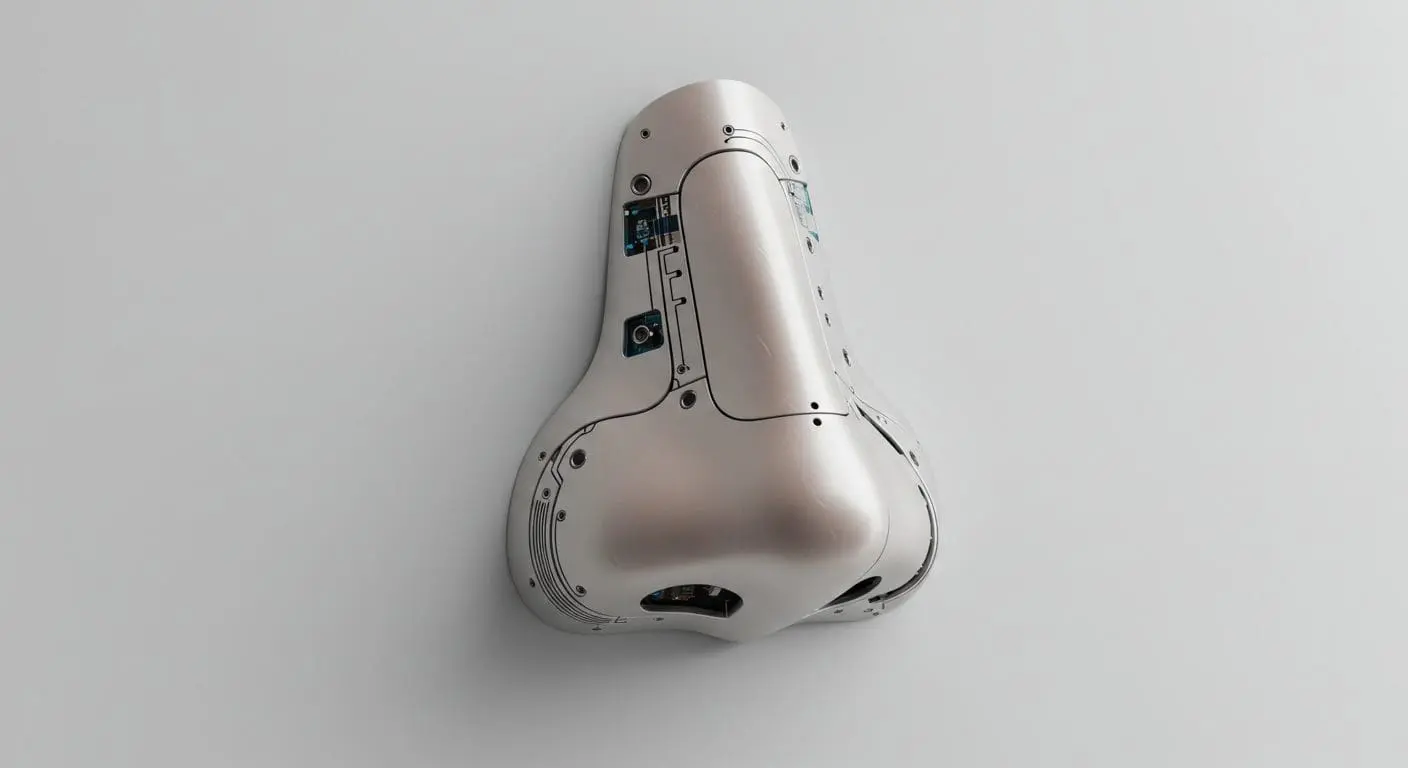
A research team at DGIST (Daegu Gyeongbuk Institute of Science and Technology) in South Korea, led by Professor Hyuk-jun Kwon, has developed an advanced AI electronic nose capable of detecting and analyzing scents with high precision. The device mimics the human olfactory system using combinatorial coding, where scent molecules generate unique electrical signal patterns that are learned by AI models. This technology integrates graphene sensors enhanced with cerium oxide nano catalysts, enabling accurate identification of complex odors and fine-grained concentration estimation. Tested on common fragrances, the e-nose achieved over 95% accuracy and demonstrated durability, bending more than 30,000 times without performance loss. The innovation, supported by South Korean government programs, is poised for applications in personalized healthcare, cosmetics, and environmental monitoring, marking a significant advancement in artificial olfaction technology.
A research team at DGIST has developed an advanced AI electronic nose that mimics the human olfactory system, offering significant improvements over existing technologies. This innovation converts scent molecules into electrical signals and employs artificial intelligence to analyze them accurately, making it suitable for applications in personalized healthcare, cosmetics, and environmental monitoring.
Current electronic noses face challenges in distinguishing subtle differences between similar scents or analyzing complex odor compositions. The DGIST team addressed these limitations by integrating a principle known as combinatorial coding, where multiple sensors respond to a single scent molecule, creating unique electrical patterns that enhance recognition accuracy.
The technology utilizes graphene processed with a laser and incorporates cerium oxide nano catalysts to create sensitive sensor arrays. This fabrication method simplifies production while maintaining high efficiency. Performance tests demonstrated the device’s capability, achieving over 95% accuracy in identifying fragrances and estimating their concentrations.
Additionally, the AI electronic nose is ultra-thin, flexible, and durable, making it ideal for wearable devices or patches. It can withstand bending more than 30,000 times without performance degradation, enhancing its practicality for real-world applications.
Limitations of Conventional E-Noses
Conventional electronic noses (e-noses) have been widely used in applications such as food safety and industrial gas detection, but they fall short in distinguishing subtle differences between similar scents or analyzing complex odor compositions. For example, current systems struggle to differentiate among floral perfumes with overlapping notes or detect faint odors indicating fruit spoilage. These limitations stem from the inability of traditional e-noses to replicate the nuanced sensing mechanisms of the human olfactory system, which relies on combinatorial coding to recognize a wide range of scents. This gap in performance has created demand for next-generation e-nose technologies capable of higher precision and adaptability.
Inspired by Biological Mechanism
The DGIST team drew inspiration from the human olfactory system to develop their AI electronic nose, integrating a principle known as combinatorial coding. This approach involves multiple sensors responding to a single scent molecule, creating unique electrical patterns that enhance recognition accuracy. The technology utilizes graphene processed with a laser and incorporates cerium oxide nano catalysts to create sensitive sensor arrays.
The device demonstrated exceptional performance in identifying fragrances, achieving over 95% accuracy, and reliably estimating scent concentrations. Its ultra-thin and flexible design allows integration into wearable technology or patches, ensuring longevity in real-world use due to its durability, withstanding over 30,000 bends without performance loss.
Performance Tests and Applications
The AI electronic nose demonstrated exceptional performance in identifying fragrances, achieving over 95% accuracy. This capability extends to estimating scent concentrations, making it highly reliable for precise odor detection tasks.
In practical applications, the device’s ultra-thin and flexible design allows it to be integrated into wearable technology or patches. Its durability, withstanding over 30,000 bends without performance loss, ensures longevity in real-world use. These features make it ideal for industries such as healthcare, cosmetics, and environmental monitoring, where consistent and accurate scent analysis is crucial.
More information
External Link: Click Here For More



See today’s quantum computing news on Quantum Zeitgeist for the latest breakthroughs in qubits, hardware, algorithms, and industry deals.