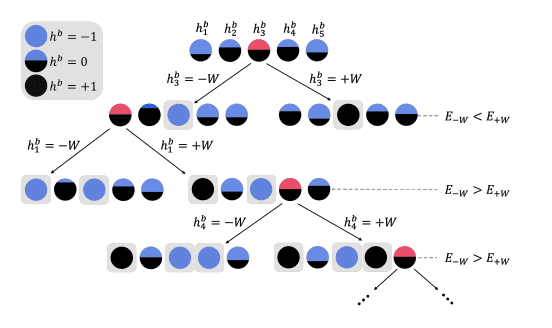
On April 21, 2025, researchers Anton Simen, Sebastián V. Romero, Alejandro Gomez Cadavid, Enrique Solano, and Narendra N. Hegade introduced a novel quantum optimization algorithm titled Branch-and-bound digitized counterdiabatic quantum optimization. Their approach integrates branch-and-bound techniques with counterdiabatic methods to tackle non-convex combinatorial problems more effectively than traditional simulated annealing. The algorithm was tested on both sparse and dense problem instances using tensor network simulations and IBM quantum hardware, demonstrating improved solution quality and efficiency.
The study introduces branch-and-bound digitized counterdiabatic optimization (BB-DCQO), an algorithm addressing relaxation challenges in higher-order unconstrained binary optimization (HUBO) problems. By leveraging bias fields as approximate solutions, BB-DCQO enhances solution quality compared to the base BF-DCQO method. Tested against simulated annealing (SA) and a greedy-tuned baseline, BB-DCQO demonstrated superior performance on both sparse HUBO instances using tensor network simulations and denser problems with up to 100 qubits on IBM quantum hardware. The results highlight BB-DCQO’s ability to consistently deliver higher-quality solutions with reduced overhead, showcasing the benefits of integrating counterdiabatic methods into branch-and-bound frameworks for tackling non-convex optimization tasks.
At its core, this advancement employs a quantum optimizer designed to solve complex optimization problems across various industries, including logistics and finance. By utilizing fractional gates, optimized operations that reduce resource usage without sacrificing effectiveness, the method minimizes circuit depth, leading to fewer errors and faster computations. Initial tests have demonstrated favorable results compared to classical methods in tasks such as combinatorial optimization and machine learning.
These areas are critical for many industries, as they hold the potential for significant improvements in efficiency and cost savings. The research underscores practical applications beyond theoretical concepts, such as supply chain management and portfolio optimization. Tested on existing quantum hardware, this method showcases real-world applicability, moving beyond simulations to deliver tangible results with current technology.
One notable achievement of this approach is its ability to avoid barren plateaus, a common issue where variational algorithms stagnate during optimization. This reliability makes it more robust than previous methods. In conclusion, this advancement represents a meaningful step forward in quantum computing by addressing key challenges and providing practical solutions that can be implemented today.
👉 More information
🗞 Branch-and-bound digitized counterdiabatic quantum optimization
🧠 DOI: https://doi.org/10.48550/arXiv.2504.15367


See today’s quantum computing news on Quantum Zeitgeist for the latest breakthroughs in qubits, hardware, algorithms, and industry deals.