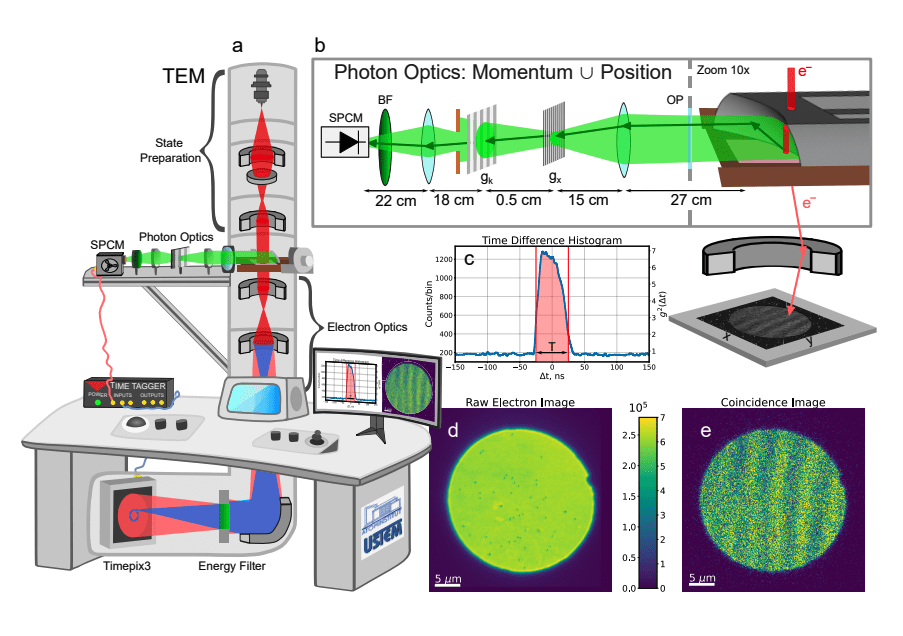
On April 17, 2025, researchers led by Alexander Preimesberger published Experimental Verification of Electron-Photon Entanglement, detailing their groundbreaking demonstration of entanglement between electrons and photons in a transmission electron microscope. This study, conducted by a team including Sergei Bogdanov, Isobel C. Bicket, Phila Rembold, and Philipp Haslinger, achieved the first successful creation of entangled pairs using cathodoluminescence, showcasing a violation of classical uncertainty bounds. Their work bridges quantum optics with electron microscopy, paving the way for advanced imaging techniques at the nanoscale.
The study demonstrates entanglement in electron-photon pairs generated via cathodoluminescence in a transmission electron microscope. Using coincidence imaging techniques, ghost images of periodic masks were reconstructed in both near- and far-field regimes. Spatial and momentum correlations revealed a violation of the classical uncertainty bound, confirming entanglement in position and momentum, continuous variables central to imaging methods, this bridges electron microscopy with optics, opening pathways for exploring many-body correlations and advanced nanoscale imaging techniques.
Recent advancements in electron microscopy have opened new avenues for studying quantum materials with unprecedented precision. Researchers have developed a novel imaging technique that allows simultaneous measurements of the position and momentum of electrons, pushing the boundaries of what is possible within the constraints of Heisenberg‘s uncertainty principle. This breakthrough holds significant implications for understanding quantum systems and could lead to new discoveries in condensed matter physics.
The innovation lies in advanced electron microscopy techniques that capture high-resolution diffraction patterns. By analyzing these patterns, researchers can extract detailed information about both the position and momentum of electrons within a material. This dual capability is achieved through careful calibration of imaging systems and precise control over experimental conditions, enabling more accurate measurements.
The research demonstrates the ability to measure both the position and momentum of electrons with high accuracy, providing insights into quantum mechanical properties of materials. This technique could be used to study a wide range of quantum phenomena, including superconductivity and topological insulators, offering new perspectives on these complex systems.
Despite its potential, the technique faces challenges related to electron microscope stability. Issues such as hysteresis in transmission electron microscopes (TEMs) can affect magnification accuracy. Researchers have addressed this by implementing rigorous calibration protocols and repeated measurements, ensuring consistency and reliability in their findings.
This advancement represents a notable step forward in quantum materials research. Enabling simultaneous measurements of position and momentum within the bounds of Heisenberg’s principle offers new opportunities for exploring fundamental properties of matter at the quantum level. As the technique evolves, it could lead to breakthroughs in our understanding of complex quantum systems and their applications in technology. This development underscores the importance of precision engineering and advanced imaging techniques in modern materials science, with the potential to become a standard tool for studying quantum phenomena.
👉 More information
🗞 Experimental Verification of Electron-Photon Entanglement
🧠 DOI: https://doi.org/10.48550/arXiv.2504.13163