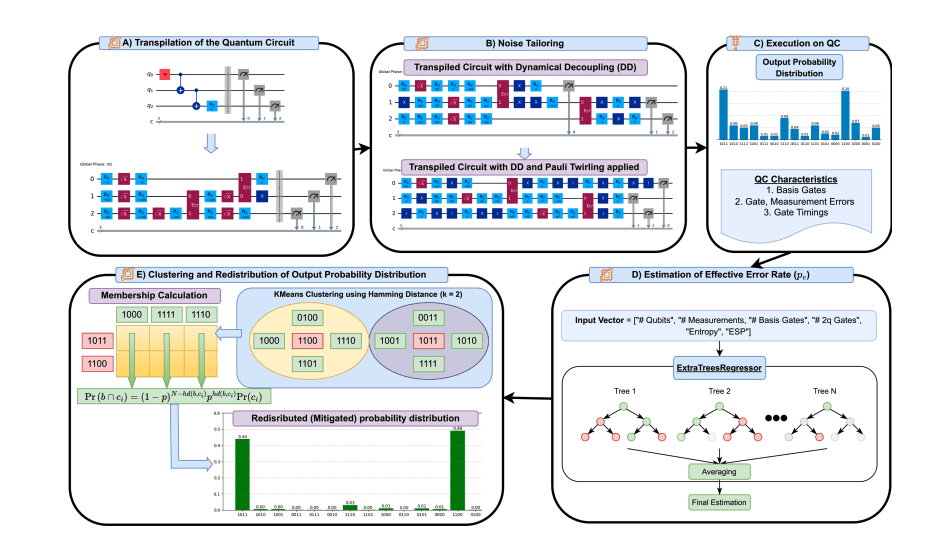
On April 14, 2025, researchers Hrushikesh Pramod Patil, Dror Baron, and Huiyang Zhou introduced Q-Cluster, a novel unsupervised learning approach for quantum error mitigation. Their method enhances noise resilience in quantum computing by clustering bit-strings and adjusting distributions via Bayesian inference, achieving superior fidelity compared to existing techniques like M3, Hammer, and QBEEP.
The paper introduces Q-Cluster, a novel quantum error mitigation (QEM) approach using unsupervised learning to reshape noisy bit-string distributions. It employs clustering based on Hamming distance, Bayesian inference for distribution adjustment, and handles high noise rates up to 40% per qubit in simulations. To address complex real-world noise, it uses Pauli twirling and a machine learning model (ExtraTrees regressor) to estimate effective error rates. Experimental results show Q-Cluster improves fidelity by 1.46x on average across five IBM machines, outperforming state-of-the-art methods M3, Hammer, and QBEEP by factors of 1.29x, 1.47x, and 2.65x, respectively.
Quantum computing holds the promise of revolutionizing technology by solving complex problems beyond the reach of classical computers. However, realizing this potential requires overcoming significant challenges, particularly those related to noise and error rates inherent in current quantum devices. Recent research has made strides in developing innovative methods to mitigate these issues, thereby enhancing the reliability and accuracy of quantum computations.
A critical area of progress lies in error mitigation techniques. Researchers have developed probabilistic error cancellation methods that identify and correct errors in real-time without requiring detailed knowledge of noise sources. These methods focus on specific types of errors, significantly improving computational fidelity. Additionally, model-free readout-error mitigation addresses inaccuracies in qubit measurements by statistically correcting known biases. By analyzing data patterns, researchers can infer and compensate for errors, leading to more reliable quantum experiment results.
Another significant advancement involves dynamical decoupling techniques. These methods protect qubits from environmental noise by inserting pulse sequences into quantum circuits, thereby extending coherence time and allowing for more complex computations before error accumulation. Complementing this, randomized compiling applies random operation sequences to average out noise effects across runs, mitigating systematic errors and enhancing algorithm robustness.
Recent work has also explored machine learning techniques to estimate quantum circuit reliability. Graph transformers analyze circuit structures to predict performance under noisy conditions, enabling researchers to optimize designs for better fault tolerance. Probabilistic error cancellation methods further enhance fidelity by focusing on specific error types without detailed noise knowledge.
The advancements in error mitigation, dynamical decoupling, randomized compiling, and machine learning-based reliability estimation are collectively pushing the boundaries of quantum computing technology. These innovations not only enhance computational accuracy and reliability but also bring us closer to practical applications of quantum computers. As research continues, these methods will likely evolve further, addressing new challenges and paving the way for a future where quantum computing becomes an indispensable tool in science and industry.
👉 More information
🗞 Q-Cluster: Quantum Error Mitigation Through Noise-Aware Unsupervised Learning
🧠 DOI: https://doi.org/10.48550/arXiv.2504.10801
See today’s quantum computing news on Quantum Zeitgeist for the latest breakthroughs in qubits, hardware, algorithms, and industry deals.