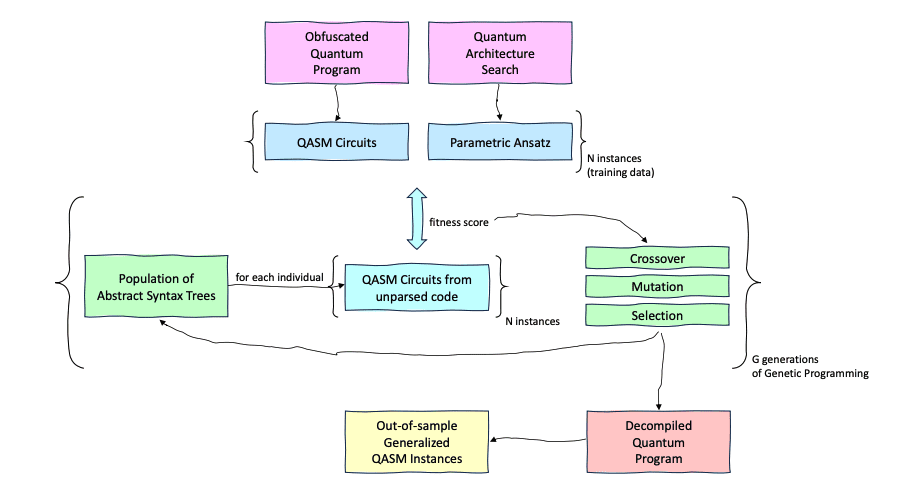
On April 11, 2025, researchers Shubing Xie, Aritra Sarkar, and Sebastian Feld introduced DeQompile, a novel tool that utilises genetic programming to decompile quantum circuits. This enhances the interpretability of automated quantum architecture search.
The research addresses challenges in demonstrating quantum advantage by introducing DeQompile, a genetic programming-based decompiler framework that reverse-engineers interpretable high-level quantum algorithms from low-level circuit representations. Using symbolic regression and abstract syntax tree manipulation, the tool enhances explainability in quantum architecture search (QAS) by distilling Qiskit algorithms from assembly language. Validation with benchmark algorithms demonstrates its efficacy, enabling scalable and provable algorithm development by integrating online learning frameworks.
In recent years, quantum computing has emerged as a transformative field, with researchers intensifying efforts to make it more practical and reliable. Central to this endeavor are challenges such as error correction and circuit optimization, which are pivotal for advancing quantum technologies.
A significant development involves the application of machine learning techniques to quantum circuit synthesis and optimization. Machine learning’s ability to identify patterns and optimize processes is being leveraged to enhance the efficiency and reliability of quantum circuits. This approach reduces errors and streamlines the creation of these circuits, a critical step in advancing quantum computing.
Another notable innovation is quantum program synthesis, which automates the generation of quantum programs. Given the complexity involved in manually crafting these programs, automation could significantly simplify the development process and accelerate progress in the field.
Additionally, researchers are exploring methods to distill and compress quantum circuits, aiming to make them more efficient without compromising their functionality. This effort is essential for conserving resources in current quantum systems, which are still limited in capacity.
Transformers, a type of AI model renowned for its success in natural language processing, has been extended to quantum circuit augmentation. While the exact application isn’t fully clear, it’s speculated that transformers might aid in generating or optimizing circuits, potentially leading to more effective quantum algorithms.
Despite these advancements, challenges remain. High error rates and resource limitations continue to hinder progress. However, the strides made so far suggest a promising trajectory towards making quantum computing more accessible and reliable.
In summary, ongoing research is focused on overcoming current limitations through innovative techniques like machine learning and circuit optimization. These efforts are paving the way for more practical quantum computers, bringing us closer to realizing their full potential in various applications.
👉 More information
🗞 DeQompile: quantum circuit decompilation using genetic programming for explainable quantum architecture search
🧠 DOI: https://doi.org/10.48550/arXiv.2504.08310