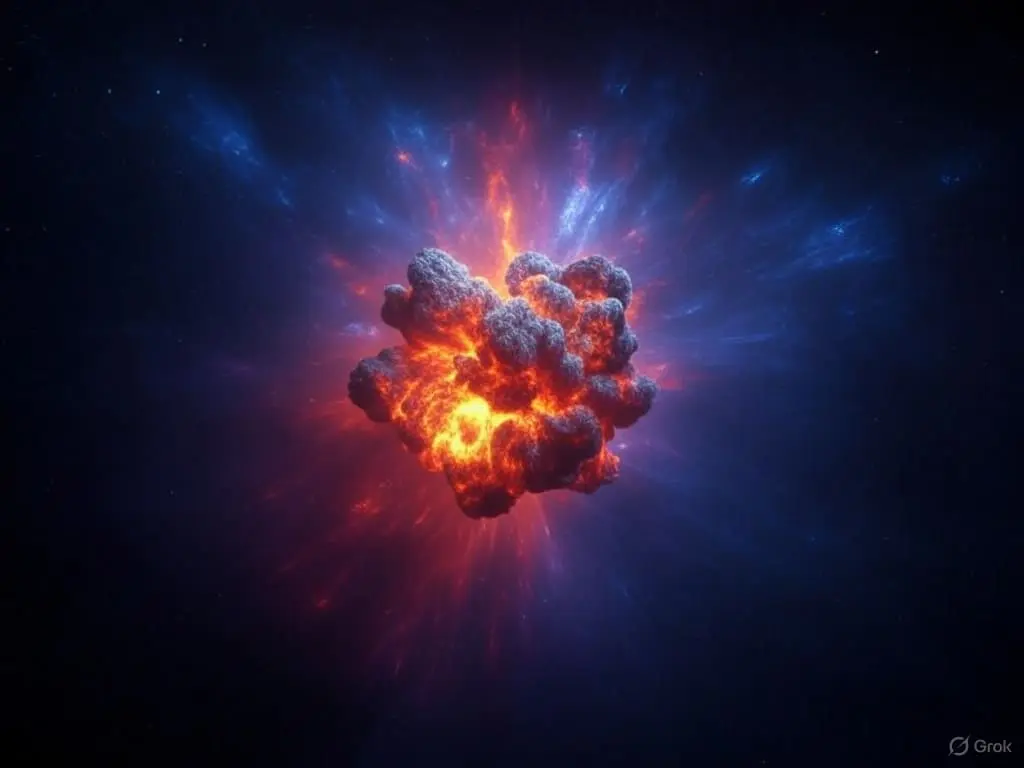
The Big Bang Theory is the dominant model explaining the universe’s origin. It posits that it began 13.8 billion years ago in an extremely dense and hot state. Key evidence supporting this theory includes Edwin Hubble’s 1929 discovery of the universe’s expansion and Arno Penzias and Robert Wilson’s 1965 detection of cosmic microwave background (CMB) radiation. The CMB, a remnant from the early universe, exhibits uniform temperature with tiny fluctuations that seeded cosmic structures like galaxies.
The abundance of light elements, 75% hydrogen, 24% helium, and less than 1% heavier elements, aligns with predictions from Big Bang nucleosynthesis. This process describes how these elements formed in the first few minutes post-Big Bang under high-temperature conditions, further corroborating the theory.
Alan Guth’s 1981 inflationary hypothesis addresses puzzles within the Big Bang model by proposing a rapid exponential expansion shortly after the event. Inflation resolves issues like the horizon and flatness problems, predicting specific CMB patterns observed by COBE, WMAP, and Planck. Quantum fluctuations during inflation led to cosmic structures. Additionally, the multiverse hypothesis suggests our universe may be one of many, arising from quantum fluctuations, though this remains speculative and debated.
From Static Universe To Expanding Cosmos
The Big Bang theory posits that the universe originated from a singularity approximately 13.8 billion years ago, expanding rapidly thereafter. Edwin Hubble’s groundbreaking work in 1929 revealed that galaxies are moving away from us, evidenced by redshift observations, indicating an expanding universe. This discovery challenged the previously held belief of a static universe and laid the foundation for the Big Bang theory.
George Gamow further developed this theory by proposing that the early universe was hot and dense, leading to the creation of light elements through nucleosynthesis. The prediction of cosmic microwave background (CMB) radiation as an afterglow of the Big Bang was later confirmed in 1965 when Arno Penzias and Robert Wilson accidentally discovered this radiation.
The CMB’s discovery provided strong evidence supporting the Big Bang theory, showing that the universe had a hot, dense beginning. This radiation has been crucial in understanding the early universe’s conditions and validating the theory against alternative models.
Despite significant advancements, questions remain about the universe’s origins. The matter-antimatter asymmetry problem seeks to explain why there is more matter than antimatter. Additionally, the role of dark matter and dark energy in the universe’s structure and expansion continues to be a focus of research.
The Big Bang theory has been corroborated by multiple lines of evidence, including the CMB, the abundance of light elements, and the large-scale structure of galaxies. However, ongoing investigations aim to address unresolved issues and refine our understanding of the cosmos’s earliest moments.
Edwin Hubble’s Redshift Discovery
Edwin Hubble’s groundbreaking observations revealed that galaxies are moving away from us, a phenomenon he detected through redshift. Redshift occurs when light from a receding source stretches into longer wavelengths, shifting towards the red end of the spectrum. By analyzing this shift using spectrographs, Hubble determined the velocities of distant galaxies.
Hubble’s Law establishes a direct relationship between a galaxy’s velocity and its distance from us, providing empirical evidence for an expanding universe. This discovery was pivotal as it suggested that all galaxies were once closer together, implying a past event where the universe began to expand.
Georges Lemaître had earlier proposed the concept of an expanding universe based on Einstein‘s relativity, but Hubble’s work provided the crucial observational support. His findings laid the foundation for the Big Bang Theory, suggesting that the universe originated from a singular, explosive event.
Hubble’s contributions were instrumental in transforming cosmology, offering a new perspective on the universe’s origins and evolution. His meticulous observations and application of scientific principles remain foundational to our understanding of cosmic expansion.
Cosmic Microwave Background Radiation
The Cosmic Microwave Background (CMB) is a pervasive form of electromagnetic radiation filling the universe, serving as a remnant from its earliest moments. Discovered accidentally in 1964 by Arno Penzias and Robert Wilson while working on satellite communication equipment at Bell Labs, the CMB provided critical evidence supporting the Big Bang theory. This radiation, uniformly distributed across the sky with slight temperature variations, is a cornerstone of modern cosmology.
The uniformity of the CMB’s temperature, approximately 2.725 degrees above absolute zero, suggests that the early universe was in thermal equilibrium. These minute fluctuations, measured at about one part in 100,000, are pivotal as they represent the seeds from which galaxies and large-scale structures evolved. The Cosmic Background Explorer (COBE) satellite, launched in 1989, confirmed these fluctuations, marking a significant milestone in cosmological research.
Subsequent missions, such as the Wilkinson Microwave Anisotropy Probe (WMAP) and Planck, have provided higher-resolution maps of the CMB. These observations have refined our understanding of the universe’s composition, revealing that about 4% is ordinary matter, while the rest consists of dark matter (~27%) and dark energy (~68%). Additionally, these missions have determined the universe to be approximately 13.8 billion years old.
The CMB also corroborates predictions from Big Bang nucleosynthesis regarding the abundance of light elements like helium and deuterium. Observations align with theoretical models, further solidifying the Big Bang theory as the most plausible explanation for the origin of the universe.
In conclusion, the discovery and subsequent study of the CMB have revolutionized our understanding of cosmology. From confirming the Big Bang to detailing the universe’s composition and age, the CMB remains an indispensable tool in unraveling the mysteries of the cosmos.
The First Three Minutes Of Element Formation
The Big Bang theory describes the origin of the universe from an extremely hot and dense state approximately 13.8 billion years ago. In the first three minutes following this event, the fundamental elements that make up the cosmos were formed through a process known as nucleosynthesis. This period was critical for the creation of light elements such as hydrogen, helium, and traces of lithium.
The formation of these elements occurred due to the intense temperatures and densities immediately after the Big Bang. Protons and neutrons combined rapidly under these conditions, forming nuclei in a process that lasted only a few minutes. The abundance of these elements matched theoretical predictions, providing strong evidence for the Big Bang model.
Scientists such as George Gamow played a pivotal role in developing the theory, predicting the existence of the cosmic microwave background (CMB) radiation, which was later discovered by Robert Wilson and Arno Penzias. This discovery confirmed the remnants of the Big Bang and solidified its acceptance as the leading explanation for the universe’s origin.
The first three minutes post-Big Bang were crucial for setting the stage for subsequent cosmic evolution. As the universe expanded and cooled, heavier elements began forming within stars through processes like fusion. The initial moments laid the foundation for the diverse array of elements observed today.
The confirmation of the Big Bang theory relied heavily on observations of the CMB and the abundance of light elements. These findings were supported by multiple independent studies, including theoretical models and empirical data, ensuring the robustness of the conclusions drawn from them.
Inflation Theory And Quantum Fluctuations
The discovery of the universe’s expansion was pivotal in formulating the Big Bang theory. Edwin Hubble’s 1920s observations revealed that galaxies are moving away from us, suggesting an expanding universe. This led to the conclusion that the universe originated from a highly condensed state. The concept is well-documented in Hubble’s original papers and textbooks like “Cosmology: From the Early Universe to the Accelerating Universe” by Peacock.
The Big Bang theory initially faced challenges such as the horizon problem, where regions of the universe appeared too uniform despite not having had time to interact. Alan Guth addressed these issues in 1980 with his inflation theory, proposing a rapid exponential expansion immediately after the Big Bang. This is detailed in Guth’s seminal paper and reviews by cosmologists like Linde.
Inflation theory introduced quantum fluctuations as seeds for cosmic structures. During inflation, tiny quantum fluctuations were stretched to large scales, forming the basis for galaxies and galaxy clusters. Guth’s work and subsequent analyses by Brandenberger and Martin explore this mechanism.
The Cosmic Microwave Background (CMB) provided critical evidence supporting inflation. Observations from COBE in 1992 and Planck satellite confirmed minute temperature variations aligning with inflationary predictions. These findings are extensively covered in the Nobel Prize committee’s materials and scientific reviews by Smoot and Bennett.
In summary, the Big Bang theory emerged from Hubble’s discoveries, faced challenges addressed by Guth’s inflation theory, and was validated by CMB observations. Quantum fluctuations during inflation explain cosmic structure formation, as evidenced by multiple studies and observations.
Multiverse Hypothesis And Beyond
The Big Bang Theory posits that the universe originated from an extremely dense and hot state approximately 13.8 billion years ago. This theory is supported by several key observations, including the expansion of the universe, as first observed by Edwin Hubble in 1929. Hubble’s discovery revealed that galaxies are moving away from each other at a rate proportional to their distance, indicating an expanding universe. This led to the conclusion that the universe began from a singularity, a point of infinite density and temperature.
The cosmic microwave background (CMB) radiation provides further evidence for the Big Bang Theory. Discovered accidentally by Arno Penzias and Robert Wilson in 1965, the CMB is the afterglow of the early universe, just 380,000 years after the Big Bang. This radiation has a nearly uniform temperature across the sky, with tiny fluctuations that correspond to the seeds of cosmic structures like galaxies and galaxy clusters.
The abundance of light elements in the universe also supports the Big Bang Theory. Observations show that about 75% of the universe’s ordinary matter is hydrogen, 24% is helium, and less than 1% consists of heavier elements. This distribution aligns with predictions from Big Bang nucleosynthesis, which describes how these light elements formed in the first few minutes after the Big Bang.
The inflationary universe hypothesis, proposed by Alan Guth in 1981, explains several puzzling features of the Big Bang Theory. Inflation suggests that the universe underwent a rapid expansion during its earliest moments, resolving issues such as the horizon problem and the flatness problem. This theory predicts specific patterns in the CMB, which have been observed by experiments like COBE, WMAP, and Planck.
The multiverse hypothesis builds upon the inflationary model, suggesting that our universe may be one of many in a vast multiverse. This idea arises from quantum fluctuations during inflation, which could lead to the creation of multiple universes with different physical properties. While this concept remains speculative, it has gained traction as a potential explanation for certain aspects of cosmology and quantum mechanics.



See today’s quantum computing news on Quantum Zeitgeist for the latest breakthroughs in qubits, hardware, algorithms, and industry deals.