On April 2, 2025, researchers Ryutaro Ohira and colleagues published ‘Multiplexed Control at Scale for Electrode Arrays in Trapped-Ion Quantum Processors,’ introducing a novel method using high-speed DACs to enable efficient scaling of trapped-ion quantum processors by reducing wiring complexity.
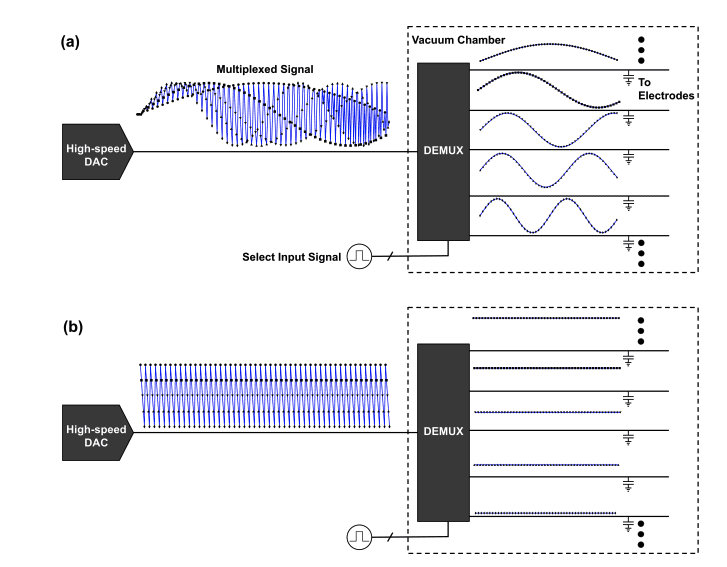
Scaling trapped-ion processors using QCCD architecture faces challenges due to the extensive electronics and wiring required for numerous trap electrodes. Conventional methods use a dedicated DAC per electrode, leading to high resource demands. This study proposes replacing multiple DACs with a single high-speed DAC generating time-division multiplexed signals, significantly reducing wiring complexity and resource requirements for large-scale processors.
This advancement simplifies current systems and paves the way for more efficient and scalable quantum technologies.
The Innovation: Overcoming Scalability Challenges
The Quantum Charge-Coupled Device (QCCD) architecture has emerged as a promising approach for building large-scale quantum computers. In this setup, trapped-ion qubits are physically moved between different zones to perform operations, measurements, and state preparations. However, scaling this system has been hindered by the need for an excessive number of digital-to-analog converters (DACs), each dedicated to controlling individual trap electrodes.
Conventional systems require approximately 10 DACs per qubit, leading to a tenfold increase in wiring complexity as the number of qubits grows. This complicates system design and introduces significant challenges in integrating vacuum or cryogenic systems with room-temperature electronics.
High-Speed DAC and Time-Division Multiplexing
To tackle these issues, researchers have proposed an innovative solution that drastically reduces both the number of required DACs and the associated wiring complexity. The key to this breakthrough lies in employing a high-speed DAC capable of generating time-division multiplexed (TDM) signals.
Instead of dedicating one DAC per electrode, the high-speed DAC rapidly cycles through multiple channels, effectively replicating the outputs of numerous conventional DACs. This method allows a single DAC to control several electrodes simultaneously by distributing its output across different channels at high frequencies.
The Impact: Reducing Hardware Demands
The implications of this innovation are substantial. According to the researchers’ analysis, a QCCD system with 10,000 trap electrodes can now be controlled using just 13 field-programmable gate arrays (FPGAs) and 104 high-speed DACs. This represents a dramatic reduction from the 10,000 dedicated DACs required by traditional methods.
To validate their approach, the researchers developed a proof-of-concept system and evaluated the quality of its analog output signals. The results demonstrate that this method maintains the necessary precision and reliability for controlling trapped-ion qubits, marking a significant step forward in practical quantum computing applications.
A Leap Toward Scalable Quantum Computing
This breakthrough addresses one of the most critical barriers to scaling quantum computers based on trapped ions. By reducing the hardware requirements through high-speed DACs and TDM techniques, researchers have simplified system design and brought large-scale quantum computing closer to reality.
As quantum technologies continue to advance, innovations like this will play a pivotal role in overcoming existing limitations and unlocking quantum computing’s full potential for solving complex problems across various fields.
Multiplexed Control at Scale for Electrode Arrays in Trapped-Ion Quantum Processors
🧠 DOI: https://doi.org/10.48550/arXiv.2504.01815


See today’s quantum computing news on Quantum Zeitgeist for the latest breakthroughs in qubits, hardware, algorithms, and industry deals.