Purdue University researchers, collaborating with Microsoft, have developed advanced hybrid semiconductor-superconductor structures for quantum computing. Their findings, published in Nature on Feb. 19, demonstrate the precise measurement of quasi-particle states essential for topological qubits. This advancement enhances quantum information reliability by encoding data across multiple particles, making corruption harder. The collaboration, rooted in a decade-long partnership that intensified since 2017, has been instrumental in pushing the boundaries of quantum technology and fostering student involvement in cutting-edge research.
Purdue University has announced a significant collaboration with Microsoft Quantum in developing their Majorana 1 topological qubit, advancing the development of a new qubit platform. This partnership leverages Purdue’s expertise in materials science and engineering to address critical challenges in quantum computing technology. The initiative focuses on creating high-quality hybrid semiconductor-superconductor structures, essential for building robust topological qubits.
The collaboration builds on groundbreaking work published in Nature, where the Microsoft team demonstrated the ability to accurately measure the state of quasi-particles forming the basis of a topological qubit. This achievement is a major step toward overcoming the limitations of traditional quantum bits, which are highly susceptible to environmental disturbances. By encoding information across multiple particles, topological qubits offer enhanced stability and error resistance.
Purdue’s role in this effort centers on advancing epitaxial technology to achieve unprecedented precision in semiconductor-superconductor interfaces. This requires not only refining individual materials but also perfecting their integration, a complex task that demands meticulous craftsmanship and innovation. Sergei Gronin, a Microsoft Quantum scientist, emphasized the importance of these advancements, noting that they represent a new frontier in quantum computing hardware.
The partnership also provides unique opportunities for Purdue
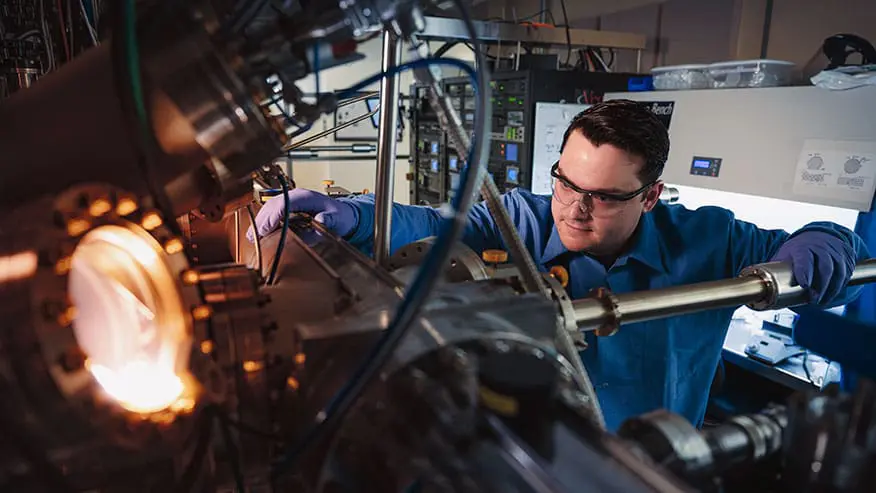
The partnership also provides unique opportunities for Purdue students to engage with cutting-edge research. Graduate students like Tyler Lindemann are actively contributing to the development of hybrid structures while gaining valuable industry experience through their involvement with Microsoft Quantum. This integration of academic and industrial expertise fosters a fertile environment for innovation, benefiting both the students and the broader quantum computing community.
Professor Manfra highlighted the transformative potential of this collaboration, stating that it represents a significant leap forward in qubit technology. The team is now focused on building on these results further to enhance the performance and scalability of topological qubits. As quantum computing continues to evolve, partnerships like this one between Purdue and Microsoft Quantum are poised to play a pivotal role in shaping the future of the field.
The partnership also provides unique opportunities for Purdue students to engage with cutting-edge research. Graduate students like Tyler Lindemann are actively contributing to the development of hybrid structures while gaining valuable industry experience through their involvement with Microsoft Quantum. This integration of academic and industrial expertise fosters a fertile environment for innovation, benefiting both the students and the broader quantum computing community.
Professor Manfra highlighted the transformative potential of this collaboration, stating that it represents a significant leap forward in qubit technology. The team is now focused on building on these results to further enhance the performance and scalability of topological qubits. As quantum computing continues to evolve, partnerships like this one between Purdue and Microsoft Quantum are poised to play a pivotal role in shaping the future of the field.
In comparison to other qubit approaches like trapped
In comparison to other qubit approaches like trapped ions or photonic qubits, topological qubits offer inherent stability advantages. The collaboration’s success could lead to more robust quantum systems capable of solving complex problems in areas such as cryptography, optimization, and materials science simulation.
Topological qubits compare favorably to other types, such as trapped ions or photonic qubits, offering stability that could enhance reliability in applications like cryptography, optimization, and materials science simulations. These applications promise breakthroughs in encryption, supply chain optimization, drug discovery, and new material creation.
External Link: Click Here For More