

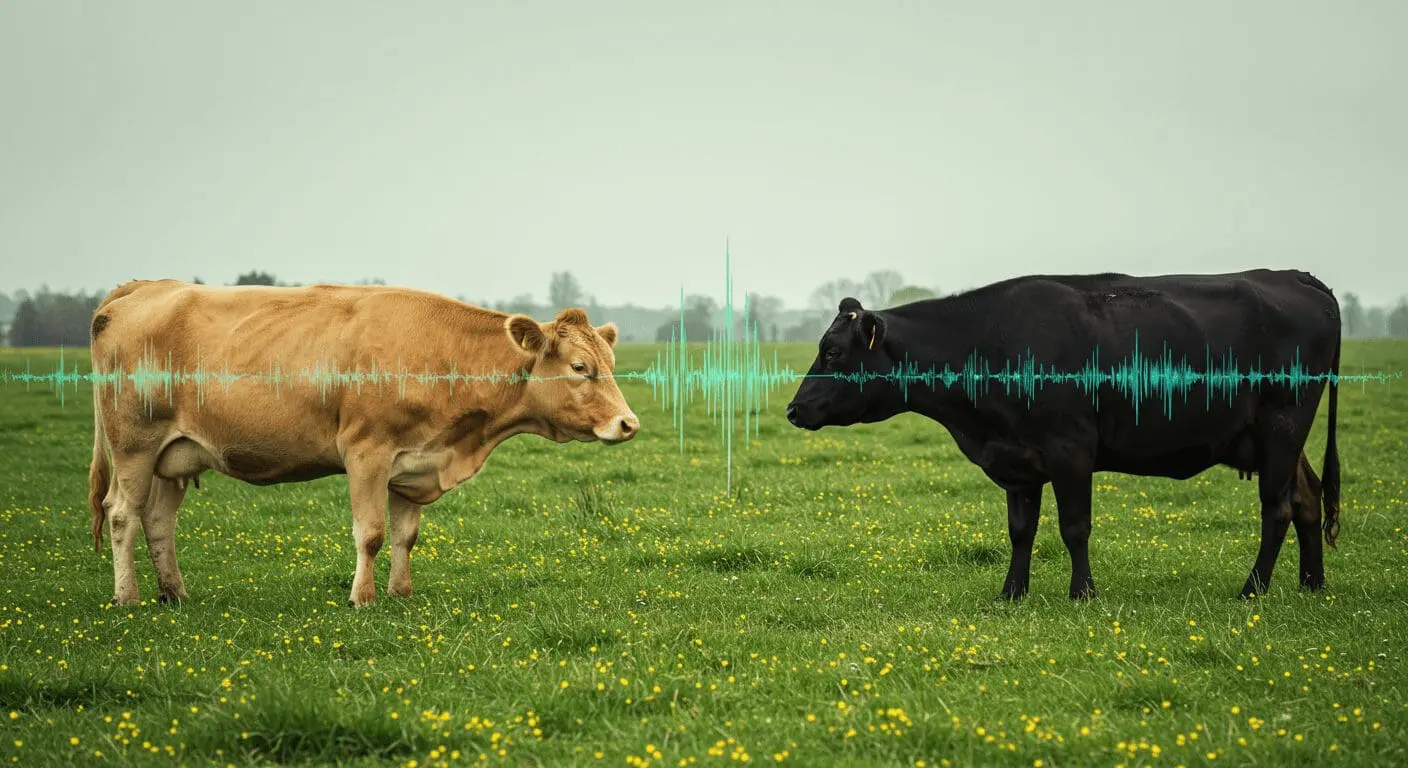
This study investigates how various ungulate species use vocalizations to express positive or negative emotional valence, including horses, sheep, pigs, wild boars, goats, cows, and Przewalski’s horses. The research examines the acoustic features that convey emotional states by employing machine learning techniques such as UMAP for dimensionality reduction, k-means clustering, Naive Bayes classification, and XGBoost.
The findings reveal varying degrees of separability between emotional valences across species, with pigs demonstrating high accuracy in distinguishing positive and negative calls, while goats and cows showed less clarity. These results highlight the potential for using vocalizations to understand animal emotions, offering insights into animal welfare and conservation efforts. Despite limitations such as dataset size and balance issues, the study provides a foundation for future research to expand our understanding of emotional communication in animals.
Species-Specific Vocalization Clustering Based on Emotional Valence
The study investigates how different ungulate species express emotional valence through their vocalizations, focusing on species-specific clustering patterns. To analyze these patterns effectively, techniques such as k-means clustering, Naive Bayes classification, and XGBoost were employed alongside UMAP for dimensionality reduction.
Pigs demonstrated the clearest separation between positive and negative emotional states with high classification accuracy (94.84%) and clustering purity (69.66%), attributed to distinct vocal features like short and long grunts. Wild boars also showed separation but with more overlap, suggesting less clarity in their emotional expression compared to pigs.
Goat calls exhibited overlapping clusters, indicating nuanced or context-dependent vocalizations for emotional expression. Cows displayed moderate overlap between positive and negative valences, possibly due to ambiguous vocal features or dataset limitations. Przewalski’s horses achieved high accuracy with XGBoost but lower performance with other methods, highlighting the effectiveness of complex models in capturing nuanced patterns.
UMAP visualizations provided a useful overview but may not represent distinct biological clusters, underscoring the importance of statistical validation. The study also noted potential biases from imbalanced datasets, particularly an overrepresentation of negative calls in cows, emphasizing the need for balanced data to ensure unbiased model performance.
Limitations include a limited number of species and emotional contexts, with only seven species analyzed. This diversity is notable but lacks generalizability across a broader range of species. Variability in classification performance across species suggests challenges in developing universal models for vocal emotional expression.
The study serves as a foundational exploration for machine learning applications in animal emotion detection, offering insights valuable for enhancing animal welfare and conservation efforts. Future research could expand by incorporating more data and exploring additional features or methods to better capture the complexity of animal vocalizations.
Application of K-Means Clustering and Naive Bayes Classification
The application of k-means clustering and Naive Bayes classification played a pivotal role in analyzing the acoustic features of ungulate vocalizations to detect emotional valence. K-means clustering was employed to identify distinct groups within the data, revealing species-specific patterns in how positive and negative affective states are expressed through sound. For instance, pigs exhibited clear separation between clusters corresponding to positive and negative emotions, with high classification accuracy achieved by Naive Bayes, underscoring their distinct vocal features such as short and long grunts. In contrast, wild boars showed less clarity, with overlapping clusters suggesting more nuanced emotional expressions.
Goat calls presented a different challenge, with significant overlap in clusters, indicating that their vocalizations may be context-dependent or more complex to categorize. Similarly, cows displayed moderate overlap between positive and negative valences, potentially due to ambiguous acoustic features or dataset limitations. These findings highlight the variability in emotional expression across species and the importance of considering such differences when developing models for animal emotion detection.
Naive Bayes classification provided a probabilistic framework to quantify these patterns, offering insights into the likelihood of certain vocalizations corresponding to specific emotional states. However, the study also revealed limitations, particularly the overrepresentation of negative calls in cows, which could bias model performance. This underscores the need for balanced datasets to ensure unbiased predictions and generalizability across different contexts and species.
The combination of k-means clustering and Naive Bayes classification complemented UMAP visualizations, providing both statistical validation and a deeper understanding of the data structure. While these methods offered valuable insights, they also highlighted challenges in capturing universal patterns of emotional expression across ungulates. Future research could benefit from integrating additional features or exploring alternative techniques to better account for species-specific variations and improve model performance.
Overall, the application of k-means clustering and Naive Bayes classification demonstrated the potential of machine learning in animal emotion detection, while also emphasizing the need for robust data collection and analysis strategies to address existing limitations.
Incorporating UMAP for Dimensionality Reduction
The study investigates how different ungulate species express emotional valence through their vocalizations, focusing on species-specific clustering patterns. Techniques such as k-means clustering, Naive Bayes classification, and XGBoost were employed alongside UMAP for dimensionality reduction to analyze these patterns effectively.
Pigs demonstrated the clearest separation between positive and negative emotional states with high classification accuracy (94.84%) and clustering purity (69.66%), attributed to distinct vocal features like short and long grunts. Wild boars also showed separation but with more overlap, suggesting less clarity in their emotional expression compared to pigs.
Goat calls exhibited overlapping clusters, indicating nuanced or context-dependent vocalizations for emotional expression. Cows displayed moderate overlap between positive and negative valences, possibly due to ambiguous vocal features or dataset limitations. Przewalski’s horses achieved high accuracy with XGBoost but lower performance with other methods, highlighting the effectiveness of complex models in capturing nuanced patterns.
UMAP visualizations provided a useful overview but may not represent distinct biological clusters, underscoring the importance of statistical validation. The study also noted potential biases from imbalanced datasets, particularly an overrepresentation of negative calls in cows, emphasizing the need for balanced data to ensure unbiased model performance.
Limitations include a limited number of species and emotional contexts, with only seven species analyzed. This diversity is notable but lacks generalizability across a broader range of species. Variability in classification performance across species suggests challenges in developing universal models for vocal emotional expression.
The study serves as a foundational exploration for machine learning applications in animal emotion detection, offering insights valuable for enhancing animal welfare and conservation efforts. Future research could expand by incorporating more data and exploring additional features or methods to better capture the complexity of animal vocalizations.
The application of k-means clustering and Naive Bayes classification played a pivotal role in analyzing the acoustic features of ungulate vocalizations to detect emotional valence. K-means clustering was employed to identify distinct groups within the data, revealing species-specific patterns in how positive and negative affective states are expressed through sound. For instance, pigs exhibited clear separation between clusters corresponding to positive and negative emotions, with high classification accuracy achieved by Naive Bayes, underscoring their distinct vocal features such as short and long grunts. In contrast, wild boars showed less clarity, with overlapping clusters suggesting more nuanced emotional expressions.
Goat calls presented a different challenge, with significant overlap in clusters, indicating that their vocalizations may be context-dependent or more complex to categorize. Similarly, cows displayed moderate overlap between positive and negative valences, potentially due to ambiguous acoustic features or dataset limitations. These findings highlight the variability in emotional expression across species and the importance of considering such differences when developing models for animal emotion detection.
Naive Bayes classification provided a probabilistic framework to quantify these patterns, offering insights into the likelihood of certain emotional states based on vocal features. This approach allowed researchers to assess the confidence in their classifications, which is crucial for understanding the reliability of the model predictions. The use of XGBoost further enhanced the ability to capture complex relationships within the data, particularly for species like Przewalski’s horses, where simpler models struggled to achieve high accuracy.
UMAP visualizations provided a powerful tool for exploring the high-dimensional space of vocal features, enabling researchers to identify potential clusters and patterns that might not be immediately apparent from raw data. However, these visualizations must be interpreted with caution, as they may not always align with biological or behavioral expectations. Statistical validation is essential to ensure that observed clusters correspond to meaningful differences in emotional expression.
The study also underscored the importance of addressing dataset biases, particularly the overrepresentation of negative calls in cows. Such imbalances can skew model predictions and reduce their generalizability, highlighting the need for balanced datasets that accurately reflect the distribution of emotional states in the population under study.
More information
External Link: Click Here For More


