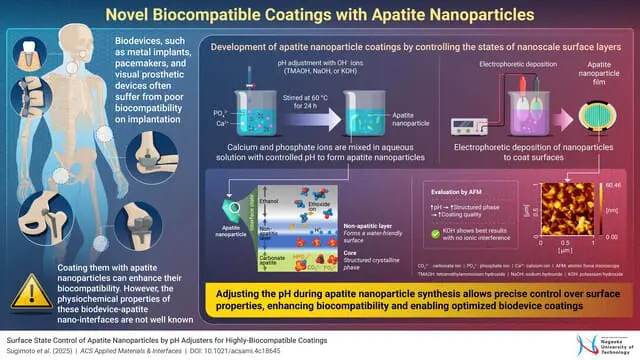
Innovative advancements in medical implant technology have been achieved by researchers at Nagaoka University of Technology developing surface-modified apatite nanoparticles. These particles are designed to improve biocompatibility and cell adhesion, addressing a critical challenge in the field where traditional implants often elicit inflammatory responses due to poor integration with biological tissues. The team led by Dr. Motohiro Tagaya has successfully synthesized these advanced apatite nanoparticles using pH-controlled synthesis methods that enhance water interactions and structural stability, thereby offering a promising solution for more effective medical implants.
The research introduces an interdisciplinary framework that focuses on the intricate interactions between apatite nanoparticles and biological systems, aiming to unravel the complexities of biocompatible materials. By controlling the nanoscale surface layer properties of these particles, Dr. Tagaya’s team has developed a method that allows for superior cell adhesion compared to conventional apatite coatings. This breakthrough was achieved through the synthesis of hydroxyapatite nanoparticles by mixing aqueous solutions of calcium and phosphate ions under pH-controlled conditions using tetramethylammonium hydroxide (TMAOH), potassium hydroxide (KOH), or sodium hydroxide (NaOH).
The study reveals that higher pH values favor the formation of carbonate-containing hydroxyapatite (CHA) with better crystallinity, a higher calcium to phosphorus ratio, and an enhanced hydration layer. This non-apatitic layer is rich in reactive ions that facilitate improved cell adhesion properties. However, it was also observed that Na+ ions reduce phosphate ion concentration, affecting the reactivity of the layer and potentially impacting uniformity during electrophoretic deposition.
Dr. Tagaya emphasizes the significance of this research for designing biocompatible surfaces with preferential cell adhesion capabilities, which could be applied to a wide range of implanted medical devices such as artificial joints and implants. The findings have the potential to revolutionize healthcare by improving patient outcomes through innovative materials that enhance tissue compatibility and reduce complications associated with traditional implantation procedures.
This study was supported by a grant from
This study was supported by a grant from the Japan Society for the Promotion of Science (JSPS) KAKENHI, highlighting the importance of collaborative research efforts in advancing medical science. The team’s contributions to nanobioceramics and biocompatible materials are expected to pave the way for groundbreaking innovations that could significantly impact the field of biomedical engineering and patient care.
In summary, this pioneering work by Dr. Motohiro Tagaya and his colleagues at Nagaoka University of Technology represents a significant step forward in medical implant technology, offering new possibilities for developing more biocompatible materials that can enhance tissue integration and improve patient outcomes in various medical applications.
The research conducted by Dr. Motohiro Tagaya and his team at Nagaoka University of Technology in Japan focuses on the development of highly biocompatible apatite nanoparticles through manipulation of their surface properties using pH adjustments. Apatite is a type of calcium phosphate mineral that plays a crucial role as a biomaterial due to its similarity with natural bone tissue.
The study involves synthesizing hydroxyapatite nanoparticles by mixing aqueous solutions of calcium and phosphate ions, then controlling the pH of the solution using different bases like tetramethylammonium hydroxide (TMAOH), sodium hydroxide (NaOH), and potassium hydroxide (KOH). The researchers observed that the choice of pH influenced the crystalline phases formed during synthesis, such as calcium-deficient hydroxyapatite (CDHA) and carbonate-containing hydroxyapatite (CHA).
The surface characteristics of these nanoparticles were found to have three distinct layers: an inner apatite layer/core with a crystalline structure, a non-apatitic layer rich in ions like phosphate and carbonate above the apatite layer, which reacts with water molecules forming a hydration layer. The pH adjustments facilitated the formation of this non-apatitic layer rich in reactive ions, enhancing hydration properties.
The study highlights that higher pH levels promote
The study highlights that higher pH levels promote the formation of the non-apatitic layer but also reduce the concentration of phosphate ions due to the presence of Na+ ions, which affects the reactivity and uniformity of electrophoretic deposition. Potassium hydroxide (KOH) was found to be more suitable than sodium hydroxide for forming this non-apatitic layer.
The findings have potential applications in surface coating of biodevices such as artificial joints and implants that are implanted in the human body, aiming to improve their biocompatibility and enhance cell adhesion. This research could inspire designs for biocompatible surfaces with preferential cell adhesion properties, contributing to advancements in medical materials and devices.
Dr. Motohiro Tagaya is an Associate Professor at Nagaoka University of Technology with expertise in nanobioceramics, biomedical engineering, and designing interfaces for cellular therapeutics. His work has been recognized with the Inoue Research Award for Young Scientists of Japan in 2012, highlighting his significant contributions to bioceramics science and engineering.
External Link: Click Here For More