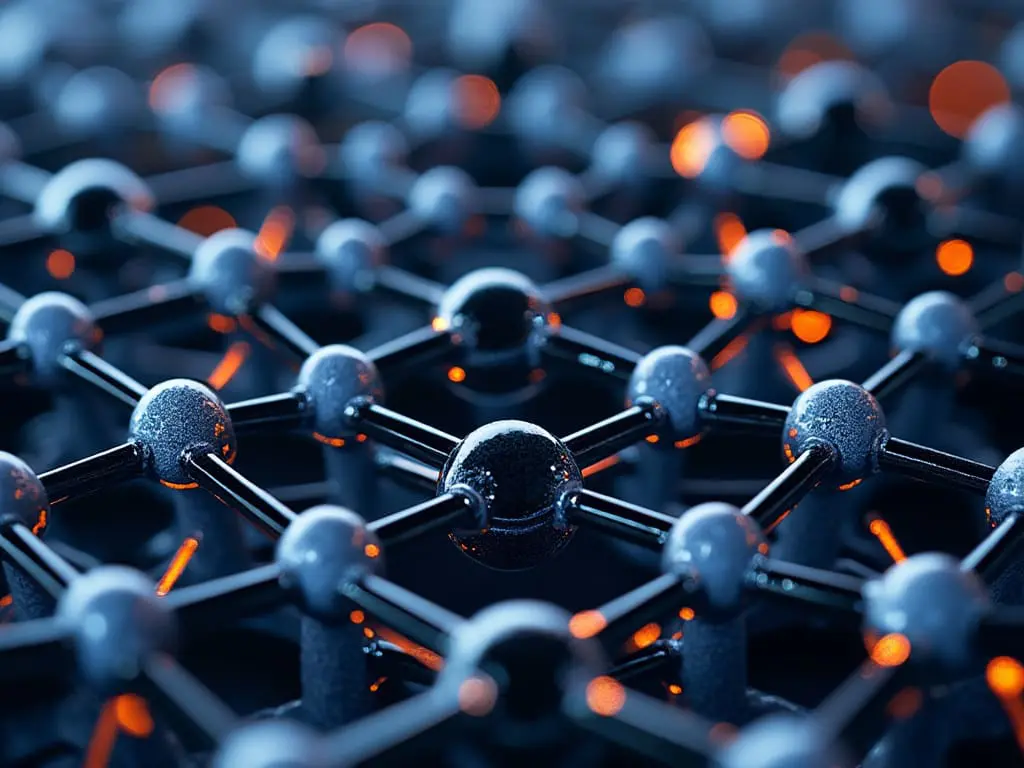
A breakthrough artificial intelligence model, CrystaLLM, has been developed by researchers at the University of Reading and University College London to predict how atoms arrange themselves in crystal structures. This innovation could lead to faster discovery of new materials for a wide range of applications, from solar panels to computer chips.
Led by Dr. Luis Antunes, who completed his PhD at the University of Reading, the research team has created a system that learns the “language” of crystals by studying millions of existing crystal structures, similar to AI chatbots. By analyzing patterns in these structures, CrystaLLM can predict new ones, eliminating the need for time-consuming computer simulations.
The model has been shown to successfully generate realistic crystal structures, even for materials it had never seen before. A free website has been created where researchers can use CrystaLLM to generate crystal structures, potentially speeding up the development of new materials for technologies like better batteries and more efficient solar cells.
AI-Powered Crystal Structure Prediction: A Breakthrough in Materials Discovery
The discovery of new materials is a crucial step in the development of innovative technologies, from solar panels to computer chips. However, predicting how atoms arrange themselves in crystal structures has long been a complex and time-consuming process. Recently, researchers at the University of Reading and University College London have developed an artificial intelligence (AI) model called CrystaLLM, which can predict crystal structures with unprecedented accuracy.
CrystaLLM works by learning the “language” of crystals through the analysis of millions of existing crystal structures. This approach is similar to that of AI chatbots, where the system learns patterns and relationships within a dataset to generate new outputs. In this case, CrystaLLM uses Crystallographic Information Files (CIFs), the standard format for representing crystal structures, as its training data. By reading these descriptions, the system predicts what comes next, gradually learning patterns about how crystals are structured.
One of the key advantages of CrystaLLM is its ability to generate realistic crystal structures even for materials it has never seen before. This is achieved without any prior knowledge of physics or chemistry rules, as the system figures them out on its own through pattern recognition. The researchers have demonstrated that CrystaLLM can successfully predict crystal structures, including those with complex arrangements of atoms.
The Limitations of Traditional Crystal Structure Prediction
The current process for predicting crystal structures relies heavily on time-consuming computer simulations of physical interactions between atoms. These simulations require massive computing power to test countless possible arrangements of atoms, making the process slow and laborious. Furthermore, these simulations often rely on simplifying assumptions and approximations, which can lead to inaccuracies in the predicted structures.
In contrast, CrystaLLM offers a breakthrough by studying millions of known crystal structures to understand patterns and predict new ones. This approach is more efficient and accurate than traditional methods, as it does not require complex physics calculations or simplifying assumptions. Instead, the system learns from the data itself, allowing it to capture subtle patterns and relationships that may be difficult to model using traditional approaches.
The Potential Impact of CrystaLLM on Materials Discovery
The integration of CrystaLLM within crystal structure prediction workflows could significantly speed up the development of new materials for various technologies. For instance, researchers could use CrystaLLM to generate realistic crystal structures for materials with specific properties, such as high-temperature superconductors or efficient thermoelectric materials.
The potential impact of CrystaLLM on materials discovery is substantial. By accelerating the process of predicting crystal structures, researchers can focus on designing and synthesizing new materials with improved properties. This could lead to breakthroughs in various fields, including energy storage, conversion, and efficiency, as well as advanced computing and electronics.
The Future of Crystal Structure Prediction: Opportunities and Challenges
The development of CrystaLLM marks a significant milestone in the field of crystal structure prediction. However, there are still opportunities for improvement and challenges to be addressed. For instance, while CrystaLLM has demonstrated impressive accuracy, it is not yet clear how well it will perform on more complex systems or those with limited available data.
Furthermore, the integration of CrystaLLM within existing workflows and software packages will require careful consideration of compatibility and usability issues. Additionally, as with any AI system, there are concerns about interpretability and explainability, particularly in a field where understanding the underlying physics is crucial.
Despite these challenges, the potential benefits of CrystaLLM make it an exciting development in the field of materials discovery. As researchers continue to refine and improve this technology, it is likely to have a significant impact on our ability to design and discover new materials with improved properties.
External Link: Click Here For More

See today’s quantum computing news on Quantum Zeitgeist for the latest breakthroughs in qubits, hardware, algorithms, and industry deals.