Researchers have made significant strides in simulating non-Markovian dynamics in multidimensional electronic spectroscopy, a crucial challenge in computational spectroscopy. By developing pseudo mode embedding and quantum algorithms, scientists can now accurately model the optical response of multichromophoric systems, which are often coupled to selected molecular vibrations and influenced by their environment.
This innovative approach has been validated through spectra simulations for a prototypical excitonic dimer interacting with fast memoryless and finite-memory environments. The results demonstrate the potential of pseudo mode embedding for simulating the dynamical features of nonlinear spectroscopy, including lineshape spectral diffusion and relaxations along delay times.
Furthermore, the explicit synthesis of quantum circuits provides a fully quantum simulation protocol of nonlinear spectroscopy, harnessing the efficient quantum simulation of many-body dynamics promised by future generations of fault-tolerant quantum computers. This breakthrough has far-reaching implications for our understanding of complex quantum systems interacting with their environment.
Simulating Non-Markovian Dynamics in Multidimensional Electronic Spectroscopy
The simulation of non-Markovian dynamics in multidimensional electronic spectroscopy remains an important challenge in computational spectroscopy. This challenge arises from the need to accurately model the optical response of multichromophore systems, which are often coupled to selected molecular vibrations and influenced by the molecular environment.
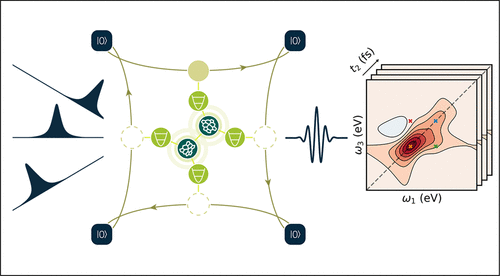
In this context, a key step is the pseudo mode embedding of the system-environment problem, resulting in a finite set of quantum states evolving according to a Markovian quantum master equation. This formulation can be solved using a collision model integrated into a quantum algorithm designed to simulate linear and nonlinear response functions. The workflow has been validated by simulating spectra for the prototypical excitonic dimer interacting with fast memoryless and finite-memory environments.
The results demonstrate the potential of pseudomode embedding for simulating the dynamical features of nonlinear spectroscopy, including lineshape spectral diffusion, and relaxations along delay times. Furthermore, the explicit synthesis of quantum circuits provides a fully quantum simulation protocol of nonlinear spectroscopy, harnessing the efficient quantum simulation of many-body dynamics promised by future generations of fault-tolerant quantum computers.
The Challenge of Disentangling Spectral Features
The challenge of disentangling and correctly assigning spectral
The challenge of disentangling and correctly assigning spectral features to dynamical processes has driven a strong interaction between theoretical models, computational simulations, and experimental developments over the last decade. Despite significant progress, the simulation of the time-resolved spectroscopic response of multichromophore systems remains a formidable task.
Two fundamental reasons contribute to this challenge: first, electronic transitions are often coupled to selected molecular vibrations (vibronic transitions), producing characteristic spectra patterns. The dimension of the vibronic wavefunction diverges exponentially with the number of relevant vibrational modes, leading to an intrinsic scaling issue due to the quantum mechanical nature of the molecular degrees of freedom involved in the system dynamics.
Secondly, the spectroscopic response is highly sensitive to the molecular environment, including the multitude of intramolecular vibrations, scaffold, and solvent degrees of freedom. The explicit inclusion of this continuum of modes into a numerical protocol is impossible; therefore, the theory of open quantum systems becomes a key aspect of addressing this challenge.
Pseudomode Embedding: A Key Step in Simulating Non-Markovian Dynamics
Pseudomode embedding is a crucial step in simulating non-Markovian dynamics in multidimensional electronic spectroscopy. This approach involves the pseudomode embedding of the system-environment problem, resulting in a finite set of quantum states evolving according to a Markovian quantum master equation.
This formulation can be solved using a collision model integrated into a quantum algorithm designed to simulate linear and nonlinear response functions. The pseudomode embedding procedure allows for the efficient simulation of non-Markovian dynamics, which is essential for accurately modeling the optical response of multichromophore systems.
The results obtained from this approach demonstrate the potential of pseudomode embedding for simulating the dynamical features of nonlinear spectroscopy, including lineshape spectral diffusion and relaxations along delay times. Furthermore, the explicit synthesis of quantum circuits provides a fully quantum simulation protocol of nonlinear spectroscopy, harnessing the efficient quantum simulation of many-body dynamics promised by future generations of fault-tolerant quantum computers.
The Role of Quantum Algorithms in Simulating Non-Markovian Dynamics
Quantum algorithms play a crucial role in simulating non-Markovian dynamics in multidimensional electronic spectroscopy. A key aspect is the development of collision models integrated into quantum algorithms designed to simulate linear and nonlinear response functions.
These algorithms can efficiently solve the Markovian quantum
These algorithms can efficiently solve the Markovian quantum master equation obtained from the pseudomode embedding procedure, allowing for the accurate simulation of non-Markovian dynamics. The results demonstrate the potential of this approach for simulating the dynamical features of nonlinear spectroscopy, including lineshape spectral diffusion and relaxations along delay times.
Furthermore, the explicit synthesis of quantum circuits provides a fully quantum simulation protocol of nonlinear spectroscopy, harnessing the efficient quantum simulation of many-body dynamics promised by future generations of fault-tolerant quantum computers. This approach has significant implications for the accurate modeling of complex systems in various fields, including chemistry and materials science.
Implications for Accurate Modeling of Complex Systems
The development of pseudomode embedding and quantum algorithms for simulating non-Markovian dynamics in multidimensional electronic spectroscopy has significant implications for the accurate modeling of complex systems. This approach allows for the efficient simulation of non-Markovian dynamics, which is essential for accurately modeling the optical response of multichromophore systems.
The results obtained from this approach demonstrate the potential of pseudomode embedding and quantum algorithms for simulating the dynamical features of nonlinear spectroscopy, including lineshape spectral diffusion and relaxations along delay times. Furthermore, the explicit synthesis of quantum circuits provides a fully quantum simulation protocol of nonlinear spectroscopy, harnessing the efficient quantum simulation of many-body dynamics promised by future generations of fault-tolerant quantum computers.
This approach has significant implications for various fields, including chemistry and materials science, where accurate modeling of complex systems is essential. The development of pseudomode embedding and quantum algorithms provides a powerful tool for simulating non-Markovian dynamics in multidimensional electronic spectroscopy, allowing for the accurate modeling of complex systems and enabling breakthroughs in our understanding of these systems.
Publication Date: 2024-11-25
Authors: Federico Gallina, Matteo Bruschi, Roberto Cacciari, Barbara Fresch, et al.
Source: Journal of Chemical Theory and Computation
DOI: https://doi.org/10.1021/acs.jctc.4c01204
See today’s quantum computing news on Quantum Zeitgeist for the latest breakthroughs in qubits, hardware, algorithms, and industry deals.