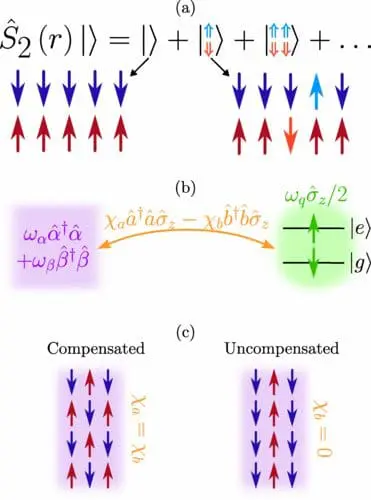
The discovery of antiferromagnets (AFMs) has opened up a new era in quantum sensing, with potential breakthroughs in quantum computing and quantum information science. Researchers have found that AFMs can couple to spin qubits via direct dispersive interaction, leading to a magnon number-dependent level splitting of the excited state. This phenomenon manifests itself as nontrivial excitation peaks in qubit spectroscopy, revealing the underlying nonclassical magnon composition of the antiferromagnetic quantum state.
Theoretical models have shown that by harnessing this phenomenon, researchers can achieve states useful for quantum computing and quantum information science protocols. Moreover, the magnonic state can be controlled via the qubit, suggesting that Fock states of magnon pairs can be generated deterministically. This new frontier in quantum sensing has the potential to revolutionize our understanding of quantum mechanics and lead to significant advancements in quantum computing and quantum information science.
Quantum Sensing of Antiferromagnetic Magnons: A New Frontier
The discovery of antiferromagnets (AFMs) has opened up new possibilities for quantum sensing and information processing. AFMs, which exhibit magnetic order with a vanishing net macroscopic magnetization, have been investigated for their potential in spintronics due to their robustness against magnetic fields, fast THz dynamics, and phenomena such as exchange bias and spin-orbit effects.
AFMs can be described by a Néel ordered state comprising two sublattices of oppositely oriented spins. Coherent excitations on the magnetic order generate a collective precession of the magnetic moments around their equilibrium position, referred to as spin waves or magnons. The semi-classical spin wave description is successful in explaining many phenomena, but it misses important physics, such as the true quantum ground state of the ordered AFM being a superposition of states with an equal number of spin-up and spin-down magnons.
This nonclassical ground state harbors composite excitations capable of generating states useful for quantum information protocols. Therefore, it is essential to establish protocols to detect and quantify the quantum properties of these states. Theoretical models have demonstrated that AFMs can couple to spin qubits via direct dispersive interaction, stemming from interfacial exchange. This kind of coupling induces a magnon number-dependent level splitting of the excited state, resulting in multiple system excitation energies.
Squeezing and Quantum Fluctuations
Squeezing and Quantum Fluctuations
Squeezing is a phenomenon where the quantum fluctuations of one observable are reduced beyond the standard quantum limit at the expense of the others. In quantum optics, squeezed states of light have been exploited in feats such as the detection of gravitational waves due to reduced quantum noise. Non-equilibrium magnets exhibit squeezing in equilibrium, and antiferromagnets can also display two-mode squeezing, where their ground state is a non-classical superposition of magnon Fock states.
The Heisenberg uncertainty principle dictates that if two observables are non-commuting, their quantum fluctuations obey this principle. Squeezing is a manifestation of this principle, where the reduction of quantum fluctuations in one observable leads to an increase in the other. In the context of AFMs, squeezing can be used to detect and quantify the quantum properties of these states.
Direct Dispersive Interaction and Magnon Coupling
Theoretical models have demonstrated that antiferromagnets can couple to spin qubits via direct dispersive interaction stemming from interfacial exchange. This kind of coupling induces a magnon number-dependent level splitting of the excited state, resulting in multiple system excitation energies. The series of level splittings manifests itself as non-trivial excitation peaks in qubit spectroscopy, thereby revealing the underlying non-classical magnon composition of the antiferromagnetic quantum state.
By appropriately choosing the drive or excitation energy, the magnonic state can be controlled via the qubit, suggesting that Fock states of magnon pairs can be generated deterministically. This enables achieving states useful for quantum computing and quantum information science protocols. The direct dispersive interaction between AFMs and spin qubits opens up new possibilities for quantum sensing and information processing.
Quantum Computing and Information Science
The ability to generate deterministic Fock states of magnon pairs has significant implications for quantum computing and information science. These states can be used as resources for quantum computing, enabling the implementation of complex quantum algorithms and protocols. The control over the magnonic state via the qubit also enables the manipulation of quantum information in a way that is not possible with traditional spin-based systems.
Theoretical models have demonstrated that AFMs can be
Theoretical models have demonstrated that AFMs can be used to generate entangled states, which are essential for many quantum computing protocols. The ability to control the magnonic state and generate deterministic Fock states of magnon pairs opens up new possibilities for quantum computing and information science.
Conclusion
The discovery of antiferromagnets has opened up new possibilities for quantum sensing and information processing. AFMs can be used to detect and quantify the quantum properties of these states, and their ability to couple to spin qubits via direct dispersive interaction opens up new possibilities for quantum computing and information science. Theoretical models have demonstrated that AFMs can be used to generate deterministic Fock states of magnon pairs, which are essential for many quantum computing protocols.
The control over the magnonic state via the qubit also enables the manipulation of quantum information in a way that is not possible with traditional spin-based systems. Further research is needed to fully explore the potential of AFMs in quantum sensing and information processing, but the possibilities are vast and exciting.
Publication Date: 2024-05-06
Authors: Anna-Luisa E. Römling and Akashdeep Kamra
Source: Physical review. B./Physical review. B
DOI: https://doi.org/10.1103/physrevb.109.174410



See today’s quantum computing news on Quantum Zeitgeist for the latest breakthroughs in qubits, hardware, algorithms, and industry deals.