Gauge theories are fundamental concepts in physics that describe the interactions between elementary particles as mediated by gauge bosons. They play a crucial role in the Standard Model of particle physics and are essential for understanding strongly correlated quantum matter. However, simulating these theories on modern quantum simulators is a challenging task due to technical difficulties. Researchers have proposed a top-down approach to realize non-Abelian SU(N) lattice gauge theories using ultracold atoms and polar molecules in optical lattices or optical tweezer arrays. This innovative solution has the potential to provide new insights into the behavior of subatomic particles and fundamental forces.
What are Gauge Theories and Why are They Important?
Gauge theories are a fundamental concept in physics, describing the interactions between elementary particles as mediated by gauge bosons. They play a crucial role in the Standard Model of particle physics and are also essential for understanding strongly correlated quantum matter with fractionalized excitations. Examples of gauge theories include quantum electrodynamics (Abelian U(1) gauge symmetry), the weak force (non-Abelian SU(2) gauge symmetry), and quantum chromodynamics (non-Abelian SU(3) gauge symmetry). These theories are currently the best descriptions of nature’s three fundamental forces, aside from gravity.
What is the Challenge in Simulating Gauge Theories?
Simulating gauge theories on modern quantum simulators is a challenging task. While these setups offer direct experimental probes complementary to dedicated classical computations and high-energy colliders, they also pose significant technical challenges. Almost all quantum simulation experiments of gauge theories have been performed in one spatial dimension, with most non-Abelian proposals restricted to building blocks or small systems. Extended systems are intrinsically vulnerable to gauge-breaking errors unless explicit gauge protection schemes are implemented.
What is the Proposed Solution?
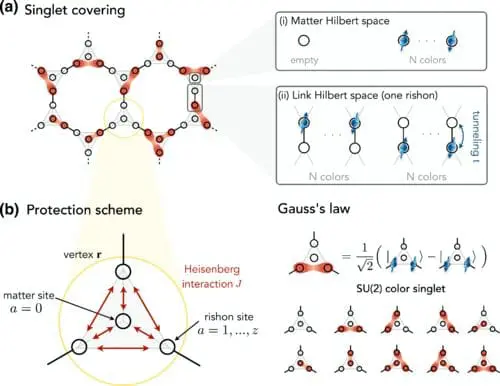
The authors propose a top-down approach to realize non-Abelian SU(N) lattice gauge theories (LGTs) using ultracold atoms and polar molecules in optical lattices or optical tweezer arrays. The focus is on realizing the gauge-protection terms locally, with the gauge-invariant dynamics induced perturbatively. This approach allows for the energetic enforcement of non-Abelian gauge constraints in current and near-term quantum simulation setups.
How Does the Proposed Solution Work?
The proposed solution involves using a combination of ultracold atoms and polar molecules to create a lattice gauge theory. The gauge-protection terms are realized locally, meaning that they are enforced at each site of the lattice, rather than globally. This allows for the energetic enforcement of non-Abelian gauge constraints, which is essential for simulating gauge theories accurately.
What are the Potential Applications of this Research?
The potential applications of this research are significant. Simulating gauge theories on quantum computers could provide new insights into the behavior of subatomic particles and the fundamental forces of nature. This could lead to breakthroughs in our understanding of the universe, from the smallest scales to the largest.
What are the Next Steps for this Research?
The next steps for this research involve further developing the proposed approach and testing it experimentally. This will require advances in quantum simulation technology, including the development of more sophisticated optical lattices and optical tweezer arrays. Additionally, theoretical work is needed to better understand the behavior of non-Abelian gauge theories in these systems.
Conclusion
In conclusion, simulating gauge theories on quantum computers is a challenging but potentially rewarding task. The proposed approach offers a promising solution to this challenge, using a top-down approach to realize non-Abelian SU(N) lattice gauge theories. While significant technical challenges remain, the potential applications of this research make it an exciting and important area of study.
Publication details: “Spin Exchange-Enabled Quantum Simulator for Large-Scale Non-Abelian Gauge Theories”
Publication Date: 2024-09-30
Authors: Jad C. Halimeh, Lukas Homeier, Annabelle Bohrdt, Fabian Grusdt, et al.
Source: PRX Quantum 5, 030358
DOI: https://doi.org/10.1103/PRXQuantum.5.030358



See today’s quantum computing news on Quantum Zeitgeist for the latest breakthroughs in qubits, hardware, algorithms, and industry deals.