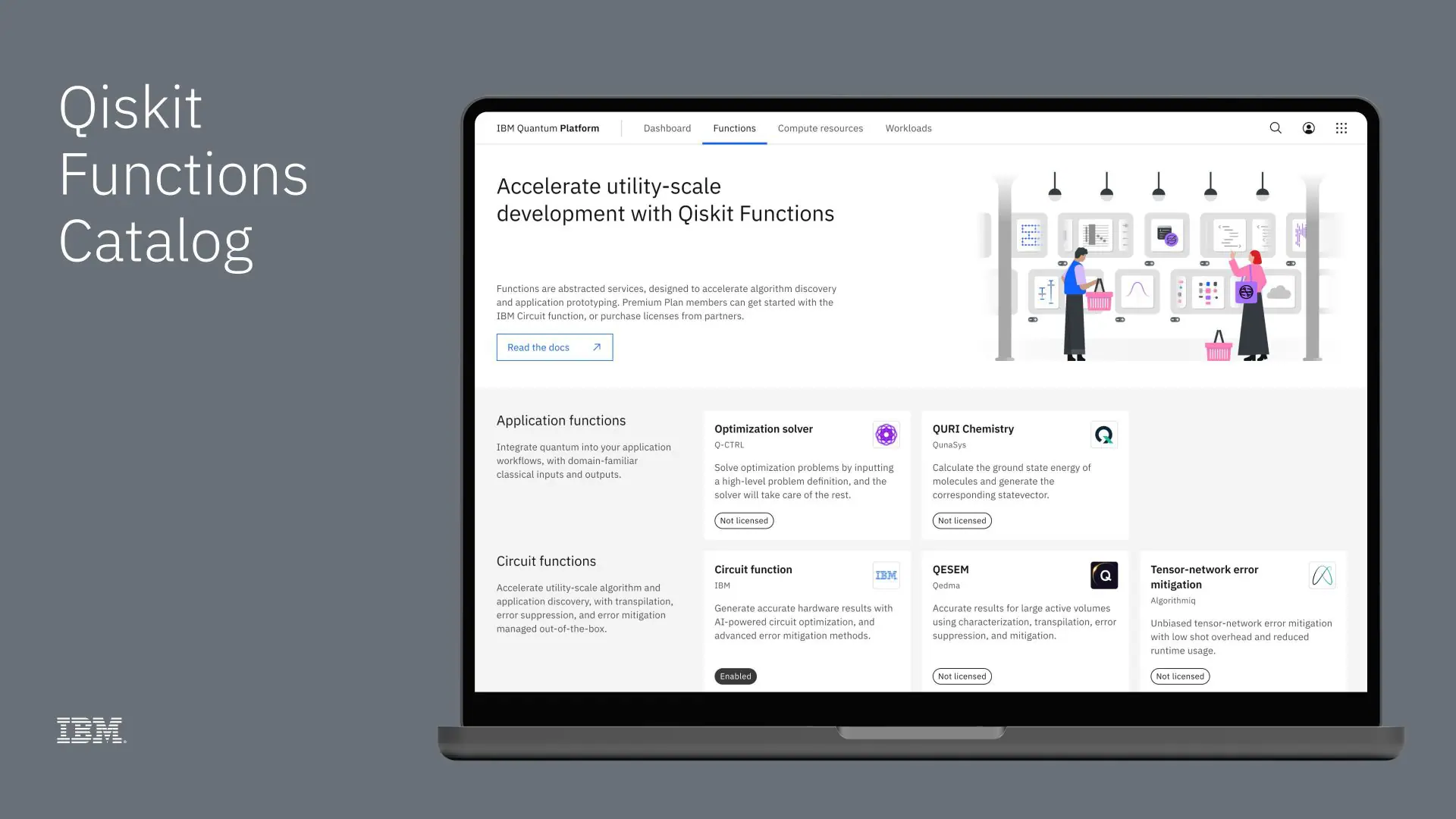
Researchers have been exploring complex problems using utility-scale quantum computers on the IBM Quantum Platform, but this requires a deep understanding of quantum processing units and error suppression methods.
To make these capabilities more accessible, IBM has launched the Qiskit Functions Catalog. This platform allows developers to release abstracted services, known as Qiskit Functions, which can accelerate algorithm discovery and application prototyping. Jay Gambetta, VP of IBM Quantum, announced the catalog’s preview release at IEEE Quantum Week.
The catalog currently features functions from startups in the IBM Quantum Network, including Algorithmiq, Q-CTRL, Qedma, and QunaSys, as well as one function from IBM. These functions enable users to abstract away parts of the quantum software development workflow, making it easier for enterprise developers to experiment with quantum computing in their specific domains.
Unlocking Utility-Scale Quantum Computing with Qiskit Functions Catalog
The advent of utility-scale quantum computers has opened up new avenues for researchers to explore complex problems that were previously difficult to simulate using classical methods. However, harnessing the power of these machines requires a deep understanding of quantum computing and error suppression techniques. To bridge this gap, IBM has introduced the Qiskit Functions Catalog, a platform that enables developers to create and share modular tools for quantum computing.
Simplifying Quantum Computing with Circuit and Application Functions
The Qiskit Functions Catalog offers two types of functions: Circuit Functions and Application Functions. Circuit Functions provide a simplified interface for running circuits, managing synthesis, optimization, and execution of the representative ISA circuit. This allows computational scientists to focus on mapping their problems to circuits, rather than building the pattern for each problem from scratch.
Application Functions, on the other hand, cover higher-level tasks like exploring algorithms and domain-specific use cases. These functions enable enterprise developers and data scientists without a background in quantum information science to experiment with plugging quantum into their domain-specific workflows.
Partner Contributions to the Qiskit Functions Catalog
The launch of the Qiskit Functions Catalog features contributions from IBM’s ecosystem partners, including Algorithmiq, Q-CTRL, Qedma, and QunaSys. These partners have developed functions that can be licensed by Premium Plan developers, including:
- Circuit Functions:
- Q-CTRL’s Performance Management function, which applies AI-driven error suppression to automatically reduce errors, improve scalability, and save compute time.
- Algorithmiq’s circuit function applies TEM (tensor-network error mitigation), an error mitigation method that allows users to obtain unbiased estimators with the optimal number of shots.
- Qedma’s circuit function uses proprietary protocols for efficient and accurate characterization of noisy QPU operations and applies error suppression and error mitigation based on the characterization data.
- Application Functions:
- QunaSys’ chemistry application function, which solves the ground-state problem for molecules.
- Q-CTRL’s Optimization Solver as an application function, which solves utility-scale problems requiring no quantum expertise.
Laying the Groundwork for a Quantum Applications Ecosystem
The Qiskit Functions Catalog is designed to be a go-to platform for developers hoping to develop and release quantum computing tools. To further enable users to release functions of their own, IBM has introduced Qiskit addons, a collection of modular tools that can plug into the quantum algorithm workflow.
Qiskit addons include:
- Multi-product formulas (MPF), which reduce algorithmic errors known as Trotter errors through a weighted combination of several circuit executions during the mapping step.
- Operator backpropagation (OBP), which reduces circuit depth during the optimize step by trimming operations from the end of the circuit.
- Sampling-based quantum diagonalization (SQD), which classically post-processes noisy samples from a quantum processor to produce more accurate eigenvalue estimations of, e.g., chemistry Hamiltonians.
These Qiskit add-ons will further enable algorithm discovery and encourage developers to get started by checking out their respective GitHub pages. Those interested in releasing functions are also encouraged to familiarize themselves with Qiskit Serverless, the service that underpins them. Quantum workflows inherently require both quantum and classical processing, and Serverless manages the classical and quantum resources required to execute functions efficiently.
With the launch of the Qiskit Functions Catalog, IBM is laying the groundwork for a quantum applications ecosystem that will enable developers to create and share modular tools for quantum computing, ultimately unlocking the full potential of utility-scale quantum computers.
External Link: Click Here For More




See today’s quantum computing news on Quantum Zeitgeist for the latest breakthroughs in qubits, hardware, algorithms, and industry deals.