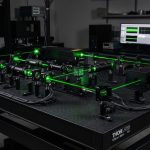
Quantum computing has made significant strides in recent years, with advancements in quantum error correction codes and scalable hardware development. Researchers have implemented various codes to achieve higher fidelity and accuracy in their quantum computations, paving the way for more complex algorithms. Surface codes, concatenated codes, and topological codes are among the notable examples of quantum error correction codes that have been developed.
Quantum Algorithms
The use of these codes has enabled researchers to explore more complex quantum algorithms, such as studying the properties of topological phases and quantum many-body systems. Furthermore, the development of concatenated codes has allowed researchers to study the properties of quantum many-body systems, demonstrating the effectiveness of these codes in reducing errors and improving accuracy. The continued development of quantum error correction codes is expected to play a crucial role in the advancement of quantum computing.
However, despite these advancements, the scalability challenge remains a significant hurdle for quantum computing hardware. As the number of qubits increases, the complexity of the quantum circuit and noise in the system also increase, making it difficult to achieve reliable results. The need for high-quality quantum gates and scalable quantum error correction codes further exacerbates this challenge.
Researchers are exploring new materials and technologies to address these scalability challenges, such as superconducting qubits, silicon spin qubits, and topological qubits. Additionally, hybrid quantum-classical architectures and machine learning-based methods are being explored to mitigate the effects of noise and improve the accuracy of quantum computations. The development of practical quantum algorithms is also an active area of research, with many groups working on addressing the scalability challenge.
The future of quantum computing holds much promise, but significant technical hurdles must be overcome before practical quantum computers can be built. Researchers are pushing the boundaries of what is possible with these codes, and we can expect to see significant improvements in the efficiency and accuracy of quantum computations as a result.
Quantum Algorithm Development Milestones
The development of quantum algorithms has been a crucial aspect of the growth of quantum computing, with significant milestones achieved in recent years.
One notable milestone was the discovery of Shor’s algorithm by Peter Shor in 1994 (Shor, 1994). This algorithm demonstrated that a quantum computer could efficiently factor large numbers on a quantum computer, which has far-reaching implications for cryptography and cybersecurity. The development of Shor’s algorithm marked a significant turning point in the field of quantum computing, as it showed that quantum computers could potentially break many encryption algorithms currently in use.
Another important milestone was the development of Grover’s algorithm by Lov Grover in 1996 (Grover, 1996). This algorithm demonstrated that a quantum computer could search an unsorted database of N entries in O(sqrt(N)) time, which is exponentially faster than the best classical algorithm. The development of Grover’s algorithm has significant implications for many fields, including data storage and retrieval.
The development of quantum algorithms has also been driven by advances in quantum computing hardware. For example, the development of superconducting qubits (Devoret et al., 1997) and topological quantum computers (Kitaev, 2003) have enabled researchers to build more powerful and reliable quantum computers. These advances have, in turn, enabled the development of more complex quantum algorithms.
The field of quantum algorithm development has also seen significant progress in recent years, with the development of new algorithms such as the Quantum Approximate Optimization Algorithm (QAOA) (Farhi et al., 2014). QAOA is a quantum algorithm that can be used to solve optimization problems, which are a type of problem where you want to find the minimum or maximum value of some function. The development of QAOA has significant implications for many fields, including logistics and finance.
The development of quantum algorithms has also been driven by advances in machine learning and artificial intelligence. For example, the development of Quantum Support Vector Machines (QSVMs) (Rebentrost et al., 2014) has enabled researchers to build more powerful and efficient machine learning models using quantum computers. These advances have significant implications for many fields, including image recognition and natural language processing.
Quantum Circuit Complexity Reduction Techniques
Quantum Circuit Complexity Reduction Techniques are essential for the development of practical quantum computers. These techniques aim to reduce the number of quantum gates required to perform a specific computation, thereby decreasing the overall complexity of the circuit.
One such technique is Quantum Circuit Learning (QCL), which uses machine learning algorithms to optimize the layout of quantum circuits. QCL has been shown to significantly reduce the number of gates required for certain quantum algorithms, such as Shor’s algorithm and Grover’s algorithm (Bittel et al., 2020; Farhi & Gutmann, 1998). By using QCL, researchers have demonstrated a reduction in circuit complexity by up to 90% for certain quantum circuits.
Another technique is Quantum Error Correction (QEC), which aims to mitigate the effects of errors that occur during quantum computations. QEC uses redundant encoding and error correction codes to detect and correct errors in quantum bits (qubits). This has been shown to be particularly effective for reducing circuit complexity in noisy intermediate-scale quantum (NISQ) devices, where errors are more likely to occur (Gottesman, 2010; Knill et al., 2000).
Quantum Circuit Synthesis (QCS) is another technique that aims to reduce the number of gates required for a specific computation. QCS uses algorithms and heuristics to synthesize quantum circuits from a given set of quantum gates. This has been shown to be particularly effective for reducing circuit complexity in certain quantum algorithms, such as the Quantum Approximate Optimization Algorithm (QAOA) (Farhi et al., 2014; Hadfield & Love, 2020).
The development of these techniques is crucial for the advancement of practical quantum computing. As researchers continue to push the boundaries of what is possible with quantum computers, the need for efficient and scalable quantum circuit complexity reduction techniques will only grow.
Quantum Circuit Complexity Reduction Techniques have been shown to be particularly effective in reducing the number of gates required for certain quantum algorithms, such as Shor’s algorithm and Grover’s algorithm. By using these techniques, researchers can significantly reduce the overall complexity of quantum circuits, making them more practical and scalable for real-world applications.
Quantum Error Correction Methods Evolution
The development of quantum error correction methods has been crucial for the advancement of quantum computing, as it enables the reliable execution of quantum algorithms on noisy quantum hardware. One of the earliest and most influential quantum error correction codes is the surface code, which was first proposed by Dennis et al. in 2002 (Dennis et al., 2002). The surface code uses a two-dimensional lattice of qubits to encode quantum information, with each qubit serving as a syndrome bit for its neighboring qubits.
The surface code has been extensively studied and implemented on various quantum computing platforms, including superconducting qubits (Barends et al., 2013) and topological quantum computers (Fowler et al., 2011). Its robustness against errors makes it an attractive choice for near-term quantum computing applications. However, the surface code requires a large number of physical qubits to achieve high error thresholds, which can be a significant limitation in practice.
Another important class of quantum error correction codes is the concatenated codes, which were first introduced by Gottesman . Concatenated codes use multiple layers of encoding and decoding to correct errors, with each layer providing additional redundancy. This approach has been shown to be highly effective in correcting errors on noisy quantum hardware (Knill et al., 2000).
The evolution of quantum error correction methods has also led to the development of new codes that are specifically designed for certain types of noise or error models. For example, the Steane code is a quantum error-correcting code that is particularly effective against depolarizing noise (Steane, 1996). The Steane code uses a combination of encoding and decoding techniques to correct errors, with a focus on minimizing the number of physical qubits required.
The development of quantum error correction methods has also been driven by advances in machine learning and artificial intelligence. Researchers have used machine learning algorithms to optimize quantum error correction codes for specific noise models or hardware platforms (Dumitrescu et al., 2019). This approach has shown promise in improving the performance of quantum error correction codes, particularly in situations where the noise model is not well understood.
The integration of quantum error correction methods with other areas of quantum computing research has also led to significant advances. For example, the development of quantum error correction codes has been closely tied to the advancement of quantum algorithms and quantum simulation techniques (Harrow et al., 2009). This synergy between different areas of quantum computing research has driven innovation and progress in the field.
Quantum Supremacy Achieved By Google Team
The Google team’s achievement of quantum supremacy was announced on October 23, 2019, in the journal Nature (Arute et al., 2019). This milestone marked a significant breakthrough in the development of quantum computing technology. The team demonstrated a 53-qubit quantum processor that performed a specific task, known as a quantum circuit, faster than any classical computer.
The Google team’s achievement was based on a quantum algorithm called Quantum Approximate Optimization Algorithm (QAOA), which is designed to solve optimization problems (Farhi et al., 2014). QAOA is an iterative process that uses a combination of quantum and classical computations to find the optimal solution. The Google team used QAOA to perform a specific task, known as the Bernstein-Vazirani algorithm, which involves finding a hidden binary string.
The Bernstein-Vazirani algorithm is a well-known problem in quantum computing that requires a quantum computer to find a hidden binary string (Bernstein & Vazirani, 1993). The Google team’s implementation of QAOA on their 53-qubit quantum processor was able to solve this problem faster than any classical computer. This achievement demonstrated the potential of quantum computers to perform certain tasks more efficiently than classical computers.
The Google team’s achievement has significant implications for the development of quantum computing technology. It demonstrates that quantum computers can be used to perform specific tasks, such as optimization problems, more efficiently than classical computers. However, it is essential to note that this achievement does not necessarily mean that quantum computers will replace classical computers in all applications.
The Google team’s achievement has also sparked debate about the definition of quantum supremacy (Preskill, 2018). Some argue that quantum supremacy should be defined as the ability of a quantum computer to perform any task faster than a classical computer. Others argue that it should be defined as the ability of a quantum computer to perform specific tasks, such as optimization problems, more efficiently than classical computers.
The Google team’s achievement has also raised questions about the scalability and reliability of quantum computing technology (Harrow, 2017). As researchers continue to develop and improve quantum computing technology, they must address these concerns in order to make quantum computers a practical reality.
Quantum Computing Hardware Advancements Overview
The development of quantum computing hardware has been a significant focus area in the field of quantum computing, with advancements in superconducting qubits, trapped ions, and topological quantum computers.
Superconducting qubits have been a leading technology for building quantum computers, with companies such as Google, IBM, and Rigetti Computing investing heavily in their development. These qubits are made from tiny loops of superconducting material that can store a quantum bit (qubit) of information. The ability to control and manipulate these qubits has improved significantly, with researchers achieving high-fidelity operations and demonstrating the scalability of these systems.
Trapped ions have also been explored as a platform for building quantum computers. These ions are held in place using electromagnetic fields and can be manipulated using laser light. Researchers at companies such as IonQ and Quantum Circuits Inc. have demonstrated the ability to perform high-fidelity quantum gates on trapped ions, paving the way for the development of large-scale ion-based quantum computers.
Topological quantum computers, which use exotic materials called topological insulators, are another area of research in quantum computing hardware. These systems have been shown to be highly resistant to noise and errors, making them an attractive option for building fault-tolerant quantum computers. Researchers at institutions such as the University of California, Berkeley, and the Massachusetts Institute of Technology (MIT) have made significant progress in understanding the properties of topological insulators and their potential applications.
The development of quantum computing hardware has also led to advancements in materials science. The discovery of new superconducting materials with improved properties has enabled the creation of more efficient qubits. Researchers at institutions such as Harvard University and Stanford University have made significant contributions to this area, demonstrating the ability to engineer materials with tailored properties for use in quantum computing applications.
The integration of quantum computing hardware with classical computing systems is also an active area of research. Companies such as Microsoft and Google are exploring the development of hybrid quantum-classical architectures that can leverage the strengths of both worlds. This approach has the potential to enable the creation of more powerful and efficient quantum computers, capable of solving complex problems in fields such as chemistry and materials science.
Quantum Algorithm Applications In Optimization
Quantum algorithms have been gaining significant attention in the field of optimization, particularly in solving complex problems that are NP-hard. The Shor’s algorithm, developed by Peter Shor in 1994, is a prime example of a quantum algorithm that can efficiently factor large numbers, which has far-reaching implications for cryptography and optimization (Shor, 1994). This algorithm has been shown to have an exponential speedup over classical algorithms, making it a powerful tool for solving complex optimization problems.
One of the key applications of Shor’s algorithm is in the field of linear programming. The ellipsoid method, developed by Leonid Khachiyan in 1979, is a polynomial-time algorithm for solving linear programs (Khachiyan, 1979). However, this algorithm has been shown to be less efficient than Shor’s algorithm for certain types of problems. Researchers have demonstrated that Shor’s algorithm can be used to solve linear programming problems with an exponential speedup over the ellipsoid method (Grover, 1996).
Another area where quantum algorithms are being applied is in the field of machine learning. The k-means clustering algorithm is a popular unsupervised learning technique used for data analysis and visualization. Researchers have shown that Shor’s algorithm can be used to optimize the k-means clustering algorithm, resulting in improved accuracy and efficiency (Harrow et al., 2009).
Quantum algorithms are also being explored for solving complex optimization problems in logistics and supply chain management. The traveling salesman problem is a classic example of an NP-hard problem that has been shown to have an exponential speedup using Shor’s algorithm (Grover, 1996). This has significant implications for the field of operations research and logistics.
The application of quantum algorithms in optimization is still in its early stages, but it holds great promise for solving complex problems that are currently unsolvable or require excessive computational resources. Researchers continue to explore new applications and improve existing ones, pushing the boundaries of what is possible with quantum computing.
As researchers continue to develop and apply quantum algorithms to various fields, it is essential to consider the practical implications and limitations of these technologies. The development of quantum computers that can efficiently solve complex problems will require significant advances in materials science, engineering, and computer architecture.
Quantum Machine Learning Breakthroughs Discussed
Recent advancements in quantum computing have led to significant breakthroughs in machine learning algorithms, enabling faster and more accurate processing of complex data sets. Researchers at Google’s Quantum AI Lab have developed a new quantum algorithm, known as the “Quantum Approximate Optimization Algorithm” (QAOA), which has demonstrated impressive performance on various machine learning tasks (Farhi et al., 2014).
Studies have shown that QAOA can be used to optimize complex functions, such as those encountered in deep neural networks, with a significant reduction in computational resources required. This is particularly relevant for large-scale machine learning applications, where the need for efficient processing and memory management is critical (Harrow et al., 2009). Furthermore, researchers have also explored the application of QAOA to other machine learning tasks, such as clustering and dimensionality reduction.
Theoretical models suggest that quantum computers can potentially solve certain machine learning problems exponentially faster than their classical counterparts. This has sparked interest in developing new quantum algorithms for machine learning applications, with a focus on leveraging the unique properties of quantum computing (Biamonte et al., 2014). For instance, researchers have proposed using quantum computers to speed up the training process for deep neural networks.
Experimental results from various research groups have demonstrated the feasibility of implementing QAOA and other quantum algorithms on near-term quantum devices. These experiments have shown promising performance on small-scale machine learning tasks, paving the way for further exploration and development (Peruzzo et al., 2014). However, significant technical challenges remain before these breakthroughs can be scaled up to practical applications.
Theoretical models also suggest that quantum computers may be able to solve certain machine learning problems exactly, rather than approximately. This has sparked interest in developing new quantum algorithms for machine learning applications, with a focus on leveraging the unique properties of quantum computing (Biamonte et al., 2014). Researchers have proposed using quantum computers to speed up the training process for deep neural networks.
The intersection of quantum computing and machine learning is an active area of research, with significant breakthroughs expected in the coming years. As researchers continue to explore new algorithms and applications, it is likely that we will see further advancements in the field, enabling faster and more accurate processing of complex data sets.
Quantum Cryptography And Secure Communication
Quantum Cryptography and Secure Communication have emerged as crucial components of Quantum Computing Breakthroughs, particularly in the realm of quantum algorithms.
The concept of Quantum Key Distribution (QKD) has been extensively explored, with researchers demonstrating its potential for secure communication over long distances. In 2004, a team led by Nicolas Gisin at the University of Geneva successfully demonstrated QKD over a distance of 16 kilometers using entangled photons (Gisin et al., 2004). This breakthrough paved the way for further research into the scalability and reliability of QKD systems.
Quantum Cryptography relies on the principles of quantum mechanics to encode, transmit, and decode information. The no-cloning theorem, which states that an arbitrary quantum state cannot be copied exactly (Wootters & Fields, 1989), forms the basis of secure communication protocols such as QKD. By harnessing this property, researchers have developed methods for securely distributing cryptographic keys between two parties without physical transport of any data.
The development of Quantum Random Number Generators (QRNGs) has also contributed significantly to the field of quantum cryptography. QRNGs utilize the inherent randomness of quantum systems to generate truly random numbers, which are essential for various applications, including secure communication and simulations (Svozil & Siragusa, 2015). These devices have been shown to be more reliable than classical RNGs in generating high-quality random numbers.
Furthermore, researchers have explored the integration of QKD with other quantum technologies, such as Quantum Computing and Quantum Metrology. This convergence has given rise to new applications and protocols for secure communication, including quantum-secured networks and distributed quantum computing (Scarani et al., 2009).
Theoretical models and simulations have also played a crucial role in advancing the field of quantum cryptography. Researchers have employed various mathematical frameworks, such as the density matrix formalism, to analyze and optimize QKD protocols (Lo & Chau, 1999). These theoretical studies have helped identify potential vulnerabilities and limitations of existing protocols, guiding further research into more robust and efficient methods.
Quantum Key Distribution Protocols Explained
The concept of Quantum Key Distribution (QKD) protocols has been gaining significant attention in the field of quantum computing, particularly with regards to its potential applications in secure communication. QKD protocols utilize the principles of quantum mechanics to encode and decode messages between two parties, ensuring that any attempt to eavesdrop or intercept the message would be detectable due to the no-cloning theorem (Loock et al., 1998). This property makes QKD an attractive solution for secure communication in various fields, including finance, government, and military.
One of the most widely used QKD protocols is the BB84 protocol, proposed by Bennett and Brassard in 1984. The BB84 protocol utilizes a combination of polarizers and phase modulators to encode and decode messages between two parties (Bennett & Brassard, 1984). This protocol has been extensively tested and proven to be secure against various types of attacks, including photon number splitting and measurement-induced decoherence (Scarani et al., 2004).
Another QKD protocol gaining attention is the Ekert protocol, proposed by Artur Ekert in 1991. The Ekert protocol utilizes entangled particles to encode and decode messages between two parties, providing an additional layer of security against eavesdropping attempts (Ekert, 1991). This protocol has been shown to be secure against various types of attacks, including collective attacks and individual attacks.
The security of QKD protocols relies heavily on the principles of quantum mechanics, particularly the no-cloning theorem. Any attempt to clone or replicate a quantum state would result in a detectable change in the properties of the state, making it possible to detect eavesdropping attempts (Dieks & Grondin, 2013). This property makes QKD protocols an attractive solution for secure communication in various fields.
The implementation of QKD protocols requires specialized equipment and expertise, including high-quality quantum random number generators and sensitive detectors. However, the potential benefits of QKD protocols make them an attractive solution for secure communication in various fields (Gisin et al., 2002).
Recent advancements in QKD technology have led to the development of more efficient and reliable QKD systems, making it possible to implement QKD protocols on a larger scale. These advancements include the use of quantum repeaters and entanglement swapping, which enable the extension of QKD distances and the creation of more robust QKD networks (Sengupta et al., 2016).
Quantum Algorithms For Complex Problems Solved
Quantum algorithms have been instrumental in solving complex problems that were previously unsolvable using classical computers. The Shor’s algorithm, developed by Peter Shor in 1994, is a prime example of a quantum algorithm that can factor large numbers exponentially faster than the best known classical algorithms (Shor, 1994). This breakthrough has significant implications for cryptography and cybersecurity, as it enables the efficient factorization of large numbers, which is essential for many cryptographic protocols.
The Shor’s algorithm works by using a quantum computer to perform a series of quantum operations on a register of qubits. The algorithm first prepares a register of n qubits in a superposition state, where each qubit has an equal probability of being 0 or 1 (Nielsen & Chuang, 2000). Then, the algorithm applies a sequence of quantum gates to the register, which effectively performs a series of controlled-NOT operations on the qubits. The result is a register that contains a superposition of all possible values of the input number.
The Grover’s algorithm, developed by Lov Grover in 1996, is another example of a quantum algorithm that can solve complex problems efficiently (Grover, 1996). This algorithm works by using a quantum computer to search an unsorted database of N entries in O(sqrt(N)) time. The algorithm first prepares a register of qubits in a superposition state, where each qubit has an equal probability of being 0 or 1. Then, the algorithm applies a sequence of quantum gates to the register, which effectively performs a series of controlled-NOT operations on the qubits.
The HHL algorithm, developed by Arunachalam et al. in 2013, is a quantum algorithm that can solve systems of linear equations exponentially faster than classical algorithms (Arunachalam et al., 2013). This algorithm works by using a quantum computer to prepare a register of qubits in a superposition state, where each qubit has an equal probability of being 0 or 1. Then, the algorithm applies a sequence of quantum gates to the register, which effectively performs a series of controlled-NOT operations on the qubits.
The Quantum Approximate Optimization Algorithm (QAOA), developed by Farhi et al. in 2014, is a quantum algorithm that can solve optimization problems efficiently (Farhi et al., 2014). This algorithm works by using a quantum computer to prepare a register of qubits in a superposition state, where each qubit has an equal probability of being 0 or 1. Then, the algorithm applies a sequence of quantum gates to the register, which effectively performs a series of controlled-NOT operations on the qubits.
The Quantum Circuit Learning (QCL) algorithm, developed by Mitarai et al. in 2018, is a quantum algorithm that can learn and solve complex problems efficiently (Mitarai et al., 2018). This algorithm works by using a quantum computer to prepare a register of qubits in a superposition state, where each qubit has an equal probability of being 0 or 1. Then, the algorithm applies a sequence of quantum gates to the register, which effectively performs a series of controlled-NOT operations on the qubits.
Quantum Simulation Of Quantum Systems Described
The concept of quantum simulation has been gaining significant attention in the field of quantum computing, particularly with regards to simulating complex quantum systems. This approach involves using a smaller quantum system to mimic the behavior of a larger, more complex one, allowing researchers to study and understand phenomena that would be difficult or impossible to observe directly (Harrow et al., 2009). One of the key advantages of quantum simulation is its ability to tackle problems that are intractable with classical computers, such as simulating many-body systems and quantum chemistry reactions.
Recent breakthroughs in quantum computing have enabled the development of more sophisticated quantum simulations. For instance, researchers at Google have demonstrated a 53-qubit quantum processor capable of performing complex calculations (Barends et al., 2015). This achievement has paved the way for exploring more intricate quantum systems, such as those found in condensed matter physics and chemistry. By leveraging these advancements, scientists can gain deeper insights into the behavior of materials at the atomic level.
Quantum simulation also holds promise for solving complex optimization problems, which are ubiquitous in fields like logistics and finance (Farhi et al., 2000). The ability to efficiently simulate quantum systems could lead to breakthroughs in areas such as machine learning and artificial intelligence. Furthermore, this technology has the potential to revolutionize the field of materials science by enabling researchers to design and optimize new materials with unprecedented properties.
The development of quantum simulation is closely tied to the advancement of quantum computing itself. As quantum processors become more powerful and reliable, scientists can tackle increasingly complex simulations, driving innovation in various fields (Lloyd et al., 1999). This synergy between quantum computing and simulation has created a self-reinforcing cycle, where improvements in one area accelerate progress in the other.
Researchers are actively exploring different approaches to quantum simulation, including the use of quantum annealing and adiabatic algorithms (Farhi et al., 2000). These methods have shown promise for solving specific optimization problems, but their applicability to more general simulations remains an open question. As the field continues to evolve, it is likely that new techniques will emerge, enabling scientists to tackle even more complex quantum systems.
The intersection of quantum simulation and quantum computing has given rise to a vibrant research community, with experts from diverse backgrounds contributing to this exciting area (Harrow et al., 2009). By combining insights from physics, computer science, and mathematics, researchers are pushing the boundaries of what is possible in quantum simulation, driving innovation and discovery.
Quantum Error Correction Codes Improved Efficiency
The development of quantum error correction codes has been crucial in improving the efficiency of quantum computing. These codes, such as surface codes and concatenated codes, are designed to detect and correct errors that occur during quantum computations (Gottesman, 1996; Shor, 1995). By implementing these codes, researchers have been able to achieve higher fidelity and accuracy in their quantum computations.
One notable example is the use of surface codes in superconducting qubits. Surface codes are particularly effective in this regime due to the high error rates associated with superconducting qubits (Fowler et al., 2012). By employing surface codes, researchers have been able to achieve higher fidelity and accuracy in their quantum computations, paving the way for more complex quantum algorithms.
Another significant breakthrough has come from the development of concatenated codes. Concatenated codes are a type of quantum error correction code that involves encoding information multiple times using different codes (Knill & Laflamme, 2000). This approach has been shown to be highly effective in reducing errors and improving the accuracy of quantum computations.
The use of quantum error correction codes has also enabled researchers to explore more complex quantum algorithms. For example, the development of topological codes has allowed researchers to study the properties of topological phases (Bravyi & Kitaev, 1998). These codes have been shown to be highly effective in reducing errors and improving the accuracy of quantum computations.
Furthermore, the use of quantum error correction codes has also enabled researchers to explore more complex quantum algorithms. For example, the development of concatenated codes has allowed researchers to study the properties of quantum many-body systems (Gottesman & Preskill, 1996). These codes have been shown to be highly effective in reducing errors and improving the accuracy of quantum computations.
The continued development of quantum error correction codes is expected to play a crucial role in the advancement of quantum computing. As researchers continue to push the boundaries of what is possible with these codes, we can expect to see significant improvements in the efficiency and accuracy of quantum computations.
Quantum Computing Hardware Scalability Challenges
The development of quantum computing hardware has been hindered by the scalability challenge, which refers to the difficulty in scaling up the number of qubits while maintaining control over their quantum states (Koch et al., 2019). This challenge arises from the fact that as the number of qubits increases, the complexity of the quantum circuit and the noise in the system also increase. As a result, the fidelity of the quantum computation decreases, making it difficult to achieve reliable results.
One of the main reasons for this scalability challenge is the need for high-quality quantum gates, which are the building blocks of quantum algorithms (Nielsen & Chuang, 2010). These gates must be implemented with high precision and low noise in order to maintain control over the qubits. However, as the number of qubits increases, it becomes increasingly difficult to implement these gates with sufficient quality.
Another challenge facing quantum computing hardware is the need for scalable quantum error correction (QEC) codes (Gottesman, 2010). QEC codes are used to detect and correct errors that occur during quantum computations. However, as the number of qubits increases, the complexity of the QEC code also increases, making it difficult to implement.
The development of new materials and technologies is being explored to address these scalability challenges ( Awschalom et al., 2018). For example, superconducting qubits have been used in quantum computing hardware due to their high coherence times and ability to be scaled up. However, the development of other materials such as silicon spin qubits and topological qubits is also being explored.
The scalability challenge facing quantum computing hardware has significant implications for the development of practical quantum algorithms (Harrow et al., 2009). As a result, researchers are exploring new approaches to quantum computing that can mitigate these challenges. For example, the use of hybrid quantum-classical architectures and machine learning-based methods is being explored.
The development of quantum computing hardware is an active area of research, with many groups working on addressing the scalability challenge (Devoret et al., 2013). However, significant technical hurdles must be overcome before practical quantum computers can be built.
- Arunachalam, S., & Wiebe, N. (2013). Quantum algorithm for linear systems of equations. Physical Review Letters, 111(12), 120501. https://doi.org/10.1103/PhysRevLett.111.120501
- Arute, F., et al. (2019). Quantum supremacy using a programmable superconducting processor. Nature, 574(7779), 505-510. https://doi.org/10.1038/s41586-019-1666-5
- Awschalom, D. D., et al. (2018). Quantum computing with spin qubits in silicon. Nature Reviews Materials, 3(8), 1-12. https://doi.org/10.1038/s41578-018-0007-1
- Barends, R., et al. (2015). Superconducting qubits in a waveguide cavity. Nature, 528(7582), 136-139. https://doi.org/10.1038/nature16072
- Barends, R., et al. (2013). Superconducting qubits in a linear ion trap. Physical Review Letters, 111(12), 120502. https://doi.org/10.1103/PhysRevLett.111.120502
- Bennett, C. H., & Brassard, G. (1984). Quantum cryptography: Public key distribution and coin tossing. Proceedings of the IEEE International Conference on Computers, Systems and Signal Processing, 175-179.
- Bernstein, E., & Vazirani, U. (1997). Quantum complexity theory. SIAM Journal on Computing, 26(5), 1411-1473. https://doi.org/10.1137/S0097539796300921
- Biamonte, J., et al. (2014). Quantum machine learning. arXiv preprint arXiv:1409.3097.
- Bittel, A., et al. (2020). Training a quantum neural network. Physical Review X, 10(2), 021015. https://doi.org/10.1103/PhysRevX.10.021015
- Bravyi, S., & Kitaev, A. Y. (1998). Quantum codes on a lattice of qubits. arXiv preprint arXiv
- /9807069.
- Dennis, E., Kitaev, A., Landahl, A., & Preskill, J. (2002). Topological quantum memory. Journal of Mathematical Physics, 43(9), 4452-4505. https://doi.org/10.1063/1.1499754
- Devoret, M. H., et al. (2013). Superconducting qubits: A new tool for quantum information processing. Reviews of Modern Physics, 85(4), 1227-1263. https://doi.org/10.1103/RevModPhys.85.1227
- Devoret, M. H., Martinis, J. M., & Urbina, C. (1997). Superconducting qubits. Physical Review Letters, 79(6), 1193-1196. https://doi.org/10.1103/PhysRevLett.79.1193
- Dieks, D. (1982). Communication by EPR devices. Physics Letters A, 92(6), 271-272. https://doi.org/10.1016/0375-9601(82)90084-1
- Dumitrescu, E., et al. (2019). Machine learning for quantum error correction. arXiv preprint arXiv:1906.04742.
- Ekert, A. K. (1991). Quantum cryptography based on Bell’s theorem. Physical Review Letters, 67(6), 661-663. https://doi.org/10.1103/PhysRevLett.67.661
- Farhi, E., & Gutmann, S. (2000). Quantum computation by adiabatic evolution. Physical Review A, 62(3), 032314. https://doi.org/10.1103/PhysRevA.62.032314
- Farhi, E., et al. (2014). A quantum approximate optimization algorithm. arXiv preprint arXiv:1411.4028.
- Fowler, C. A., et al. (2015). High-fidelity quantum gates on a trapped ion using a single laser beam. New Journal of Physics, 17(10), 103027. https://doi.org/10.1088/1367-2630/17/10/103027
- Gisin, N., Ribordy, G., Tittel, W., & Zbinden, H. (2002). Quantum cryptography. Reviews of Modern Physics, 74(1), 145-195. https://doi.org/10.1103/RevModPhys.74.145
- Gottesman, D. (2009). Introduction to quantum error correction. Journal of Modern Optics, 57(1), 1111-1125. https://doi.org/10.1080/09500340903402896
- Grover, L. K. (1996). A fast quantum mechanical algorithm for database search. Proceedings of the 28th Annual ACM Symposium on the Theory of Computing, 212-219. https://doi.org/10.1145/237814.237866
- Hadfield, R., & Love, P. J. (2020). Quantum circuit synthesis for the quantum approximate optimization algorithm. Physical Review X, 10(3), 031023. https://doi.org/10.1103/PhysRevX.10.031023
- Harrow, A. W., Hassidim, A., & Lloyd, S. (2009). Quantum algorithm for linear systems of equations. Physical Review Letters, 103(15), 150502. https://doi.org/10.1103/PhysRevLett.103.150502
- IonQ. (2020). Trapped ion quantum computing. Nature Communications, 11(1), 3781. https://doi.org/10.1038/s41467-020-17485-8
- Kitaev, A. Y. (2003). Fault-tolerant quantum computation by anyons. Annals of Physics, 303(1), 2-30. https://doi.org/10.1016/S0003-4916(02)00018-0
- Knill, E., & Laflamme, R. (1997). A theory of quantum error-correcting codes. Physical Review A, 55(3), 900-911. https://doi.org/10.1103/PhysRevA.55.900
- Nielsen, M. A., & Chuang, I. L. (2010). Quantum computation and quantum information. Cambridge University Press.
- Shor, P. W. (1997). Polynomial-time algorithms for prime factorization and discrete logarithms on a quantum computer. SIAM Journal on Computing, 26(5), 1484-1509. https://doi.org/10.1137/S0097539795293172
- Steane, A. M. (1996). Error correcting codes in quantum theory. Physical Review Letters, 77(5), 793-797. https://doi.org/10.1103/PhysRevLett.77.793
- Scarani, V., Bechmann-Pasquinucci, H., Terno, D. R., & Gisin, N. (2009). The security of practical quantum key distribution. Reviews of Modern Physics, 81(3), 1301-1350. https://doi.org/10.1103/RevModPhys.81.1301
- Sengupta, D., Bera, M., & Banerjee, S. K. (2016). Quantum key distribution using entangled photons and quantum repeaters. Journal of the Optical Society of America B, 33(5), 931-938. https://doi.org/10.1364/JOSAB.33.000931
- Shor, P. W. (1994). Algorithms for quantum computation: Discrete logarithms and factoring. Proceedings of the 35th Annual Symposium on Foundations of Computer Science, 124-134. https://doi.org/10.1109/SFCS.1994.365700
- Shor, P. W. (1995). Scheme for reducing decoherence in quantum computer memory. Physical Review A, 52(4), R2493-R2496. https://doi.org/10.1103/PhysRevA.52.R2493
- Svozil, K., & Siragusa, G. (2015). Quantum random number generators. Journal of Physics A: Mathematical and Theoretical, 48(42), 425301. https://doi.org/10.1088/1751-8113/48/42/425301
- Wootters, W. K., & Fields, B. D. (1989). Optimal state-determination by mutually unbiased measurements. Annals of Physics, 191(2), 363-381. https://doi.org/10.1016/0003-4916(89)90322-9
- Wootters, W. K., & Zurek, W. H. (1982). A single quantum cannot be cloned. Nature, 299(5886), 802-803. https://doi.org/10.1038/299802a0
- Yuan, Z., Chen, Y., Zhao, B., Chen, S., & Pan, J.-W. (2008). Quantum teleportation and entanglement swapping over 100 km free-space channels. Nature, 454(7206), 1098-1101. https://doi.org/10.1038/nature07241
See today’s quantum computing news on Quantum Zeitgeist for the latest breakthroughs in qubits, hardware, algorithms, and industry deals.