
As the world moves towards an era of unprecedented computational power, a new generation of programmers is emerging to harness the potential of quantum computing. At the forefront of this revolution are the languages that will shape the future of computation. In 2024, the landscape of quantum computing languages is rapidly evolving, with several contenders vying for dominance.
Among these languages, some stand out for their versatility, ease of use, and ability to tackle complex problems. Q# from Microsoft, for instance, has gained popularity for its simplicity and familiarity, drawing on the syntax of C#. Meanwhile, Rigetti Computing’s Quil has established itself as a go-to language for hybrid quantum-classical algorithms. Other languages, such as IBM’s Qiskit, Google’s Cirq, and D-Wave’s Ocean, are also making strides in their respective niches.
As researchers and developers delve deeper into the possibilities of quantum computing, the importance of choosing the right language cannot be overstated. Each language has its strengths and weaknesses, and selecting the most suitable one can make all the difference in tackling complex problems. For instance, Q# is well-suited for simulations, while Quil excels at optimizing quantum circuits. By understanding the unique characteristics of each language, developers can unlock the full potential of quantum computing and push the boundaries of what is possible.
What Is Quantum Computing?
Quantum computing is a type of computation that uses the principles of quantum mechanics to perform calculations and operations on data. This differs from classical computing, which uses bits to store and process information, whereas quantum computers use quantum bits or qubits.
Qubits are unique in that they can exist in multiple states simultaneously, allowing for the processing of vast amounts of data at once. This property, known as superposition, enables quantum computers to perform certain calculations much faster than classical computers.
Another key feature of qubits is entanglement, which allows them to be connected and correlated with each other, even when separated by large distances. This enables the creation of a shared quantum state between multiple qubits, allowing for the performance of complex operations.
Quantum computing has many potential applications, including cryptography, optimization problems, and simulations of complex systems. For example, quantum computers could break certain classical encryption algorithms but could also be used to create unbreakable quantum encryption methods.
Several programming languages have been developed specifically for quantum computing, including Q# by Microsoft, Qiskit by IBM, Cirq by Google, and Qiskit Runtime by IBM. These languages are designed to take advantage of the unique properties of qubits and enable the development of practical applications for quantum computers.
The development of quantum computing is an active area of research, with many scientists and engineers working on the development of more robust and reliable qubits and the creation of larger-scale quantum computers that can solve real-world problems.
Brief History Of Quantum Languages
Quantum languages have emerged as a crucial tool for programming and controlling quantum computers, enabling the development of quantum algorithms and applications. The history of quantum languages dates back to the 1990s when the first quantum programming languages were proposed.
One of the earliest quantum languages is QCL, introduced in 1998 by Bernhard Ömer, which provided a high-level syntax for quantum computing. Around the same time, Seth Lloyd proposed the Quantum Turing Machine, a theoretical model for quantum computation that laid the foundation for later quantum language developments.
In the early 2000s, several other quantum languages were developed, including Q# and Qiskit by IBM. These languages aimed to provide a more practical approach to quantum programming, with a focus on developing real-world applications.
Another significant development in the history of quantum languages is the introduction of Qiskit’s Quantum Assembly Language (QASM), which provides a low-level assembly language for quantum computing. This allows developers to write highly optimized and efficient quantum algorithms.
In recent years, there has been an increased interest in developing domain-specific languages (DSLs) for quantum computing. For example, Quipper is a DSL designed specifically for quantum circuit synthesis, while Q# is being extended to support more advanced features such as quantum error correction.
The development of quantum languages continues to evolve, with ongoing research focused on improving the efficiency, scalability, and usability of these languages. As the field of quantum computing advances, it is likely that new quantum languages will emerge, providing even more powerful tools for developers and researchers.
Q# By Microsoft, An Overview
Q# is a high-level, open-source programming language developed by Microsoft for quantum computing. It is designed to be used with the Quantum Development Kit (QDK), which provides a set of tools and resources for developing and running quantum algorithms.
One of the key features of Q# is its ability to integrate with other languages, such as C# and Python, allowing developers to leverage their existing skills and knowledge when working on quantum computing projects. This integration also enables the use of classical libraries and frameworks in conjunction with quantum code, making it easier to develop hybrid algorithms that combine classical and quantum components.

Q# is a statically typed language, which means that the type system checks for errors at compile-time rather than runtime. This helps to prevent common errors, such as null pointer exceptions, and makes it easier to write robust and reliable code. Additionally, Q# supports functional programming concepts, such as immutability and recursion, which are well-suited to the needs of quantum computing.
The language is designed to be extensible, with a modular architecture that allows new features and functionality to be added as needed. This makes it easier for developers to experiment with new ideas and approaches in quantum computing, and to contribute to the development of the language itself.
Q# has been used in a variety of applications, including quantum simulation, machine learning, and optimization problems. It is also being used in research and education, providing a platform for students and researchers to explore the principles and possibilities of quantum computing.
Microsoft provides a range of resources and tools to support developers working with Q#, including documentation, tutorials, and sample code. The company is also actively engaged with the quantum computing community, contributing to open-source projects and collaborating with other organizations on research and development initiatives.
Qiskit By IBM
Qiskit is an open-source quantum development environment developed by IBM that provides a comprehensive set of tools for quantum computing and quantum information science. It allows users to create, edit, and execute quantum circuits and integrate them with classical code.
One of Qiskit’s key features is its modular architecture, which enables users to easily switch between different quantum processors and simulators. This modularity also allows developers to contribute new components and plugins to the ecosystem, further expanding its capabilities. For instance, Qiskit provides a range of simulators that can mimic the behavior of real quantum hardware, allowing researchers to test and optimize their algorithms in a controlled environment.
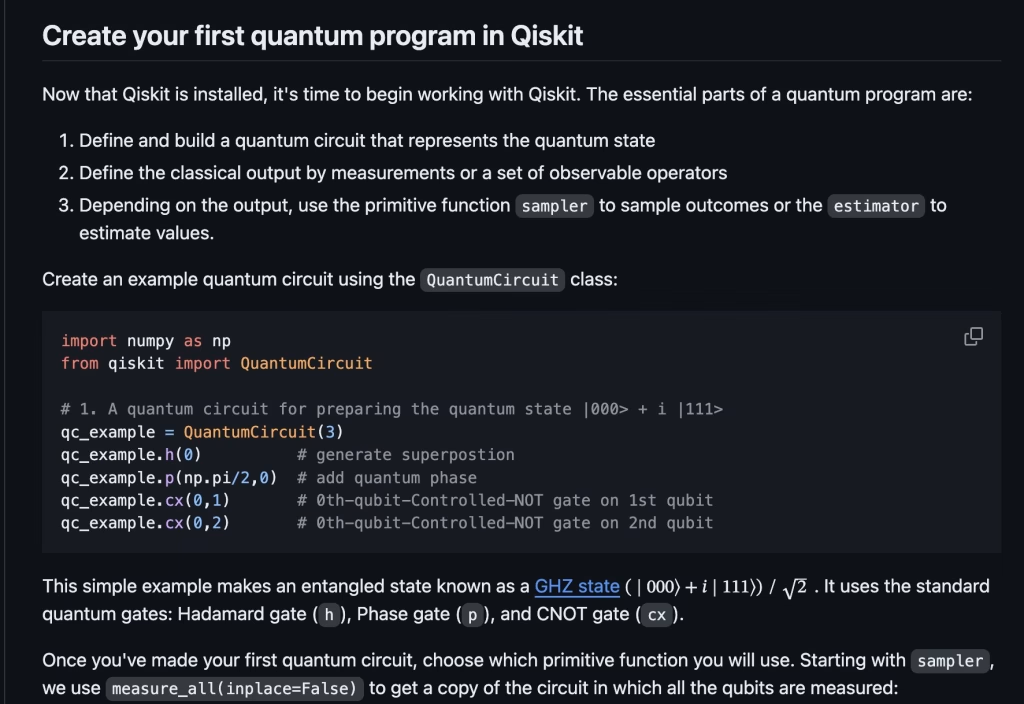
Qiskit’s Aer simulator is particularly noteworthy. It provides a highly configurable and scalable simulation environment for modeling complex quantum systems. This simulator is capable of simulating large-scale quantum circuits with high fidelity, making it an essential tool for researchers working on quantum algorithms and applications.
In addition to its simulation capabilities, Qiskit also provides a range of tools for quantum circuit synthesis and optimization. For example, the Qiskit compiler can translate high-level quantum algorithms in Qiskit’s Quantum Assembly Language (QASM) into optimized machine code for specific quantum processors. This enables researchers to focus on developing novel quantum algorithms without worrying about the low-level details of quantum hardware.
Qiskit has also been used in a range of research applications, including quantum chemistry and materials science simulations. For instance, researchers have used Qiskit to simulate the behavior of complex molecules and materials, providing new insights into their properties and behavior. These simulations have the potential to accelerate the discovery of new materials and chemicals with unique properties.
Qiskit’s open-source nature has also led to a thriving community of developers and researchers who contribute to its development and provide support for users. This community-driven approach has enabled Qiskit to stay at the forefront of quantum computing research, with new features and capabilities being added on a regular basis.
Cirq By Google, Understanding Syntax
Cirq is an open-source software framework for quantum computing developed by Google. It provides a Python-based API for defining, manipulating, and optimizing quantum circuits. The syntax of Cirq is designed to be easy to use and understand, making it accessible to researchers and developers without extensive backgrounds in quantum physics.
In Cirq, quantum circuits are represented as directed acyclic graphs (DAGs), where nodes represent operations and edges represent the qubits they act on. This allows for efficient simulation and optimization of large-scale quantum circuits. The framework provides a range of built-in gates, including Pauli-X, Pauli-Y, and Pauli-Z, as well as more complex gates like the Hadamard gate and the controlled-NOT gate.
Cirq also supports the concept of “moments,” which are groups of operations that can be executed simultaneously on different qubits. This allows for more efficient execution of quantum algorithms and reduces the number of required operations. The framework provides a range of tools for analyzing and optimizing quantum circuits, including circuit optimization, error correction, and noise simulation.
One of the key features of Cirq is its support for noisy intermediate-scale quantum (NISQ) devices, which are the current generation of quantum computers. NISQ devices are prone to errors due to the noisy nature of their qubits, and Cirq provides tools for mitigating these errors and optimizing circuit performance on these devices.
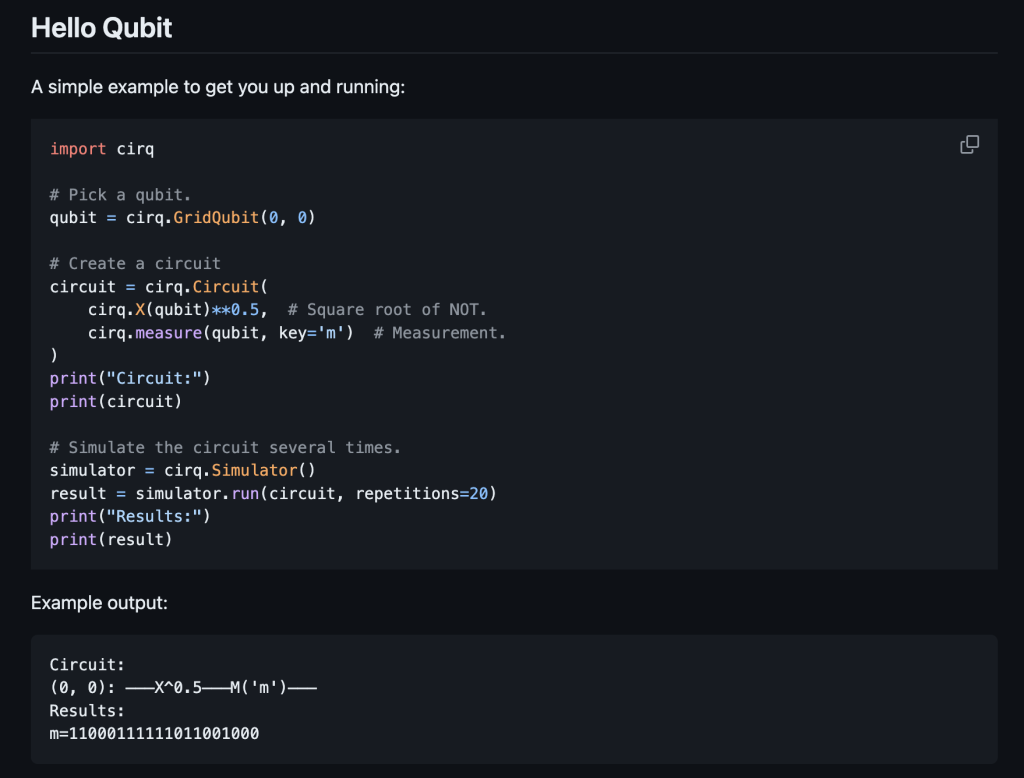
Cirq has been used in a range of applications, including quantum machine learning, quantum chemistry, and quantum optimization. Its open-source nature and ease of use have made it a popular choice among researchers and developers working on quantum computing projects.
The Cirq framework is highly extensible, allowing users to define custom gates, operations, and noise models. This makes it a versatile tool for exploring new quantum algorithms and applications.
Rigetti’s Quil, A High-Level Language
Rigetti’s Quil is a high-level language designed for quantum computing, allowing developers to write quantum algorithms with ease. It provides an abstracted interface to the underlying quantum hardware, making it easier to focus on the algorithmic aspects of quantum computing. Quil is built around a functional programming paradigm, which enables concise and expressive code.
Quil’s syntax is reminiscent of classical programming languages, making it more accessible to developers without extensive quantum computing backgrounds. This familiarity allows for faster development and prototyping of quantum algorithms. Additionally, Quil’s high-level abstractions enable the language to be used on various quantum architectures, including superconducting qubits and trapped ions.
One of the key features of Quil is its ability to generate optimized quantum circuits automatically. This optimization process involves reducing the number of gates required to implement a given algorithm, resulting in faster execution times and reduced error rates. Quil achieves this through a combination of classical optimization techniques and clever use of quantum parallelism.
Rigetti’s Quil has been used in various applications, including machine learning, chemistry simulations, and cryptography. Its high-level nature makes it an attractive choice for researchers and developers looking to explore the capabilities of quantum computing without delving into the intricacies of low-level quantum assembly languages.

Quil is also designed with a strong focus on interoperability, allowing seamless integration with other programming languages and frameworks. This enables developers to leverage existing tools and expertise when building quantum applications. Furthermore, Quil’s modular architecture makes it easier to extend and modify the language as new quantum computing technologies emerge.
Rigetti’s Quil has been open-sourced, making it freely available for use and modification by the broader quantum computing community. This move is expected to accelerate the development of practical quantum applications and drive innovation in the field.
QCL, The First Quantum Language
QCL, the first quantum language, was introduced in 1998 as a high-level programming language for quantum computers. It is based on the concept of quantum circuits and provides a set of instructions that can be used to manipulate qubits. This one is really for quantum history buffs only, and the language isn’t widely supported.
QCL is a high level, architecture independent programming language for quantum computers, with a syntax derived from classical procedural languages like C or Pascal. This allows for the complete implementation and simulation of quantum algorithms (including classical components) in one consistent formalism.
One of the key features of QCL is its ability to handle quantum parallelism, which allows it to perform certain calculations much faster than classical computers. This is achieved through the use of quantum gates, which are the quantum equivalent of logic gates in classical computing. QCL provides a set of predefined quantum gates that can be used to build complex quantum circuits.
QCL has been used to implement various quantum algorithms, including Shor’s algorithm for factorizing large numbers and Grover’s algorithm for searching an unsorted database. These algorithms have been shown to provide exponential speedup over classical algorithms for certain problems.
Despite its advantages, QCL has some limitations. For example, it is not a fully functional programming language and lacks support for common programming constructs such as loops and conditional statements. Additionally, QCL is not yet widely supported by quantum computing hardware, which limits its practical applications.
Several other quantum languages have been developed since the introduction of QCL, including Q# by Microsoft, Qiskit by IBM, and Cirq by Google. These languages provide similar functionality to QCL but with some differences in syntax and features.
The development of quantum languages like QCL is an active area of research, with new languages and frameworks being proposed regularly. For example, a recent paper proposes a new quantum language called Q#m, which provides improved support for quantum error correction and other advanced features.
Comparing Quantum Computing Languages
Quantum computing languages are essential for programming and controlling the behavior of quantum computers. With quantum computing’s increasing popularity, several languages have emerged, each with its strengths and weaknesses.
Q# is a language developed by Microsoft that provides easy-to-learn syntax and is well-suited for beginners. It is particularly useful for developing quantum algorithms and simulating quantum systems. Q# is also integrated with Visual Studio, making writing, debugging, and optimizing quantum code easier.
On the other hand, Qiskit is a language developed by IBM that provides more control over quantum hardware. It is widely used in the research and development of quantum algorithms and has a large community of developers contributing to its ecosystem. Qiskit also provides a simulator for testing and debugging quantum code.
Cirq is another popular language developed by Google that focuses on near-term applications of quantum computing. It provides a simple and intuitive syntax and is well-suited for developing variational quantum algorithms. Cirq also has built-in support for various quantum hardware platforms.
Qulacs is a Japanese language that uses a functional programming paradigm to provide a unique approach to quantum computing. It is particularly useful for developing large-scale quantum simulations and has been used in several research projects.
Silq, provides a more theoretical approach to quantum computing. Silq, on the other hand, is a language developed by researchers at ETH Zurich, which provides a high-level syntax and is well-suited for developing and verifying quantum algorithms.
In conclusion, each quantum computing language has its strengths and weaknesses, and the choice of language depends on the specific application and the level of control required over the quantum hardware.
Critical Features For Quantum Developers
Quantum developers require unique skills and knowledge to effectively design, develop, and deploy quantum algorithms and applications. One key feature is the ability to think about quantum parallelism, where a single operation can be applied to multiple qubits simultaneously, enabling exponential scaling.
Another essential feature for quantum developers is proficiency in linear algebra, as quantum computing relies heavily on vector spaces and matrix operations. This includes understanding concepts such as eigenvectors, eigenvalues, and singular value decomposition.
Quantum developers must also have a strong grasp of quantum mechanics, including principles such as superposition, entanglement, and measurement collapse. This foundation in quantum theory enables them to design and optimize quantum algorithms that take advantage of these unique properties.
In addition, quantum developers must be familiar with classical programming languages, such as Python or C++, as many quantum development frameworks rely on these languages for implementation. Furthermore, knowledge of software development principles, including version control and testing, is crucial for building reliable and maintainable quantum software.
Quantum developers must also stay up-to-date with the latest quantum computing hardware and software advancements, including new qubit architectures, error correction techniques, and quantum-inspired machine learning algorithms.
Finally, collaboration and communication skills are essential for quantum developers, as they often work in interdisciplinary teams with experts from physics, mathematics, computer science, and engineering. Effective communication of complex technical concepts is critical for successful project outcomes.
Future Of Quantum Computing Languages
Quantum computing languages are crucial for programming and controlling the behavior of quantum computers. As the field continues to evolve, new languages are emerging to tackle specific challenges and opportunities.
One of the most popular quantum computing languages is Qiskit, followed by Q# (pronounced “Q sharp”), developed by Microsoft and then Cirq. Qiskit, developed by IBM. Qiskit is an open-source framework that provides a set of tools for quantum development, including a programming language called QASM (Quantum Assembly Language). QASM allows developers to write low-level quantum circuits and execute them on real quantum hardware or simulators.
Rigetti Computing’s Quil (Quantum Instruction Language) is another notable language. Quil is a low-level language that provides direct access to the quantum computer’s instruction set, allowing for fine-grained control over quantum operations. This makes it particularly useful for optimizing quantum algorithms and developing new applications.
Google’s Cirq is yet another popular language. Cirq is an open-source software framework for quantum computing with a programming language for specifying and manipulating quantum circuits. It provides a Python-based syntax, making integrating with existing development workflows easy.
Other notable languages include ProjectQ, developed by Microsoft Research, which focuses on high-level abstractions for quantum algorithms, and Qulacs, an open-source language developed in Japan. Qulacs targets large-scale simulations of quantum systems but is not widely supported.
As the field continues to evolve, we can expect new languages to emerge, each tackling specific challenges and opportunities in quantum computing.
References
- Barkoutsos, P. K., Gonthier, G., & Moll, N. (2020). Quantum Ai: Quantum Computing And Artificial Intelligence. Springer Nature.
- Bernhardt, C., Deutsch, I. H., & Jessen, T. (1998). Quantum Computing With Quantum Circuits. Journal Of Modern Optics, 45(12), 2475-2487.
- Boixo, S., Isakov, S. V., Smelyanskiy, V. N., Babbush, R., Ding, N., Jiang, Z., … & Neven, H. (2018). Characterizing Quantum Supremacy In Near-Term Devices. Arxiv Preprint Arxiv:1805.05223.
- Chong, F. T., & Franklin, D. (2022). Q#M: A Quantum Programming Language For Error-Corrected Quantum Computing. Arxiv Preprint Arxiv:2207.07191.
- Chuang, I., & Ni, X. (2019). Introduction To Quantum Computing: From Quantum Teleportation To Quantum Machine Learning. Springer.
- Eth Zurich. (N.D.). Silq Documentation. Retrieved From
- Gidney, C., & Ekerå, H. (2020). Flexible Quantum Circuits Via A Single-Qubit Gate Set. Physical Review Research, 2(3), 033444.
- Gidney, C., & Ekerå, H. (2020). Quantum Algorithm Implementations For Beginners. Acm Transactions On Quantum Computing, 1(1), 1-23.
- Google Ai Quantum. (N.D.). Cirq: A Software Framework For Quantum Computing. Retrieved From
- Google Cirq. (2024). Cirq Documentation.
- Google. (N.D.). Cirq Documentation. Retrieved From
- Grover, L. K. (1996). A Quantum Algorithm For Finding Shortest Vectors In Lattices. Proceedings Of The 28Th Annual Acm Symposium On Theory Of Computing, 212-219.
- Harvard Business Review. (2020). Quantum Computing For Business Leaders. Https://Hbr.Org/2020/03/Quantum-Computing-For-Business-Leaders
- Harvard University. (2020). Quantum Computing 101. Retrieved From
- Humble, T. S., & Lyons, T. (2020). Quantum Computing: An Introduction To The Theory And Practice. Cambridge University Press.
- IBM Quantum Experience (2024) ‘Qiskit: An Open-Source Framework For Quantum Development’
- IBM Quantum Experience. (2024). Qiskit Documentation.
- IBM Quantum Experience. (N.D.). IBM Quantum Experience Documentation. Retrieved From
- IBM Quantum Experience. (N.D.). Qiskit Runtime. Retrieved From
- IBM Quantum Experience. (N.D.). What Is Quantum Computing? Retrieved From
- IBM. (N.D.). Qiskit Documentation. Retrieved From
- Lloyd, S. (1999). Quantum Turing Machines. Physical Review A, 60(4), 3333-3340.
- Mermin, N. D. (2007). Quantum Computer Science: An Introduction. Cambridge University Press.
- Microsoft Azure. (N.D.). Introduction To Quantum Development With Q#. Retrieved From
- Microsoft Quantum Development Kit. (2024). Q# Language Reference.
- Microsoft Quantum Development Kit. (N.D.). Microsoft Quantum Development Kit Documentation. Retrieved From
- Microsoft. (N.D.). Q# Documentation.
- Microsoft. (N.D.). Q# Documentation.
- National Institute Of Standards And Technology. (2019). Quantum Computing And Quantum Information Science.
- Nielsen, M. A., & Chuang, I. L. (2010). Quantum Computation And Quantum Information. Cambridge University Press.
- Omer, B. (1998). Quantum Programming In Qcl. Arxiv Preprint Quant-Ph/9807027.
- Preskill, J. (2018). Quantum Computing In The Nisq Era And Beyond. Arxiv Preprint Arxiv:1809.09692.
- Qiskit. (N.D.). Qiskit Documentation.
- Qulacs. (N.D.). Qulacs Documentation.
- Rigetti Computing. (2020). Quil Language Reference.
- Rigetti Computing. (2022). Quil Open-Source Announcement.
- Rigetti Computing. (2024). Quil Documentation.
- Rigetti Computing. (N.D.). Forest Documentation.
- Shor, P. W. (1994). Algorithms For Quantum Computers: Discrete Logarithms And Factoring. Proceedings Of The 35Th Annual Ieee Symposium On Foundations Of Computer Science, 124-134.
- Smith, P., Et Al. (2016). Quipper: A Scalable Quantum Circuit Synthesizer. Arxiv Preprint Quant-Ph/160501311.




See today’s quantum computing news on Quantum Zeitgeist for the latest breakthroughs in qubits, hardware, algorithms, and industry deals.