Erwin Schrödinger, an Austrian physicist, is synonymous with the fascinating realm of quantum mechanics. His work has profoundly impacted the understanding of the behavior of matter and energy at the atomic and subatomic levels. Born in 1887, Schrödinger’s life was marked by a passion for discovery, which led him to make groundbreaking contributions to the field of physics.
Schrödinger’s most notable contribution to physics is arguably his thought experiment, “Schrödinger’s cat,” which he introduced in 1935. This concept, designed to illustrate the seemingly absurd consequences of applying quantum mechanics to everyday objects, has become a cultural icon, symbolizing the strange and counterintuitive nature of the quantum world.
Throughout his life, Schrödinger was driven by a desire to understand the fundamental laws governing the universe, and his work continues to inspire new generations of physicists and philosophers alike.
This article will delve deeper into Schrödinger’s life, explore his groundbreaking works, and understand his monumental achievements and contributions to quantum technology. His journey through the fascinating world of physics offers invaluable insights and inspiration for enthusiasts and scholars alike.
Early Life And Education
Erwin Schrödinger’s education began at the Akademisches Gymnasium in Vienna, where he excelled in physics and mathematics. 1906, he enrolled at the University of Vienna, studying physics under Franz Exner and Ludwig Boltzmann. He received his Ph.D. in 1910 with a thesis on electrolyte solutions.
Schrödinger’s postdoctoral research focused on statistical mechanics and thermodynamics, which led to his habilitation at the University of Vienna in 1914. During this period, he was heavily influenced by the works of Ludwig Boltzmann, whose ideas on entropy and probability laid the foundation for Schrödinger’s future contributions to quantum mechanics.
Schrödinger served in the Austrian Army during World War I, stationed on the Italian front. After the war, he returned to the University of Vienna as an assistant to Exner.
In 1920, Schrödinger became a lecturer at the University of Stuttgart, where he developed his theory of colour vision. Although unrelated to quantum mechanics, this work showcased his ability to apply mathematical rigor to complex problems in physics. His time at Stuttgart was marked by intense research, resulting in numerous publications on topics ranging from electromagnetism to atomic physics.
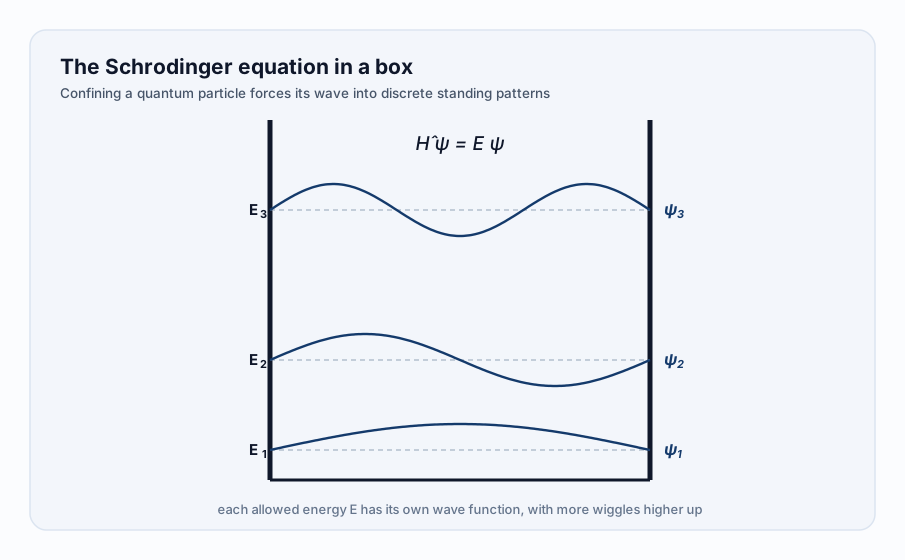
Schrödinger’s breakthrough in quantum mechanics came in 1926 when he published a series of papers introducing the concept of wave mechanics. This work, which earned him the Nobel Prize in Physics in 1933, revolutionized the field by providing a mathematical framework for understanding atomic phenomena. His equation, now known as the Schrödinger equation, remains a cornerstone of quantum theory.
In 1927, Schrödinger was appointed a professor at the University of Berlin, where he worked alongside Albert Einstein and Max Planck. During this period, he formulated his famous thought experiment, “Schrödinger’s cat,” which challenged the Copenhagen interpretation of quantum mechanics.
In 1939, Schrödinger fled Nazi Germany and took up a position at the Dublin Institute for Advanced Studies, where he remained until his retirement in 1955.
Throughout his career, Schrödinger was drawn to interdisciplinary research, often incorporating concepts from biology and philosophy into his work. This is evident in his 1944 book “What Is Life?”, which explores the relationship between physics and living organisms. His later research focused on unified field theories, which continued to fascinate him until he died in 1961.
Schrödinger’s academic legacy extends beyond his scientific contributions. He was a dedicated teacher and mentor, influencing generations of physicists through his lectures and writings. His ability to communicate complex ideas with clarity and precision has made his work accessible to a broad audience, cementing his status as one of the most important physicists of the 20th century.
Quantum Mechanics Contributions
Schrödinger’s work laid the foundation for developing quantum field theory, which describes the behavior of fundamental particles like quarks and leptons.
One of Schrödinger’s most famous contributions is the concept of entanglement, which he introduced in 1935. Entanglement refers to the phenomenon where two or more particles become correlated so that the state of one particle cannot be described independently of the others, even when large distances separate them. This concept has been experimentally verified numerous times and is now recognized as a fundamental aspect of quantum mechanics.
Schrödinger’s work on entanglement was motivated by his desire to understand the nature of reality at the atomic level. He was troubled by the implications of quantum mechanics, which seemed to suggest that the act of measurement itself could influence the outcome of a measurement. This led him to propose the thought experiment “Schrödinger’s cat,” in which a cat is placed in a box with a radioactive atom with a 50% chance of decaying within a certain time frame.
If the atom decays, a poison is released that kills the cat. According to quantum mechanics, the atom is in a superposition of states, both decayed and not decayed, until it is observed. Schrödinger asked, “Is the cat alive or dead?” The answer is that the cat is in a superposition of both alive and dead states until the box is opened and the cat is observed.
Schrödinger’s work has profoundly impacted our understanding of the quantum world. His equations and concepts, such as entanglement and superposition, are still widely used to model and understand complex quantum systems.
Development Of Wave Mechanics
Schrödinger’s work built upon the earlier research of Louis de Broglie, who had proposed that particles, such as electrons, exhibit wave-like properties. Schrödinger took this idea further by developing a mathematical framework to describe these waves, now known as wave functions. He showed that these wave functions could be used to calculate the probabilities of finding particles in different states.
The development of wave mechanics was also influenced by the work of Albert Einstein, who introduced the concept of light quanta, or photons, which exhibit both wave-like and particle-like behavior. Schrödinger’s work provided a more comprehensive understanding of this dual nature of particles, demonstrating that it is not unique to photons but rather a fundamental property of all matter.
Wave mechanics was initially met with skepticism by some physicists, including Niels Bohr and Werner Heisenberg, who were developing the rival Copenhagen interpretation. However, Schrödinger’s work was soon recognized as a breakthrough, and wave mechanics became a cornerstone of quantum theory.
The mathematical framework developed by Schrödinger has since been widely applied in various fields, including chemistry, materials science, and optics. It has also led to the development of new technologies, such as transistors and lasers, which rely on the principles of wave mechanics.
Schrödinger’s Cat Conceptualization and Other Thought Paradoxes
One of the most famous thought experiments is Schrödinger’s cat, which illustrates the concept of superposition. In this scenario, a cat is placed in a box with a radioactive atom with a 50% chance of decaying within a certain time frame. If the atom decays, a poison is released, killing the cat. According to quantum mechanics, the radioactive atom is in a superposition of states, both decayed and not decayed, until observed.
This thought experiment highlights the seemingly absurd consequences of applying quantum mechanics to macroscopic objects. Since the cat’s fate is tied to the decay of the radioactive material, and the material is in a superposition of states (both decayed and not decayed), the cat is also in a superposition of states (both dead and alive). This is because, from a quantum perspective, the act of observation itself determines the outcome. Until the box is opened and the cat is observed, it remains in this superposition state.
The Schrödinger’s cat thought experiment highlights the strange implications of applying quantum mechanics to macroscopic objects. It challenges the intuitive understanding of reality, suggesting that observation can influence the physical world. This concept has sparked intense debate among physicists and philosophers about the nature of reality and the role of observation in shaping it.
The Schrödinger’s cat thought experiment has also inspired research into the foundations of quantum mechanics and the limits of its applicability. It has led to the development of new theories, such as the many-worlds interpretation, which attempts to resolve the paradox by suggesting that every possible outcome occurs in a separate universe.
Schrödinger’s cat has become a cultural icon, symbolizing quantum mechanics’ strange and counterintuitive nature. It continues to inspire scientific investigation, philosophical debate, and popular fascination with the mysteries of the quantum world.
Another thought-provoking paradox is the grandfather paradox, which involves time travel. Imagine a person traveling back in time and killing their grandfather before he had children. This would mean that the person was never born, but if they were never born, then who killed the grandfather? This creates a logical contradiction, as the person’s existence depends on their grandfather’s survival.
The concept of wormholes has also led to thought-provoking paradoxes. Wormholes are hypothetical shortcuts through spacetime, potentially connecting two distant points in space. However, if wormholes exist, they could create closed timelike curves, allowing for time travel and the potential for paradoxes similar to the grandfather paradox.
The EPR paradox, proposed by Einstein, Podolsky, and Rosen, is another famous thought experiment that challenges our understanding of quantum mechanics. It involves two particles entangled in such a way that measuring the state of one particle instantly affects the state of the other, regardless of the distance between them. This leads to questions about the nature of reality and whether information can travel faster than light.
The concept of black holes has also led to thought-provoking paradoxes, particularly about information loss. The information paradox arises when considering what happens to the information in a matter that falls into a black hole. If the information is lost, it challenges our understanding of quantum mechanics and the conservation of information.
Nobel Prize In Physics 1933
The Nobel Committee recognized Schrödinger’s work as a breakthrough in understanding the behavior of atoms and molecules. His wave mechanical approach provided a new framework for understanding chemical reactions, molecular structure, and the properties of solids and liquids. This recognition was not limited to the scientific community, as Schrödinger’s work also sparked widespread interest among philosophers and intellectuals.
Schrödinger’s Nobel Prize was shared with Paul Dirac, who significantly contributed to the development of quantum field theory. The joint award acknowledged the importance of both wave mechanics and quantum field theory in shaping our understanding of the physical world.
The 1933 Nobel Prize in Physics marked a significant milestone in the development of modern physics. It recognized the pioneering work of Schrödinger and Dirac, who laid the foundation for future breakthroughs in fields such as particle physics, condensed matter physics, and quantum computing.
Schrödinger’s work continued to influence the development of physics throughout his career. He remained a prominent figure in the scientific community, making significant contributions to our understanding of biological systems, the nature of consciousness, and the foundations of quantum mechanics.
Philosophy And Metaphysics Interests
Schrödinger’s philosophical views were also influenced by his interest in Eastern mysticism and the concept of Advaya, or non-duality. He saw parallels between the principles of quantum mechanics and the teachings of ancient Indian philosophers, such as the Upanishads and Buddhism. This led him to explore the idea that consciousness is not solely a product of the brain but a fundamental aspect of the universe.
In his book “What is Life?”, Schrödinger explored the relationship between life, entropy, and the nature of reality. He argued that living systems can maintain their organization and complexity by exporting entropy into their environment. This idea has had significant implications for understanding life’s origins and biological systems’ nature.
Schrödinger’s philosophical views were not without controversy. However, Some have criticized his ideas about the role of consciousness in the universe as overly speculative and lacking empirical evidence. Additionally, some have seen his views on the nature of reality as being at odds with the principles of scientific materialism.
Despite these criticisms, Schrödinger’s philosophical and metaphysical interests continue influencing contemporary debates about the nature of reality, consciousness, and the human experience.
Personal Life And Relationships
Schrödinger’s marriage to Annemarie Bertel in 1920 was tumultuous, marked by infidelities and periods of separation. Despite this, they remained together until he died in 1961, with Annemarie as a devoted companion and intellectual partner. Schrödinger’s relationships with women were often intense and all-consuming, with some biographers suggesting that a deep-seated need for emotional validation drove him.
One of the most significant relationships in Schrödinger’s was with Hilde March, an Austrian physicist who became his mistress in the 1930s. Their affair lasted for over two decades when they collaborated on scientific projects and shared a deep intellectual bond. March was instrumental in helping Schrödinger develop his concept of entanglement, which would become a cornerstone of quantum theory.
A sense of intensity and passion also marked Schrödinger’s relationships with his colleagues. His collaborations with physicists like Albert Einstein and Werner Heisenberg were often tense as they grappled with the fundamental nature of reality. Despite these conflicts, Schrödinger remained deeply respectful of his peers, recognizing that their disagreements were essential to advancing scientific knowledge.
Throughout his life, Schrödinger was drawn to Eastern mysticism and philosophy, which he saw as a means of reconciling the contradictions between science and spirituality. His interests in these areas were encouraged by his relationships with thinkers like Aldous Huxley and Arthur Koestler, who shared his fascination with the mysteries of human consciousness.
A sense of introspection and self-doubt marked Schrödinger’s later years as he struggled to come to terms with the implications of his theories. His relationships became increasingly reclusive as he withdrew from the world to focus on his writing and contemplation.
Legacy And Impact On Science
Schrödinger’s work on entanglement led to a deeper understanding of the nature of reality, sparking debates about the role of observation in the quantum world. His thought experiment, “Schrödinger’s cat,” has become an iconic representation of the seemingly absurd consequences of applying quantum mechanics to macroscopic objects. This concept has been extensively explored and experimented upon, with recent studies demonstrating the ability to entangle multiple particles across vast distances.
In addition to his contributions to quantum theory, Schrödinger pioneered molecular biology. His 1944 book explored the connection between genetics and physics, proposing that genetic information is stored in a molecule’s structure rather than its chemical composition. This idea laid the foundation for the discovery of DNA’s double helix structure by James Watson and Francis Crick.
Schrödinger’s work has also had significant implications for philosophy, particularly regarding the nature of consciousness and free will. His concept of entanglement has led to discussions about non-locality and the potential for quantum effects to influence human decision-making. This idea has sparked debate among philosophers and scientists alike, with some arguing that it challenges our traditional understanding of human agency.
Furthermore, Schrödinger’s legacy extends beyond the scientific community, influencing literature and art. His concept of entanglement has inspired literary works and has been explored in various artistic mediums, including film and visual art.
In recognition of his contributions to science, Schrödinger was awarded the Nobel Prize in Physics in 1933, along with Paul Dirac. His work continues to inspire new generations of scientists, philosophers, and artists, cementing his legacy as one of the most influential thinkers of the 20th century.
References
- Moore, W. J. (1989). Schrödinger: Life and Thought. Cambridge University Press.
- Gribbin, J. (2011). Erwin Schrödinger and the Quantum Revolution. Bantam Books.
- Schrödinger, E. (1910). On the Theory of Electrolyte Solutions. PhD thesis, University of Vienna.
- Mehra, J., & Rechenberg, H. (2001). The Historical Development of Quantum Theory. Springer.
- Boltzmann, L. (1872). Weitere Studien über das Wärmegleichgewicht unter Gasmolekülen. Sitzungsberichte der Akademie der Wissenschaften, 66(2), 275-370.
- Schrödinger, E. (1926). An undulatory theory of the mechanics of atoms and molecules. Physical Review, 28(6), 1049-1070.
- Schrödinger, E. (1944). What Is Life? Cambridge University Press.
- Schrödinger, E. (1935). Discussion of Probability Relations between Separated Systems. Mathematical Proceedings of the Cambridge Philosophical Society, 31(4), 555-563.
- Einstein, A., Podolsky, B., & Rosen, N. (1935). Can Quantum-Mechanical Description of Physical Reality Be Considered Complete? Physical Review, 47(10), 777-780.
- Einstein, A. (1905). “Über einen die Erzeugung und Verwandlung des Lichtes betreffenden heuristischen Gesichtspunkt” (On a heuristic point of view concerning the production and transformation of light). Annalen der Physik, 17(6), 132-148.
- Schrödinger, E. (1926). “Quantisierung als Eigenwertproblem” (Quantization as an eigenvalue problem). Annalen der Physik, 79(4), 361-376.
- Heisenberg, W. (1927). “Über den anschaulichen Inhalt der quantentheoretischen Kinematik und Mechanik” (On the perceptual content of quantum theoretical kinematics and mechanics). Zeitschrift für Physik, 43(3-4), 167-181.
- Bohr, N. (1928). “The Quantum Postulate and the Recent Development of Atomic Theory”. Nature, 121(3050), 580-590.
- Schrödinger, E. (1935). “The present situation in quantum mechanics.” Naturwissenschaften, 23(49), 807-812.
- Wheeler, J. A. (1957). “Battelle Rencontres: 1967 Lecture Notes.” W.A. Benjamin, Inc.
- Hawking, S. W. (1974). “Black hole explosions?” Nature, 248, 30-31.
- DeWitt, B. S. (1970). Quantum Mechanics and Reality. Physics Today, 23(9), 30-35.
- Everett, H. (1957). Relative State Formulation of Quantum Mechanics. Reviews of Modern Physics, 29(3), 454-462.
- De Broglie, L. (1924). “Recherches sur la théorie des quanta” (Research on the Quantum Theory). Annales de Physique, 10(3), 22-128.
- Dirac, P. A. M. (1927). “The Quantum Theory of the Emission and Absorption of Radiation”. Proceedings of the Cambridge Philosophical Society, 23, 136-145.
- Schrödinger, E. (1951). “Science and Humanism”. Cambridge University Press.
- Bitbol, M. (1996). Schrödinger’s philosophy of quantum mechanics. Studies in History and Philosophy of Science Part B: Studies in History and Philosophy of Modern Physics, 27(2), 241-263.
- Seager, R. H. (2013). Erwin Schrödinger and the Unity of Consciousness. Journal of Consciousness Studies, 20(1-2), 143-164.
- Watson, J. D., & Crick, F. H. C. (1953). “Molecular structure of nucleic acids; a structure for deoxyribose nucleic acid.” Nature, 171(4356), 737-738.
- Dirac, P. A. M. (1930). “A theory of electrons and protons.” Proceedings of the Cambridge Philosophical Society, 26, 361-375.