Researchers from TotalEnergies Tour Coupole, Université Paris-Saclay CNRS Laboratoire de Physique des Solides, Eviden Quantum Laboratory, and National Physical Laboratory have made a groundbreaking breakthrough in quantum simulation by combining Matrix Product States (MPS) with noisy quantum computers.
They efficiently simulated short-time dynamics of correlated many-body states using MPSs compiled into short-depth quantum circuits. This hybrid approach addresses noise challenges associated with noisy intermediate-scale quantum devices, enabling the efficient simulation of complex systems on these devices. The breakthrough has significant implications for quantum simulation and potential applications in condensed matter physics, chemistry, and materials science.
Can Quantum Computers Really Simulate Complex Systems?
The quest for harnessing the power of quantum computers has led researchers to explore innovative ways to simulate complex systems. In this article, scientists from TotalEnergies Tour Coupole, Université ParisSaclay CNRS Laboratoire de Physique des Solides, Eviden Quantum Laboratory, and National Physical Laboratory have combined Matrix Product States (MPS) with noisy quantum computers to achieve a groundbreaking breakthrough in quantum simulation.
Efficiently Simulating Short-Time Dynamics
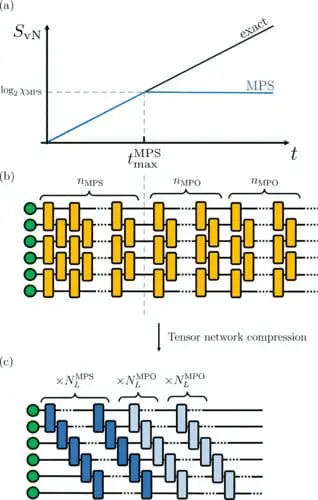
The researchers employed MPSs, which have been proven to be a powerful tool for studying quantum many-body systems. However, these states are restricted to moderately entangled states as the number of parameters scales exponentially with the entanglement entropy. To overcome this limitation, they used MPSs compiled into short-depth quantum circuits to efficiently perform the time evolution of correlated many-body states.
Harnessing Quantum Computers
On the other hand, quantum devices appear as a natural platform to encode and perform the time evolution of correlated many-body states. However, accessing the regime of longtime dynamics is hampered by quantum noise. To address this challenge, the researchers used efficient MPO-optimized quantum circuits to further simulate the dynamics on a quantum computer.
Quantifying Fidelities
The team quantified the capacities of their hybrid classical-quantum scheme in terms of fidelities, taking into account a noise model. They demonstrated that using classical knowledge in the form of tensor networks provides a way to better use limited quantum resources and lowers drastically the noise requirements to reach a practical quantum advantage.
Experimental Realization
The researchers successfully demonstrated their approach with an experimental realization of the technique combined with efficient circuit transpilation. They simulated a 10-qubit system on an actual quantum device over a longer time scale than low-bond dimension MPSs and purely quantum Trotter evolution.
How Does This Breakthrough Impact Quantum Simulation?
This breakthrough has significant implications for quantum simulation, as it enables the efficient simulation of complex systems on noisy intermediate-scale quantum (NISQ) devices. The combination of MPSs and MPO-optimized quantum circuits provides a powerful tool for simulating the dynamics of correlated many-body states.
The researchers’ approach addresses the noise challenges associated with NISQ devices, which are critical for achieving a practical quantum advantage. By using classical knowledge in the form of tensor networks, they were able to reduce the noise requirements and improve the fidelity of their simulations.
This breakthrough has potential applications in various fields, including condensed matter physics, chemistry, and materials science. The ability to efficiently simulate complex systems on NISQ devices could lead to significant advances in our understanding of quantum many-body systems and potentially even lead to new discoveries.
As researchers continue to push the boundaries of what is possible with quantum simulation, this breakthrough serves as a testament to the power of combining classical and quantum approaches. The future of quantum simulation holds much promise, and it will be exciting to see how this technology continues to evolve and impact various fields.
Publication Date: 2024-06-27
Authors: Baptiste Anselme Martin, Thomas Ayral, François Jamet, Marko J. Rančić, et al.
Source: Physical review. A/Physical review, A
DOI: https://doi.org/10.1103/physreva.109.062437
See today’s quantum computing news on Quantum Zeitgeist for the latest breakthroughs in qubits, hardware, algorithms, and industry deals.