Intel has made significant strides in quantum computing with its new Quantum Chip, according to a research paper published in Nature. The paper, titled “Probing single electrons across 300-mm spin qubit wafers,” demonstrates advanced uniformity, fidelity, and measurement statistics of spin qubits. This research could pave the way for mass production of silicon-based quantum processors, a crucial step towards building a fault-tolerant quantum computer. Intel researchers used a 300-millimeter cryogenic probing process and complementary metal oxide semiconductor (CMOS) manufacturing techniques. The spin qubits achieved 99.9% gate fidelity, the highest reported for qubits made with all-CMOS-industry manufacturing.
Intel’s Progress in Silicon-Based Quantum Processors
In a recent publication in Nature, Intel researchers presented their advancements in the development of silicon-based quantum processors or their quantum chip. The paper, “Probing single electrons across 300-mm spin qubit wafers,” demonstrated high uniformity, fidelity, and measurement statistics of spin qubits. This research is a significant step towards the mass production and scaling of silicon-based quantum processors, which are essential for building a fault-tolerant quantum computer.
Intel’s quantum hardware researchers developed a 300-millimeter cryogenic probing process to collect extensive data on the performance of spin qubit devices across whole wafers. This process utilized complementary metal oxide semiconductor (CMOS) manufacturing techniques to produce the quantum chip. The improvements in qubit device yield, combined with the high-throughput testing process, allowed researchers to gather significantly more data to analyze uniformity. This is a crucial step needed to scale up quantum computers.
High Fidelity and Uniformity in Spin Qubits
The researchers found that single-electron devices from these wafers performed well when operated as spin qubits, achieving 99.9% gate fidelity. This fidelity is the highest reported for qubits made with all-CMOS-industry manufacturing. The small size of spin qubits, measuring about 100 nanometers across, makes them denser than other qubit types, such as superconducting qubits. This density enables the construction of more complex quantum computers on a single chip of the same size.
The fabrication approach was conducted using extreme ultraviolet (EUV) lithography, which allowed Intel to achieve these tight dimensions while also manufacturing in high volume. This is a significant achievement as realizing fault-tolerant quantum computers with millions of uniform qubits will require highly reliable fabrication processes.
Intel’s legacy in transistor manufacturing expertise is proving beneficial in the creation of silicon spin qubits. The company is leveraging its cutting-edge 300-millimeter CMOS manufacturing techniques, which routinely produce billions of transistors per chip, to create silicon spin qubits similar to transistors.
Building on these findings, Intel plans to continue to make advances in using these techniques to add more interconnect layers to fabricate 2D arrays with increased qubit count and connectivity. They also aim to demonstrate high-fidelity two-qubit gates on its industry manufacturing process. However, the main priority will continue to be scaling quantum devices and improving performance with its next-generation quantum chip.

Intel, The Chip Giants segways into making a Quantum Chip
Intel’s journey into quantum computing began around 2006 when they established the Quantum Systems and Technology group within Intel Labs. Initially, they focused on exploring qubits’ fundamental physics and developing the hardware and software infrastructure for quantum computing. In 2015, Intel announced a $50 million investment over the next ten years to advance quantum computing research in partnership with QuTech, a collaboration between the Delft University of Technology and the Netherlands Organisation for Applied Scientific Research.
Throughout this period, Intel made significant strides in fabricating and controlling qubits, a critical component of quantum computers. In 2017, Intel presented a 17-qubit superconducting test chip, demonstrating progress toward scalable quantum integrated circuits (quantum chips). This milestone laid the foundation for further advancements in developing quantum processors and control systems.
In 2018, Intel unveiled its “spin qubit” fabrication technique, which aims to leverage the spin of electrons confined in silicon quantum dots for quantum computing. This approach holds promise for integrating quantum processors with conventional silicon-based electronics, potentially enabling large-scale quantum computing systems. Intel’s collaboration with academic and research institutions yielded breakthroughs, with ongoing efforts to improve qubit coherence times and reduce error rates.
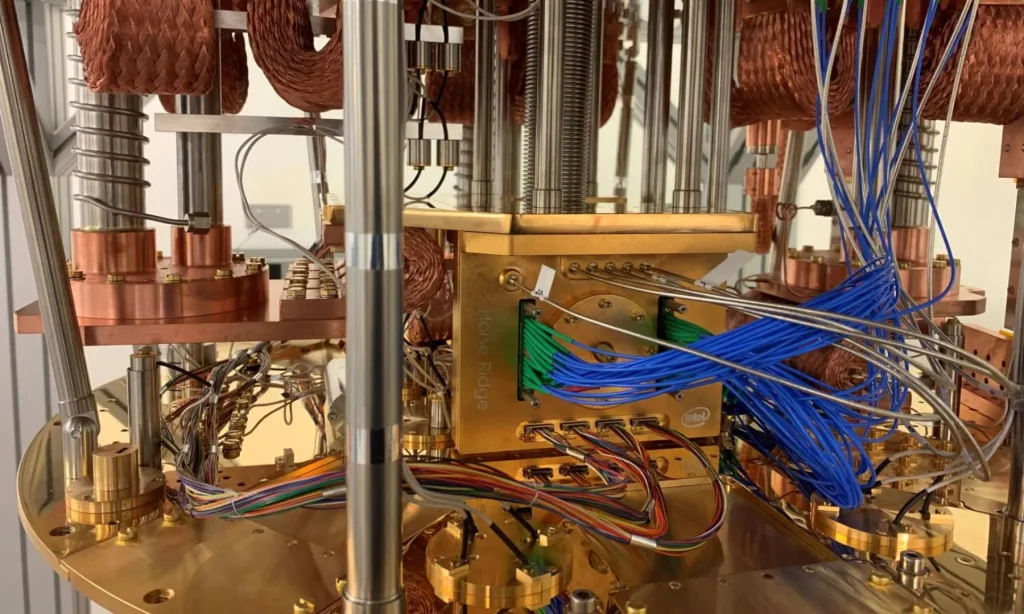
By 2020, Intel introduced Horse Ridge, a cryogenic control chip designed to simplify the control of multiple qubits in quantum systems. This innovation marked a significant step towards addressing scalability challenges in quantum computing. Intel’s commitment to advancing quantum hardware and software technologies has positioned it as a critical player in the global race for practical quantum computing capabilities.
External Link: Click Here For More




See today’s quantum computing news on Quantum Zeitgeist for the latest breakthroughs in qubits, hardware, algorithms, and industry deals.