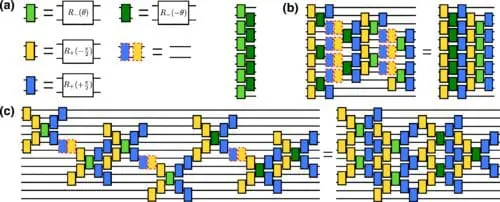
The Schwinger, a quantum electrodynamics model, has been simulated on quantum computers using a new algorithm called SCADAPT VQE. This algorithm uses the exponential decay of correlations between distant regions of the ground state to construct quantum circuits for state preparation that can be scaled to large systems. The model has been prepared on up to 100 qubits of IBM’s Eagleprocessor quantum computers. An improved error-mitigation technique, operator decoherence renormalization, has been introduced, improving the accuracy of the results. This research demonstrates the potential of quantum computers to simulate complex physical systems with high accuracy.
What is the Schwinger Model and How is it Simulated on Quantum Computers?
The Schwinger model, a quantum electrodynamics model in 1+1 dimensions, is a popular test bed for developing quantum simulation techniques for lattice gauge theories. It has been explored using a variety of platforms, including trapped ions, superconducting qubits, photonic systems, Rydberg atoms, ultracold atoms, and classical electric circuits. The model possesses many features of interest to the Quantum Chromodynamics (QCD) and quantum information science communities, including the presence of a mass gap, charge screening, a chiral condensate, few-body bound states (hadrons and nuclei), and a topological θ-term.
The vacuum of the lattice Schwinger model has been prepared on up to 100 qubits of IBM’s Eagleprocessor quantum computers. A new algorithm, called scalable circuits ADAPTVQE (SCADAPT VQE), has been presented to prepare the ground state of a gapped translationally invariant system on a quantum computer. This algorithm uses the exponential decay of correlations between distant regions of the ground state, along with ADAPTVQE, to construct quantum circuits for state preparation that can be scaled to arbitrarily large systems.
The circuits for the Schwinger model are determined on lattices up to L=14 (28 qubits) with the Qiskit classical simulator and are subsequently scaled up to prepare the L=50 (100 qubits) vacuum on IBM’s 127-superconducting-qubit quantum computers. After the introduction of an improved error-mitigation technique, called operator decoherence renormalization, the chiral condensate and charge-charge correlators obtained from the quantum computers are found to be in good agreement with classical matrix product state simulations.
What are the Challenges and Solutions in Quantum Simulations?
One of the major challenges facing quantum simulations of physical systems is the preparation of initial states on quantum computers that can be used to determine important quantities that are inaccessible to classical high-performance computing. This is known as the problem of state preparation. While simulating the dynamics of any given initial state is known to be efficient for an ideal quantum computer, preparing an arbitrary state generally requires quantum resources that asymptotically scale super-polynomially with increasing system size.
However, states of physical systems are not the general case and are often constrained by both local and global symmetries. In some instances, these symmetries allow observables to be computed by perturbing around states that can be efficiently initialized. In the foreseeable future, quantum simulations will be far from asymptotic in both system size and evolution time, and the resources required for both time evolution and state preparation will be estimated by direct construction and extrapolations thereof.
Successful quantum simulations will require specialized quantum circuits and workflows that are optimized for specific quantum hardware. The development of algorithms for preparing nontrivial initial states on quantum computers, including the ground states of quantum field theories (QFTs), is an active area of research. Even with many advances, the algorithms remain limited in capability and generally do not scale favorably to modest-scale or large-scale simulations of quantum many-body systems.
How Does the SCADAPT VQE Algorithm Work?
The SCADAPT VQE algorithm uses the exponential decay of correlations between distant regions of the ground state, along with ADAPTVQE, to construct quantum circuits for state preparation that can be scaled to arbitrarily large systems. These scalable circuits can be determined with the use of classical computers, avoiding the challenging task of optimizing parameterized circuits on a quantum computer.
The SCADAPT VQE algorithm is applied to the Schwinger model and is shown to be systematically improvable with an accuracy that converges exponentially with circuit depth. Both the structure of the circuits and the deviations of prepared wave functions are found to become independent of the number of spatial sites (L). This allows a controlled extrapolation of the circuits determined with the use of small or modest-sized systems to arbitrarily large L.
The circuits for the Schwinger model are determined on lattices up to L=14 (28 qubits) with the Qiskit classical simulator and are subsequently scaled up to prepare the L=50 (100 qubits) vacuum on IBM’s 127-superconducting-qubit quantum computers. After the introduction of an improved error-mitigation technique, called operator decoherence renormalization, the chiral condensate and charge-charge correlators obtained from the quantum computers are found to be in good agreement with classical matrix product state simulations.
What is the Role of Error Mitigation in Quantum Simulations?
Error mitigation is a crucial aspect of quantum simulations. In the case of the Schwinger model, an improved error-mitigation technique, called operator decoherence renormalization, was introduced. This technique significantly improved the accuracy of the results obtained from the quantum computers.
Error mitigation techniques are designed to correct for the errors that inevitably occur in quantum computations due to factors such as decoherence and gate errors. These errors can significantly impact the accuracy of the results obtained from quantum simulations, particularly for complex systems such as the Schwinger model.
The introduction of the operator decoherence renormalization technique allowed the chiral condensate and charge-charge correlators obtained from the quantum computers to be in good agreement with classical matrix product state simulations. This demonstrates the effectiveness of this error mitigation technique in improving the accuracy of quantum simulations.
What are the Implications of this Research for Quantum Computing?
This research demonstrates the potential of quantum computers to simulate complex physical systems, such as the Schwinger model, with high accuracy. The development of the SCADAPT VQE algorithm and the introduction of the operator decoherence renormalization error mitigation technique represent significant advances in the field of quantum computing.
The ability to prepare the ground state of a gapped translationally invariant system on a quantum computer using the SCADAPT VQE algorithm opens up new possibilities for the simulation of a wide range of physical systems. Furthermore, the successful application of the operator decoherence renormalization technique demonstrates the potential of error mitigation techniques to significantly improve the accuracy of quantum simulations.
This research also highlights the importance of developing specialized quantum circuits and workflows that are optimized for specific quantum hardware. As quantum computing technology continues to advance, the development of such specialized tools and techniques will be crucial for harnessing the full potential of quantum computers.
Publication Date: 2024-04-18
Authors: Rol, C. Farrell, Marc Illa, Anthony N. Ciavarella, et al.
Source: PRX Quantum 5, 020315
DOI: https://doi.org/10.1103/PRXQuantum.5.020315


See today’s quantum computing news on Quantum Zeitgeist for the latest breakthroughs in qubits, hardware, algorithms, and industry deals.