Symplectic geometry and circuit quantization are mathematical concepts used in quantum physics. Symplectic geometry studies symplectic manifolds, while circuit quantization describes the behavior of quantum circuits. The standard approach to circuit quantization involves introducing a classical Lagrangian, a function that describes the dynamics of a system.
However, this approach faces challenges when dealing with nonlinear circuit elements. These challenges are addressed by using symplectic geometry and graph theory to present a Hamiltonian formulation of nondissipative electrodynamic circuits. This approach opens up new possibilities for the design and analysis of quantum circuits, paving the way for advancements in quantum computing.
What is Symplectic Geometry and Circuit Quantization?
Symplectic geometry and circuit quantization are mathematical concepts used in the field of quantum physics. Symplectic geometry is a branch of differential geometry and topology that studies symplectic manifolds; these are smooth manifolds equipped with a closed, non-degenerate 2-form. Circuit quantization, on the other hand, is a theory that describes the behavior of quantum circuits with high precision.
The most common approach to circuit quantization involves introducing a classical Lagrangian, a function that describes the dynamics of a system. The degrees of freedom in this function are either magnetic fluxes or electric charges in the circuit. By combining nonlinear circuit elements such as Josephson junctions or quantum phase slips, it is possible to build circuits where a standard Lagrangian description, and thus the standard quantization method, does not exist.
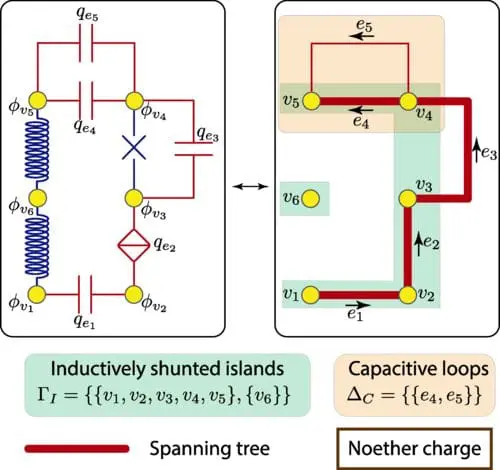
This challenge is addressed by using the mathematics of symplectic geometry and graph theory to present a Hamiltonian formulation of nondissipative electrodynamic circuits. The resulting procedure for circuit quantization is independent of whether circuit elements are linear or nonlinear, or if the circuit is driven by external biases.
How Does This Theory Apply to Quantum Circuits?
The quantum mechanical description of superconducting circuits has paved the way for the rapid evolution of superconductor-based quantum computers. It has enabled the discovery of the transmon, fluxonium, bosonic, and more complex circuits. It has also facilitated advancements in coupling between qubits, opened new avenues towards quantum simulation, and led to the theory of circuit quantum electrodynamics.
In this established formalism of circuit quantization, generalized branch or node fluxes or charges describe the energy of the elements. While these fluxes and charges are conjugates in all but the simplest circuits, there are inevitable constraints that arise between variables, complicating a straightforward quantization prescription.
The standard resolution in the literature is to begin by studying the classical Lagrangian mechanics of the circuit. In the Lagrangian formalism, nondynamical degrees of freedom are efficiently removed by integrating them out. After this step, a Legendre transformation to a classical Hamiltonian for the genuinely dynamical degrees of freedom is performed. Since the Legendre transformation reveals the canonical momenta for each coordinate, a Hamiltonian can be quantized self-consistently.
What are the Challenges in Circuit Quantization?
Circuits might contain a combination of nonlinear and noninvertible capacitive and inductive elements, for example, Josephson junctions (JJs) and quantum phase slips (QPSs). Treating both of these nonlinear and noninvertible elements in the same circuit is still an open problem.
The energy of the JJs depends on the flux φ as E=cos(2πφ/φ0), while the energy of the QPSs on the charge q across the element as E=cos(2πq/2e). One can prove that no Lagrangian of the circuit with a single type of variable (flux or charge) exists in general.
Although for the minimal circuit of one JJ and one QPS included in a loop, one can immediately write down a Hamiltonian, circuits involving even a few more elements quickly become intractable.
How Does Symplectic Geometry Help in Circuit Quantization?
Symplectic geometry, combined with graph theory, provides a way to address the challenges in circuit quantization. By using these mathematical tools, a Hamiltonian formulation of nondissipative electrodynamic circuits can be presented.
This formulation is independent of whether circuit elements are linear or nonlinear, or if the circuit is driven by external biases. It provides an efficient algorithm for quantizing circuits, including those that cannot be quantized using existing methods.
This approach allows for the rederivation of known results from the formalism and provides a new way to tackle the challenges in circuit quantization. It opens up new possibilities for the design and analysis of quantum circuits, paving the way for advancements in quantum computing and related fields.
What is the Future of Circuit Quantization?
The field of circuit quantization is still evolving, with many open problems and challenges. The use of symplectic geometry and graph theory to address these challenges is a promising development, but much work remains to be done.
As quantum computing continues to advance, the need for efficient and accurate methods of circuit quantization will only grow. The development of new mathematical tools and techniques, such as the Hamiltonian formulation presented in this work, will be crucial in meeting this demand.
The future of circuit quantization will likely involve further integration of mathematical concepts from fields like symplectic geometry and graph theory. As these tools are further developed and refined, they will enable new breakthroughs in the design and analysis of quantum circuits, pushing the boundaries of what is possible in quantum computing.
Publication Date: 2024-04-11
Authors: Andrew Osborne, Trevyn Larson, Sarah Garcia Jones, Ray W. Simmonds, et al.
Source: PRX Quantum 5, 020309
DOI: https://doi.org/10.1103/PRXQuantum.5.020309
See today’s quantum computing news on Quantum Zeitgeist for the latest breakthroughs in qubits, hardware, algorithms, and industry deals.