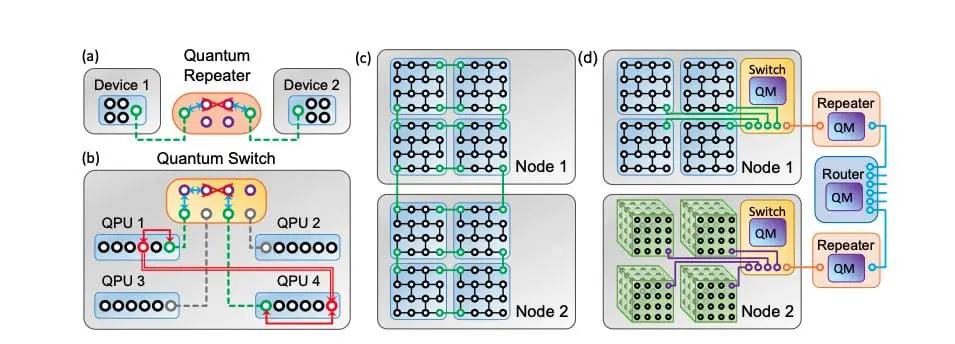
Distributed Quantum Computing (DQC) is an emerging field that aims to revolutionize information processing by using interconnected quantum processors. This approach could significantly increase computational power by overcoming the limitations of standalone systems. The practical realization of large-scale quantum processors is expected to adopt a distributed approach, integrating Quantum Processing Units into classical High-Performance Computing infrastructures. IBM’s Quantum System Two is an example of DQC implementation. Despite challenges, the future of DQC is promising, with further research and exploration of its foundational principles, achievements, and promising directions.
What is Distributed Quantum Computing?
Distributed Quantum Computing (DQC) is an emerging field that aims to revolutionize the way we process information by leveraging the unique principles of quantum mechanics. As researchers continue to push the boundaries of quantum technologies, DQC emerges as a promising path to explore with the aim of enhancing the computational power of current quantum systems. This approach involves the use of interconnected quantum processors to overcome the limitations faced by standalone systems.
The concept of DQC introduces a new approach that could significantly increase computational power. This is achieved by using several quantum processors that contain a limited number of qubits, rather than relying on a single quantum processor with a large number of qubits. This distributed infrastructure could overcome the challenges posed by both fundamental and practical issues, such as decoherence, dissipation, crosstalk, processor topology, cabling, connectors, and control electronics.
There is a growing consensus among both the academic community and companies that the practical realization of large-scale quantum processors should adopt a distributed approach. This involves the use of clusters of small modular quantum chips within a network infrastructure with classical and/or quantum communications. Quantum Processing Units (QPUs) are intended to be seamlessly integrated into a classical High-Performance Computing (HPC) infrastructure alongside CPUs, GPUs, and other hardware accelerators. This integration allows for their utilization in collaboration within a shared development environment, leading to what is already called quantum-centric supercomputing centers.
How is Distributed Quantum Computing Being Implemented?
An example of the implementation of DQC is IBM’s Quantum System Two, a modular architecture that serves as the basis for building their new quantum-centric HPC infrastructures. The model features three IBM Quantum Heron processors, each with 133 fixed-frequency qubits and tunable couplers. According to IBM, Heron yields a 35x improvement in performance with respect to the previous 127-qubit Eagle processor, virtually eliminating crosstalk.
However, the interest in DQC is not new. The first works that analyzed the possibility of using non-local effects to perform distributed computing date back to the end of the 20th century. This interest grew after it was shown that DQC is superior to classical computing for the phase estimation problem, even under non-ideal conditions. Shortly after, resource-optimized protocols for non-local quantum gates were introduced, necessary to move from specific problems like phase estimation to universal quantum computing.
What are the Key Developments in Distributed Quantum Computing?
After the first theoretical studies on the feasibility of DQC, a series of proposals for experimental realizations began to appear. At the same time, several interesting developments regarding DQC algorithms were made, such as the distributed versions of the Grover and Shor algorithms. The first taxonomy of DQC systems was proposed in the early 2000s, where two types of systems were described: those with entanglement between nodes (called type-I) and those with only internode classical communication (called type-II).
What are the Challenges and Future Directions in Distributed Quantum Computing?
Despite the promising developments, DQC still faces several challenges. These include the need for further research on quantum communication protocols and entanglement-based distributed algorithms. Each aspect contributes to the mosaic of distributed quantum computing, making it an attractive approach to address the limitations of classical computing.
The future of DQC lies in further research and exploration of its foundational principles, landscape of achievements, challenges, and promising directions. The objective is to provide an exhaustive overview for experienced researchers and field newcomers. This will involve a comprehensive survey of the current state of the art in the DQC field, exploring its foundational principles, landscape of achievements, challenges, and promising directions for further research.
Conclusion
In conclusion, Distributed Quantum Computing is a promising field that has the potential to revolutionize the way we process information. By leveraging the unique principles of quantum mechanics and using interconnected quantum processors, DQC could significantly enhance the computational power of current quantum systems. Despite the challenges, the future of DQC looks promising with further research and exploration of its foundational principles, landscape of achievements, challenges, and promising directions.
Performance Quantum Computing”
Publication Date: 2024-04-01
Authors: David Barral, F. Javier Cardama, Guillermo Díaz, Daniel Faílde, et al.
Source: arXiv (Cornell University)
DOI: https://doi.org/10.48550/arxiv.2404.01265