A team led by Christian Roos at the University of Innsbruck has developed a network of up to 91 quantum sensors that can eliminate environmental noise, increasing the precision of measurements. The sensors, each consisting of a single atom, are used in correlation spectroscopy, a method that allows for the extraction of information despite environmental disruptions. The team’s work, which the Austrian Science Fund FWF supported, the Austrian Federal Ministry of Education, Science and Research, and the European Union, among others, was published in the journal Physical Review X.
Quantum Sensor Technology: Enhancing Precision through Correlation Spectroscopy
Quantum sensor technology, with its remarkable sensitivity to environmental factors, has the potential to outperform conventional sensors in precision, particularly in measuring magnetic or gravitational fields. However, this sensitivity can also lead to errors due to interactions with the environment. A team led by Christian Roos at the University of Innsbruck has developed a method to overcome this challenge by comparing the signals of up to 91 quantum sensors, effectively eliminating the noise caused by environmental interactions.
Noise Cancellation in Quantum Sensors
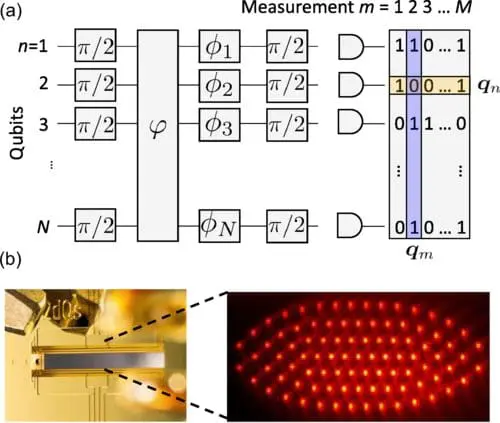
The quantum properties required for sensing can be obscured by noise, which are rapid interactions between the sensor and the environment that disrupt the information within the sensor. This makes the quantum signal unreadable. To address this, the team led by Roos, in collaboration with partners in Israel and the USA, has introduced a method called “correlation spectroscopy”. This technique involves using a network of up to 91 sensors, each consisting of a single atom. As noise affects all sensors equally, analyzing simultaneous changes in the states of all sensors allows the team to effectively subtract the environmental noise and reconstruct the desired information.
Correlation Spectroscopy: A Versatile Tool for Precision Measurement
The correlation spectroscopy method not only allows for precise measurement of magnetic field variations in the environment, but also enables the determination of the distance between the quantum sensors. The versatility of this method is reflected in its applicability for various other sensing tasks and within diverse experimental platforms. While correlation spectroscopy has been demonstrated previously with two atomic clocks, allowing for superior precision in measuring time, this work marks the first application of this method on such a large number of atoms.
The Role of Sensor Networks in Enhancing Precision
The Innsbruck scientists have shown that the precision of the sensor measurements increases with the number of particles in the sensor network. Interestingly, entanglement, which is conventionally used to enhance quantum sensor precision but is difficult to create in the laboratory, does not provide an advantage compared to the multi-sensor network. This finding underscores the potential of sensor networks in enhancing the precision of quantum measurements.
The Future of Quantum Sensor Technology
The work of Roos and his team, published in the journal Physical Review X (DOI: https://doi.org/10.1103/PhysRevX.14.011033), represents a significant advancement in the field of quantum sensor technology. It was financially supported by the Austrian Science Fund FWF, the Austrian Federal Ministry of Education, Science and Research, the European Union, and the Federation of Austrian Industries Tyrol, among others. As the team continues to refine their experimental setup and explore the potential of correlation spectroscopy, the future of quantum sensor technology looks promising.
External Link: Click Here For More