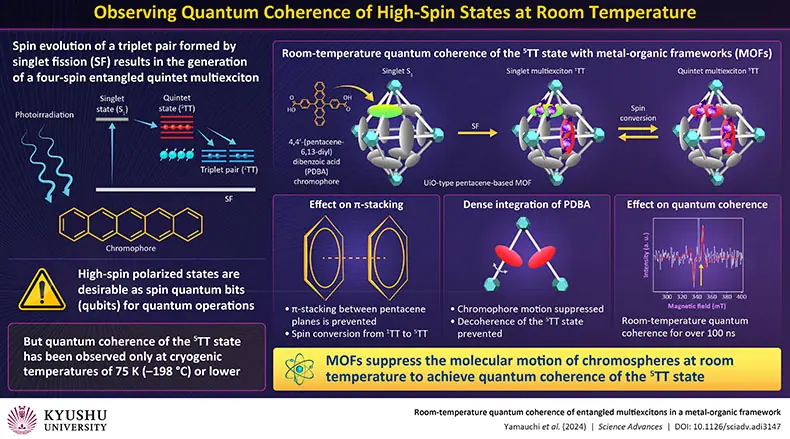
Researchers led by Associate Professor Nobuhiro Yanai from Kyushu University, in collaboration with Professor Yasuhiro Kobori of Kobe University, have achieved quantum coherence at room temperature for the first time. This was accomplished by embedding a chromophore in a metal-organic framework (MOF). The breakthrough could advance quantum computing and sensing technologies, which use qubits, quantum versions of classical computing bits. The team used a chromophore based on pentacene in a UiO-type MOF to maintain quantum coherence of a quintet multiexciton state at room temperature. This could lead to the generation of multiple qubits at room temperatures, opening doors to room-temperature molecular quantum computing.
“The MOF in this work is a unique system that can densely accumulate chromophores. Additionally, the nanopores inside the crystal enable the chromophore to rotate, but at a very restrained angle,” says Yanai. “This is the first room-temperature quantum coherence of entangled quintets,”
Professor Yasuhiro Kobori of Kobe University
Breakthrough in Quantum Coherence at Room Temperature
A team of researchers led by Associate Professor Nobuhiro Yanai from Kyushu University’s Faculty of Engineering, in collaboration with Associate Professor Kiyoshi Miyata from Kyushu University and Professor Yasuhiro Kobori of Kobe University, have made a significant breakthrough in quantum coherence at room temperature. Quantum coherence refers to the ability of a quantum system to maintain a well-defined state over time without being affected by surrounding disturbances. Results are published in Science “Room-temperature quantum coherence of entangled multiexcitons in a metal-organic framework”
The Role of Chromophores and Metal-Organic Frameworks
The researchers achieved this breakthrough by embedding a chromophore, a dye molecule that absorbs light and emits color, in a metal-organic framework (MOF), a nanoporous crystalline material composed of metal ions and organic ligands. This development is a crucial advancement for quantum computing and sensing technologies, which are seen as the next major advancements in computing technology.
Qubits and Quantum Sensing
Qubits, the quantum analogs of bits in classical computing that can exist in a superposition of 0 and 1, are central to quantum computing and sensing. They can be implemented using various systems, one of which is the intrinsic spin of an electron. Electrons have two spin states: spin up and spin down. Qubits based on spin can exist in a combination of these states and can be “entangled,” allowing the state of one qubit to be inferred from another.
Quantum sensing technology, due to its extremely sensitive nature to environmental noise, is expected to enable sensing with higher resolution and sensitivity compared to traditional techniques. However, it has been challenging to entangle four electrons and make them respond to external molecules, that is, achieve quantum sensing using a nanoporous MOF. To overcome this, the researchers introduced a chromophore based on pentacene in a UiO-type MOF, which facilitated enough motion in the pentacene units to allow the electrons to transition from the triplet state to a quintet state, while also sufficiently suppressing motion at room temperature to maintain quantum coherence of the quintet multiexciton state.
First Room-Temperature Quantum Coherence of Entangled Quintets
Upon photoexciting electrons with microwave pulses, the researchers could observe the quantum coherence of the state for over 100 nanoseconds at room temperature. This is the first room-temperature quantum coherence of entangled quintets, a significant milestone in the field of quantum computing and sensing.
Future Implications and Possibilities
While the coherence was observed only for nanoseconds, the findings will pave the way for designing materials for the generation of multiple qubits at room temperatures. Yanai speculates that it will be possible to generate quintet multiexciton state qubits more efficiently in the future by searching for guest molecules that can induce more such suppressed motions and by developing suitable MOF structures. This could potentially open doors to room-temperature molecular quantum computing based on multiple quantum gate controls and quantum sensing of various target compounds.
“It will be possible to generate quintet multiexciton state qubits more efficiently in the future by searching for guest molecules that can induce more such suppressed motions and by developing suitable MOF structures,” speculates Yanai. “This can open doors to room-temperature molecular quantum computing based on multiple quantum gate control and quantum sensing of various target compounds.”
Nobuhiro Yanai
Summary
Researchers at Kyushu University and Kobe University have achieved quantum coherence at room temperature for the first time, using a dye molecule embedded in a nanoporous crystalline material. This breakthrough could pave the way for the development of room-temperature molecular quantum computing and quantum sensing technologies.
- Researchers led by Associate Professor Nobuhiro Yanai from Kyushu University, in collaboration with Associate Professor Kiyoshi Miyata from Kyushu University and Professor Yasuhiro Kobori of Kobe University, have achieved quantum coherence at room temperature for the first time.
- The breakthrough was made possible by embedding a chromophore, a dye molecule that absorbs light and emits colour, in a metal-organic framework (MOF), a nanoporous crystalline material composed of metal ions and organic ligands.
- This advancement is significant for quantum computing and sensing technologies, which utilise the quantum mechanical properties of qubits, the quantum analogs of bits in classical computing.
- The researchers used a chromophore based on pentacene in a UiO-type MOF to suppress molecular motion and achieve room-temperature quantum coherence.
- The MOF structure allowed the electrons to transition from the triplet state to a quintet state, while also sufficiently suppressing motion at room temperature to maintain quantum coherence of the quintet multiexciton state.
- The researchers could observe the quantum coherence of the state for over 100 nanoseconds at room temperature.
- While the coherence was observed only for nanoseconds, the findings will pave the way for designing materials for the generation of multiple qubits at room temperatures.

See today’s quantum computing news on Quantum Zeitgeist for the latest breakthroughs in qubits, hardware, algorithms, and industry deals.