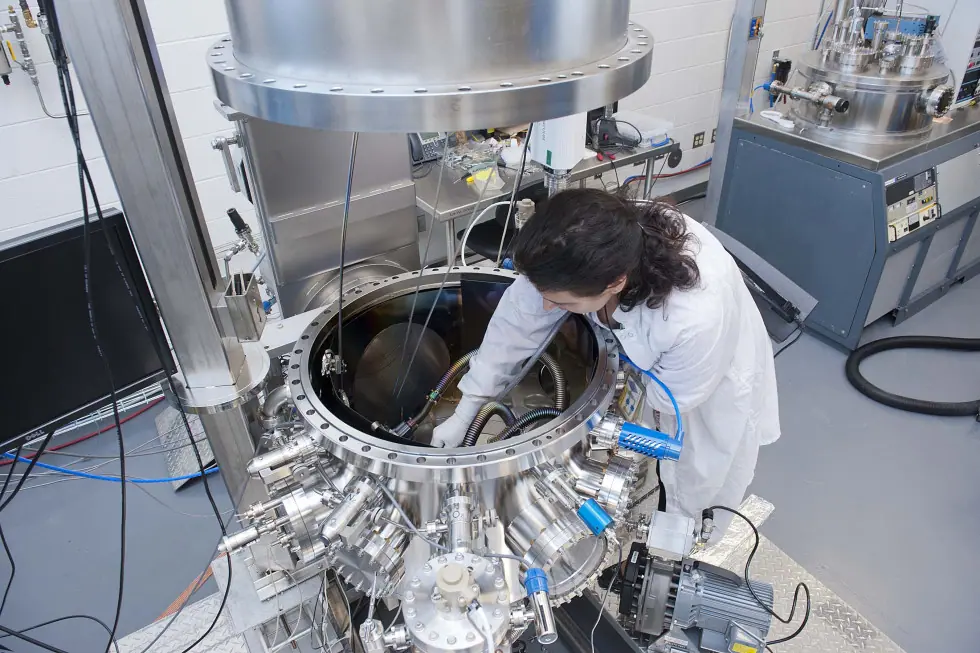
The US Department of Energy’s Thomas Jefferson National Accelerator Facility, known as Jefferson Lab, is leading a team to advance superconducting technology for computer chips. The team includes imec, the New York Center for Research, Economic Advancement, Technology, Engineering, and Science (NY CREATES), and Cornell University. Their project, aimed at developing sustainable hardware for artificial intelligence and quantum computing, is one of 11 selected by the Department of Energy to receive a total of $73 million in funding. The team’s goal is to develop improved superconducting materials that offer 100 times improved energy efficiency and are compatible with conventional electronics technology.
Jefferson Lab’s Multidisciplinary Team and Superconducting Technologies
The U.S. Department of Energy’s Thomas Jefferson National Accelerator Facility, commonly known as Jefferson Lab, is renowned for its work with superconducting technologies. These technologies are integral to the lab’s mission of exploring the quantum universe, specifically the quarks and gluons that inhabit it. Superconducting radiofrequency (SRF) technology, a core competency of Jefferson Lab, is used to accelerate electron particles in the lab’s Continuous Electron Beam Accelerator Facility. This allows researchers worldwide to conduct experiments to study the fundamental building blocks of matter. With funding from the DOE’s Office of Nuclear Physics, Jefferson Lab has been consistently improving SRF technology to benefit particle accelerators for nuclear physics and other programs in the DOE’s Office of Science.
Advancing Computer Chip Technology with Superconducting Materials
Jefferson Lab is leading a multidisciplinary team to explore the use of new superconducting materials and structures in ultra-energy-efficient Superconducting Digital (SCD) electronics. These electronics are aimed at emerging artificial intelligence and quantum computing technologies. The team includes imec, the New York Center for Research, Economic Advancement, Technology, Engineering, and Science (NY CREATES), and Cornell University. The project, titled “Advanced superconducting integration process enabling sustainable hardware for AI and quantum computing,” is one of 11 projects selected by DOE to receive a total of $73 million in investments to accelerate new technologies from discovery to commercialization.
The A+ Team and Their Vision
The team, referred to as “an A+ Team … of exceptional talent” during the DOE review process, is composed of experts from various fields. Anne-Marie Valente-Feliciano, a senior physicist at Jefferson Lab, leads the project. The team also includes Anna Herr and Quentin Herr from imec, who are world-renowned experts in computer memory technology, and Satyavolu Papa Rao, a materials scientist and vice president for research at NY CREATES. The team’s vision is to develop improved superconducting and barrier materials that would perform better and tolerate higher processing temperatures, making them fully compatible with the fabrication processes of conventional electronics technology.
The Potential of Superconducting Digital Logic Circuitry
Superconducting digital logic circuitry is seen as a critical path that needs to be explored. In large-scale applications such as AI running in a data center, superconducting materials offer a 100X improved energy efficiency, even after accounting for the overhead of a closed-loop cryogenic system for cooling. Superconducting digital logic chips can also be placed near quantum computing chips, to control and communicate with them. This technology is important for enabling both quantum and classical computing in the future.
The Role of Cornell University and the Future of Computing
Cornell University’s Katja Nowack, an assistant professor of physics, brings significant experience in the characterization of superconducting materials. Her techniques enable imaging the properties of these materials so they can be better tuned to application at scale. The team believes that their proposed technology will allow energy-efficient learning much faster on real-time data closer to human rates of learning. However, reaching this goal will take time and will happen in stages.
DOE’s Accelerate Initiative and Its Impact on Innovation
The DOE’s Accelerate initiative aims to fuel innovation in basic research so that new materials and technologies can be scaled and transitioned into new products and capabilities to enhance the country’s economic health and security. The 11 funded projects are supported by the Office of Science programs in Advanced Scientific Computing Research, Biological and Environmental Research, Basic Energy Sciences, Fusion Energy Sciences, High Energy Physics, Nuclear Physics, and the DOE Isotope Program. Each project is led by a national laboratory with partners from other national labs, industries, and universities.
Jefferson Lab’s Contribution to Society
This project is one of several at Jefferson Lab that aims to apply the lab’s expertise in niche technologies toward innovations that will have a positive impact on society. It is supported by DOE’s Offices of Advanced Scientific Computing Research and Nuclear Physics. The development of such a concept using research in innovative materials and its potential use in the future by society is an exciting prospect for the team at Jefferson Lab.
“Society needs faster, better-performing computer technology,” said Anne-Marie Valente-Feliciano, Jefferson Lab senior physicist and SRF process and materials group leader. “The project is aimed at developing a new computer chip technology using superconducting materials for faster performance and improved efficiency.”
“Without greater innovation in high-performance computing,” said Quentin Herr, “it’s predicted that by 2040, half of the world’s energy will go toward computing.”
“In order to satisfy humanity’s need for computing, new paradigms are required,” said team member Satyavolu Papa Rao, materials scientist, engineer and vice president for research at NY CREATES. “Superconducting digital logic circuitry is a very critical path that needs to be explored, and that’s what we are doing.”
“My lab brings expertise in a pretty unique way to image the relevant materials and structures,” Nowack said. “We specialize in a type of magnetic imaging at low temperatures that we typically use to explore emergent phenomena in quantum materials. But it so happens that our imaging is well-suited to help develop a greater understanding of the fundamentals of the materials involved in SCD electronics. This is a critical need to advance the kind of technology we pursue in this project.”
“There’s potential for 100X improvement,” said Quentin Herr. “Ours is a very aggressive project, but one that’s extremely important because computing permeates all of our lives and continues to expand.”
“AI needs large datasets and six-month-long learning cycles on energy-hungry computing systems today,” said Anna Herr. “Our proposed technology will allow energy-efficient learning much faster on real-time data closer to human rates of learning.”
“Eventually,” said Valente-Feliciano, “the materials and technology are going to mature to where they can be implemented in devices useful for the community at large. Of course, this will happen in stages, you’re not going to find a computer like that on the shelf tomorrow. But you can imagine it can be used for experiments and larger data centers.”
“This research will integrate novel concepts and approaches in use-inspired basic research to address gaps or challenges that limit the ultimate transition to applied research for further development and demonstration,” said Asmeret Asefaw Berhe, director of DOE’s Office of Science, in announcing the grants. “Achieving these research goals will greatly accelerate the innovation cycle, which currently can take years to decades to realize.”
Summary
A multidisciplinary team led by Jefferson Lab is developing a superconducting approach to advanced computer chip technology, aiming to create ultra-energy-efficient electronics for artificial intelligence and quantum computing. The project, which is part of a $73 million investment by the Department of Energy, seeks to improve superconducting materials for faster performance and improved efficiency, potentially offering a 100-fold increase in energy efficiency for large-scale applications such as AI in data centres.
- The U.S. Department of Energy’s Thomas Jefferson National Accelerator Facility (Jefferson Lab) is leading a multidisciplinary team to advance superconducting technologies for computer chip technology.
- The team includes imec, the New York Center for Research, Economic Advancement, Technology, Engineering, and Science (NY CREATES), and Cornell University.
- The project, titled “Advanced superconducting integration process enabling sustainable hardware for AI and quantum computing,” is one of 11 projects selected by the Department of Energy (DOE) to receive a total of $73 million in investments.
- The project aims to develop a new computer chip technology using superconducting materials for faster performance and improved efficiency.
- The team’s approach is to innovate major changes to the existing fabrication process, including scalability.
- A key goal is to develop improved superconducting and barrier materials that would perform better and tolerate higher processing temperatures.
- Superconducting materials offer a 100X improved energy efficiency in large-scale applications such as AI running in a data center.
- The technology is also important for enabling both quantum and classical computing in the future.
- The project is supported by DOE’s Offices of Advanced Scientific Computing Research and Nuclear Physics.
See today’s quantum computing news on Quantum Zeitgeist for the latest breakthroughs in qubits, hardware, algorithms, and industry deals.