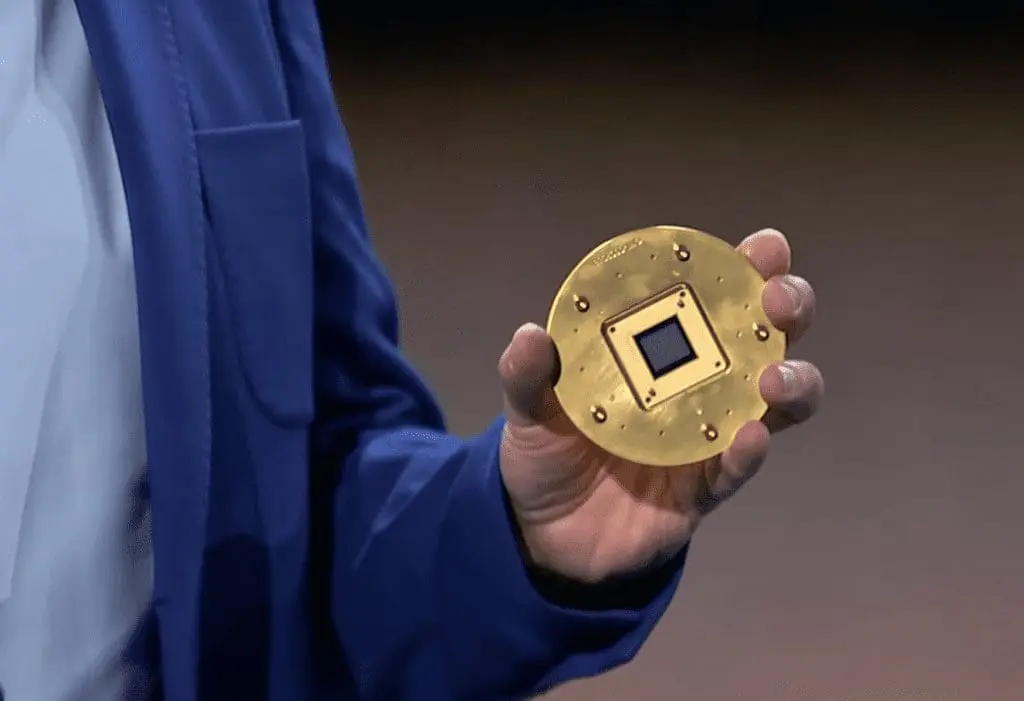
It’s a long journey to fault-tolerant quantum computation, but AWS and Amazon want to tackle this with a new chip they have been producing. At re:Invent 2023, their annual conference, AWS introduced the new Amazon Quantum Chip. So far, details are few, but the focus is on error correction, how the device can suppress errors, and how the architecture makes scaling up the number of qubits considerably easier.
The company has been involved in the quantum space for a while with its AWS Braket Service and the AWS Centre for Quantum Computing at Caltech. AWS and Peter Desantis, SVP, AWS Utility Computing Products, spoke about how the new qubit developed by Amazon is more fault-tolerant due to error suppression.
Amazon Quantum Chip Announced at re:Invent 2023
Amazon announced the logical qubit built at the Amazon Web Services (AWS) Center for Quantum Computing which opened back in 2021, at their annual re:Invent 2023 conference, where specialists get together to announce news and innovation from Amazon. Just as Steve Jobs and Elon Musk showed off new products, Amazon has taken a leap out of their playbook and created a buzz around new Amazon product launches. However this is the first
Amazon has been building its quantum capabilities. Just as AWS has become the backbone of web services and the cloud, Amazon has provided access to various quantum hardware from various providers, from Rigetti to IonQ. Analogously, as it supplied tools such as servers, Databases, and other applications, it cemented its lead within the cloud service space.
But Amazon does develop their technologies where it sees fit, and Quantum is one of those areas where it has entered the fray with its hardware. However, this is not unexpected, as it’s been working on developing Quantum devices with Caltch; it’s just that we haven’t seen any output yet. The passive error correction allows a 100X error correction rate and marks one of the first steps towards error-corrected quantum computers.
Error-correcting with Amazon’s Quantum Chip
Quantum error correction is a fundamental aspect of quantum computing, designed to protect quantum information from errors due to decoherence and other quantum noise. Quantum bits, or qubits, which are the basic units of quantum information, are much more susceptible to errors than classical bits due to their inherent nature. Unlike classical bits, which can be either 0 or 1, qubits can exist in superpositions of these states, making them vulnerable to even minor environmental disturbances.
Quantum error correction addresses this challenge by employing various algorithms and techniques to detect and correct errors without measuring the quantum state directly, thus preserving the quantum information. These techniques are essential for the realization of practical and reliable quantum computers, as they allow for longer computation times by maintaining the integrity of the qubits.
Bit Flip Error in Quantum Computing
A bit flip error is a specific type of error in quantum computing that mirrors the classical bit flip but with some unique quantum characteristics. In classical computing, a bit flip error is when a bit unintentionally changes its state from 0 to 1 or from 1 to 0. In quantum computing, this concept extends to qubits, the fundamental units of quantum information.
A qubit, unlike a classical bit, can exist not only in the definite states of 0 or 1 but also in superpositions of these states. However, when a bit flip error occurs in a quantum system, it specifically refers to the unintended flipping of the state of a qubit from |0⟩ to |1⟩ or vice versa. This error can be caused by various factors like environmental noise, imperfections in the quantum system, or faulty quantum gates.
Phase Flip Error in Quantum Computing
In quantum computing, a phase flip error represents a different class of error than the more familiar bit flip. While a bit flip involves the change of a qubit’s state from |0⟩ to |1⟩ or vice versa, a phase flip error alters the phase of the qubit’s state.
Quantum states are described by complex numbers, and a phase flip essentially multiplies the state by a factor of -1 in the complex plane. This means if a qubit is in a superposition state like α|0⟩ + β|1⟩ (where α and β are complex amplitudes), a phase flip error changes this state to α|0⟩ - β|1⟩. It’s important to note that phase flip errors do not affect the probability of measuring a state as |0⟩ or |1⟩; instead, they alter the relative phase between these states, which is crucial in quantum algorithms.
What do we know about the Amazon Quantum Chip
According to Peter Desantis (from AWS), This logical qubit that Amazon has produced in its recent announcement is both hardware-efficient due to error impression and scalable. The latter is crucial for scaling up the number of qubits to where large numbers of qubits can be connected to build larger quantum circuits.
Currently, the state of the art is around 1,000 qubits – these are physical qubits. PsiQuantum is on the quest to create a million-qubit system using its photonic-based technology. How many qubits does the Amazon Quantum Chip have? We simply don’t know the exact number.
A physical qubit typically needs error correcting, which means that to store a state in a logical qubit, many physical qubits must be deployed. This shrinks the utility. Amazon is focused on how they can build logical qubits. The details have not yet been disclosed, but we expect to learn more about the QPU or Quantum Processing Unit soon.
- The Amazon Quantum Chip uses a special oscillator-based qubit that strongly suppresses bit flip errors, and requires a much simpler outer error-correcting code to protect the remaining phase flip errors. The estimated savings in overhead associated with quantum error correction is up to 6x for practical systems.
- The Amazon Quantum Chip is based on a superconducting quantum circuit technology that “prints” qubits on the surface of a silicon microchip, making it highly scalable in the number of physical qubits. This scalability allows one to exponentially suppress the logical error rate by adding more physical qubits to the chip. Other approaches based on similar oscillator-based qubits rely on large 3D resonant cavities that need to be manually pieced together.