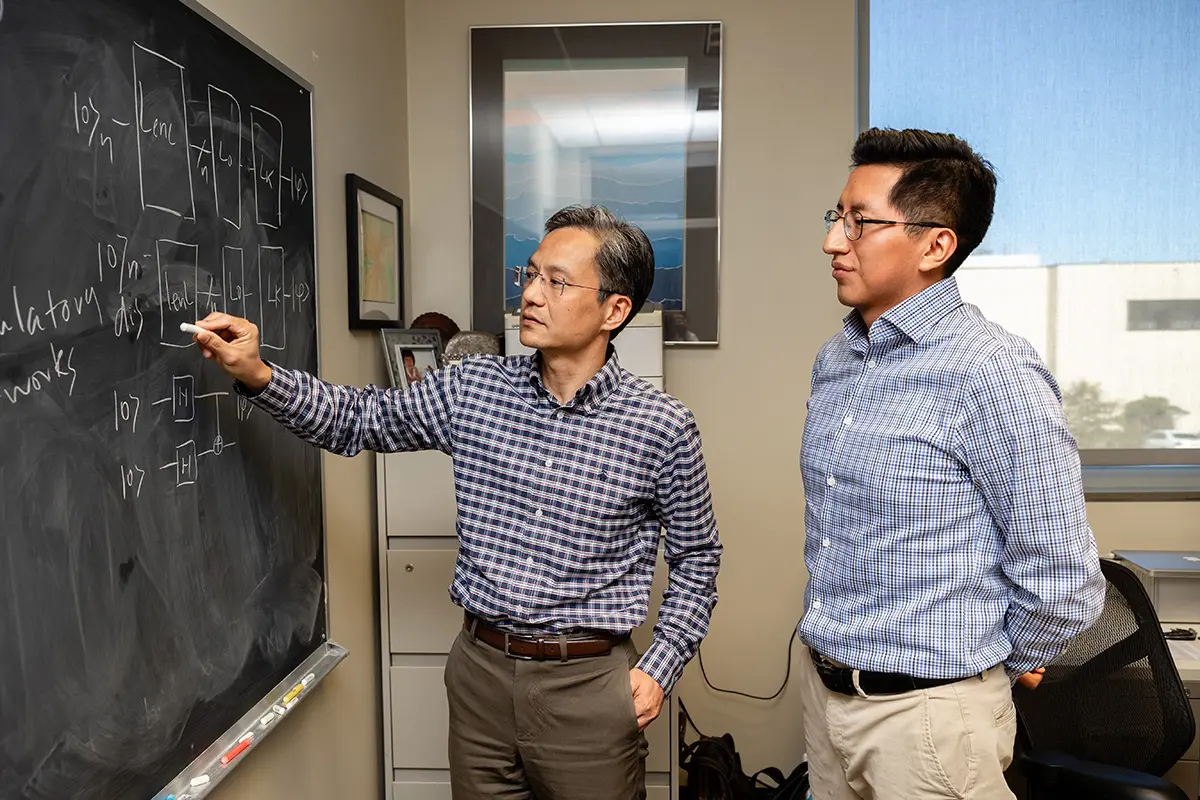
Researchers at Texas A&M University have used quantum computing to assist with genetic research, discovering new links between genes. The team used the technology to map gene regulatory networks (GRNs), which show how genes can activate or deactivate each other. Published in npj Quantum Information, the study suggests quantum computing could help predict gene relationships more accurately, with potential implications for human and animal medicine. The team, including Ph.D. student Cristhian Roman Vicharra, found quantum computing allowed for more complex gene comparisons than traditional computing. The researchers plan to compare healthy cells with diseased or mutated ones in future.
Quantum Computing and Genetic Research
The GRN is akin to a map that illustrates how genes influence each other. For instance, if one gene switches on or off, it may alter another gene, which could subsequently change several more genes. The quantum computing GRNs are constructed in ways that allow for the capture of more complex relationships between genes than traditional computing. This has led to the discovery of some links between genes that were previously unknown.
The ability to predict which genes will affect other genes is vital for scientists seeking ways to halt harmful cellular processes or encourage beneficial ones. If gene expression can be predicted through the GRN and the changes understood in relation to the state of the cells, certain outcomes might be controlled. For example, altering how one gene is expressed could potentially inhibit the growth of cancer cells.
Overcoming Limitations with Quantum Computing
Quantum computing is helping to overcome the limitations of older computing technologies used to map GRNs. Before the advent of quantum computing, the algorithms could only handle comparing two genes at a time. Comparing genes in pairs could lead to misleading conclusions, as genes may operate in more complex relationships.
In traditional computing, data is processed in bits, which only have two states, on and off, or 1 and 0. However, quantum computing introduces a state called the superposition that’s both on and off simultaneously. This gives rise to a new kind of bit, the quantum bit, or qubit. Because of superposition, both the active and inactive states for a gene in the GRN can be simulated, as well as this single gene’s impact on other genes. This results in a more comprehensive picture of how genes influence each other.
The Future of Quantum Computing in Biomedical Field
While the research team has worked diligently to demonstrate that quantum computing is beneficial to the biomedical field, there is still much work to be done. Quantum computing is a very new field, and most people working in it have a physics background. Understanding both the biology and quantum computing sides is crucial.
The research team includes both biomedical scientists and engineers. In the future, they plan to compare healthy cells to ones with diseases or mutations. The aim is to see how a mutation might affect genes’ states, expression, frequencies, etc. For now, it’s important to get as clear an understanding as possible of how healthy cells work before comparing them to mutated or diseased cells. The first step was to predict this baseline model and see whether the network mapped made sense. The next steps will build on this foundation.
“The GRN is like a map that tells us how genes affect each other,” Cai said. “For example, if one gene switches on or off, then it may change another gene that could change three, or five, or 20 more genes down the line.
“Because our quantum computing GRNs are constructed in ways that allow us to capture more complex relationships between genes than traditional computing, we found some links between genes that people hadn’t known about previously,” he said. “Some researchers who specialize in the type of cells we studied read our paper and realized that our predictions using quantum computing fit their expectations better than the traditional model.”
“If you can predict gene expression through the GRN and understand how those changes translate to the state of the cells, you might be able to control certain outcomes,” Cai said. “For example, changing how one gene is expressed could end up inhibiting the growth of cancer cells.”
“Prior to using quantum computing, the algorithms could only handle comparing two genes at a time,” Cai said.
“With traditional computing, data is processed in bits, which only have two states, on and off, or 1 and 0,” Cai said. “But with quantum computing, you can have a state called the superposition that’s both on and off simultaneously. That gives us a new kind of bit, the quantum bit, or qubit.
“Because of superposition, I can simulate both the active and inactive states for a gene in the GRN, as well as this single gene’s impact on other genes,” he said. “You end up with a more complete picture of how genes influence each other.”
“It’s a very new field,” Cai said. “Most people working in quantum computing have a physics background. And people on the biology side don’t usually understand how quantum computing works. You really have to be able to understand both sides.”
“In the future, we plan to compare the healthy cells to ones with diseases or mutations,” Cai said. “We hope to see how a mutation might affect genes’ states, expression, frequencies, etc.”
“The first step was to predict this baseline model and see whether the network we mapped made sense,” Cai said. “Now, we can keep going from there.” – Cai
Summary
Researchers at Texas A&M University have utilised quantum computing to enhance genetic research, discovering previously undetected links between genes by mapping gene regulatory networks (GRNs). This advancement in computing technology could significantly improve predictions of gene relationships, potentially revolutionising both animal and human medicine.
- Researchers at Texas A&M University have used quantum computing to assist with genetic research, discovering new links between genes that were previously undetectable.
- The team used the technology to map gene regulatory networks (GRNs), which show how genes can activate or deactivate each other.
- The study, published in npj Quantum Information, suggests that quantum computing could help scientists more accurately predict relationships between genes, with potential implications for animal and human medicine.
- The team, led by a researcher named Cai, found that quantum computing allowed them to capture more complex relationships between genes than traditional computing.
- This could be crucial for scientists looking to stop harmful cellular processes or promote helpful ones, as understanding these gene relationships could potentially control certain outcomes, such as inhibiting the growth of cancer cells.
- The research team, which includes biomedical scientists and engineers, plans to compare healthy cells to ones with diseases or mutations in the future.
- The team acknowledges that there is still much work to be done, as quantum computing is a new field and requires understanding from both the physics and biology sides.
See today’s quantum computing news on Quantum Zeitgeist for the latest breakthroughs in qubits, hardware, algorithms, and industry deals.