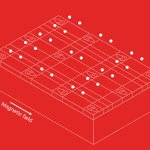
Google Quantum AI published the completion of the second milestone on its plan in “Suppressing Quantum Mistakes by Scaling a Surface Code Logical Qubit,” published in Nature last 22 February 2023. The experimental results show a prototype of a logical qubit, the basic unit of an error-corrected quantum computer, with performance approaching scalable fault-tolerant quantum computing.
Error rates far below those achievable with physical qubits will be required for practical quantum computing. Quantum error correction (QEC) provides a path to algorithmically relevant error rates by encoding logical qubits within many physical qubits. The number of physical qubits improves the protection against physical errors.
Furthermore, Quantum error correction is a substantial departure from today’s quantum computing, in which each physical qubit on the processor serves as a unit of computation. It describes how to achieve minimal mistakes by exchanging numerous good qubits for one excellent qubit: information is encoded across several physical qubits to create a single logical qubit that is more durable and capable of performing large-scale quantum computations. The more physical qubits used to construct a logical qubit under the appropriate conditions, the better that logical qubit becomes.
Nevertheless, if the additional faults from each new physical qubit outweigh the benefits of Quantum Error Correction, this will not work until the high physical error rates have made it possible.
The error rates of Google AI’s third-generation Sycamore processor’s qubits range from 1 in 10,000 to 1 in 100. Based on their research and that of others, constructing large-scale quantum computers will necessitate far reduced error rates. To run quantum circuits that can solve industrially significant issues, we will need rates from 1 in 109 to 1 in 106.
This work demonstrates that the system can manufacture the logical qubits required for a large-scale error-corrected quantum computer carefully.
The Surface Coding for reducing logical qubit’s error rate
To that purpose, Google employed a surface code, a type of error-correcting code, and demonstrated for the first time that increasing the code’s size reduces the logical qubit’s error rate. This was accomplished by methodically minimizing several error causes as they scaled from 17 to 49 physical qubits, a first for any quantum computing platform.
Surface codes are a type of quantum error-correcting code that encodes a logical qubit into the joint entangled state of a d d square of physical qubits (data qubits). Two anti-commuting logical observables, XL and ZL, define the logical qubit states. If we can detect and repair local physical mistakes, this non-local encoding of information protects the logical qubit from them.
But here’s the catch: each individual physical qubit is prone to error; therefore, the more qubits in a code, the greater the chance of error. The study aims for the improved protection provided by Quantum Error-Correction to outweigh the increasing chances of error as the number of qubits increases. For this to happen, the physical qubits must have faults below the so-called “fault-tolerant threshold,” which is relatively low for the surface code. It is so low that it has just recently become experimentally possible. They are now on the verge of achieving this desired regime.
Suppressing Logical Errors by Scaling a Quantum Error-Correcting Code
The experiment modeled the logical error performance of surface codes from distance-3 to 25 while also scaling the physical error rates to understand how the surface code results project forward to future devices. The simulation only analyzes Pauli errors for efficiency. When the physical error rate is large, the chance of logical error grows with the growing system size (εd+2 > εd).
On the other hand, low physical error rates demonstrate the intended exponential suppression of logical error (εd+2 < εd). This threshold behavior can be subtle. There is a crossover region in which growing system size initially decreases the logical error per cycle before raising it later due to finite-scale considerations. This is where the team expects their experiment will take place.
Through an experimental design of running a distance-25 repetition code to examine damaging, low-probability error sources and observe a 1.7 × 10⁻⁶ logical error per cycle floor imposed by a single high-energy event. The team has precisely incorporated error budgets to highlight the future systems’ most significant issues.
Despite the fact that the device is near the threshold, achieving algorithmically meaningful logical error rates with manageable resources will necessitate an error-suppression factor of Λd/(d+2) ≫ 1. Based on the error budget and simulations, the team believes that component performance needs to improve by at least 20% to fall below the threshold and significantly more to enable realistic scaling.
The Logical Qubit Performance
The study demonstrates that the measurement of logical qubit performance scaling across multiple code sizes and that the system of superconducting qubits has enough performance to offset the additional errors caused by growing qubit numbers. In terms of logical error probability across 25 cycles and logical error per cycle ((2.914 0.016)% vs. (3.028 0.023)%), they find that the distance-5 surface code logical qubit beats an ensemble of distance-3 logical qubits on average.
These findings are an experimental illustration of how quantum error correction improves performance as the number of qubits increases, showing the road to achieving the logical error rates required for computation.
The first stage in that process, suppressing logical errors by scaling a quantum error-correcting code, the cornerstone of a fault-tolerant quantum computer, is demonstrated in this paper.
Read the full research article here.
See today’s quantum computing news on Quantum Zeitgeist for the latest breakthroughs in qubits, hardware, algorithms, and industry deals.