Contextuality, a fundamental feature distinguishing quantum mechanics from classical physics, remains a challenging concept to quantify and consistently observe in experiments. Vinicius P. Rossi, Beata Zjawin, and Roberto D. Baldijão, all from the University of Gdańsk, alongside David Schmid and John H. Selby from the Perimeter Institute for Theoretical Physics, and Ana Belén Sainz from both the University of Gdańsk and Basic Research Community for Physics e. V, now demonstrate that contextuality is surprisingly common. Their research establishes that even with a limited number of randomly chosen experimental settings, non-classical behaviour arises with a probability exceeding 99 percent. This finding significantly advances our understanding of how readily quantum effects manifest, and the team provides a freely available software tool allowing researchers to predict and optimise the likelihood of observing contextuality within specific experimental parameters, potentially accelerating the development of quantum technologies.
Quantum Contextuality Across Many States
Researchers are investigating how common contextuality is in quantum systems, a key feature that separates quantum mechanics from classical physics. By examining a large number of quantum states, they aim to determine how frequently this nonclassical behaviour arises. This work explores the statistical properties of contextuality, moving beyond specific examples to consider a broader range of quantum systems. The team systematically quantifies contextuality using a specific mathematical measure, allowing them to compare quantum and classical behaviours across different quantum states. Results demonstrate that a significant proportion of randomly chosen quantum states exhibit contextuality exceeding that found in any classical model, suggesting it is a widespread characteristic of quantum mechanics. This contextuality persists even in complex systems and under various measurement conditions, and can be statistically distinguished from classical behaviour with high confidence.
Typical Contextuality in Random Quantum Systems
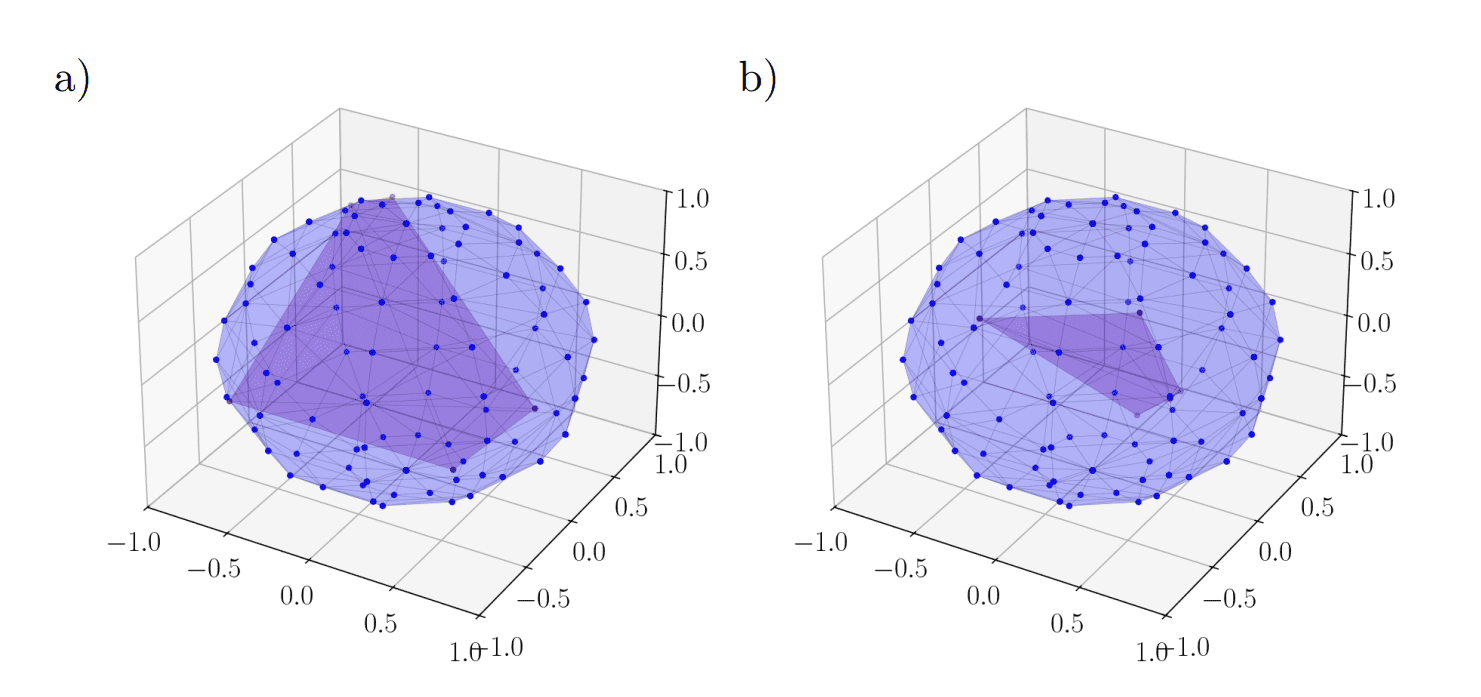
This research focuses on quantifying how often contextuality appears in quantum mechanics. In essence, it aims to answer the question: how common is contextuality in randomly generated quantum systems? Contextuality is a key feature distinguishing quantum mechanics from classical physics, related to the idea that measurement outcomes depend on which other measurements are performed simultaneously. The primary contribution is a computational framework and methodology to empirically determine the probability that a randomly chosen quantum system will be contextual. Researchers generate random quantum states and measurements, then employ a mathematical test to determine if a given combination is contextual.
They run large-scale computer simulations, generating many random systems and applying the test to each one, estimating the probability of contextuality. Parallel processing speeds up these simulations, and statistical methods are used to assess the confidence level of the results. An open-source software package automates the entire process, making it reproducible and accessible to other researchers. The results suggest that contextuality is relatively common in randomly generated quantum systems, with a high percentage exhibiting this nonclassical behaviour. The probability of contextuality depends on several parameters, including the dimension of the quantum system, the number of initial states used, the number of measurements performed, and the purity of the states.
Contextuality Commonly Arises in Random Quantum Setups
Researchers have investigated how frequently contextuality, a key feature distinguishing quantum mechanics from classical physics, arises in random experimental setups. Their work establishes that contextuality is surprisingly common, appearing with a probability exceeding 99% even in experiments with a modest number of randomly chosen preparations and measurements. This suggests that many quantum systems may inherently possess this nonclassical resource, even without specific experimental design to highlight it. The team also examined how the “sharpness” or purity of the initial quantum states affects the likelihood of observing contextuality.
While decreasing purity does reduce the typicality of contextuality, this dependence is not particularly strong, indicating that contextuality remains fairly prevalent even when realistic experimental noise is present. Importantly, researchers found that while contextuality itself is common, achieving high degrees of contextuality, necessary for significant advantages in quantum technologies, is less typical. To aid further investigation, the scientists developed an open-source toolbox that allows researchers to quantify the typicality of contextuality as a function of various experimental parameters. Future work could focus on designing experiments that specifically maximize contextuality to unlock its potential for quantum technologies like parity-oblivious multiplexing. This research provides a valuable baseline for understanding the natural occurrence of nonclassical behaviour in quantum systems and informs the development of experiments that can harness it effectively.
👉 More information
🗞 How typical is contextuality?
🧠 ArXiv: https://arxiv.org/abs/2510.20722