

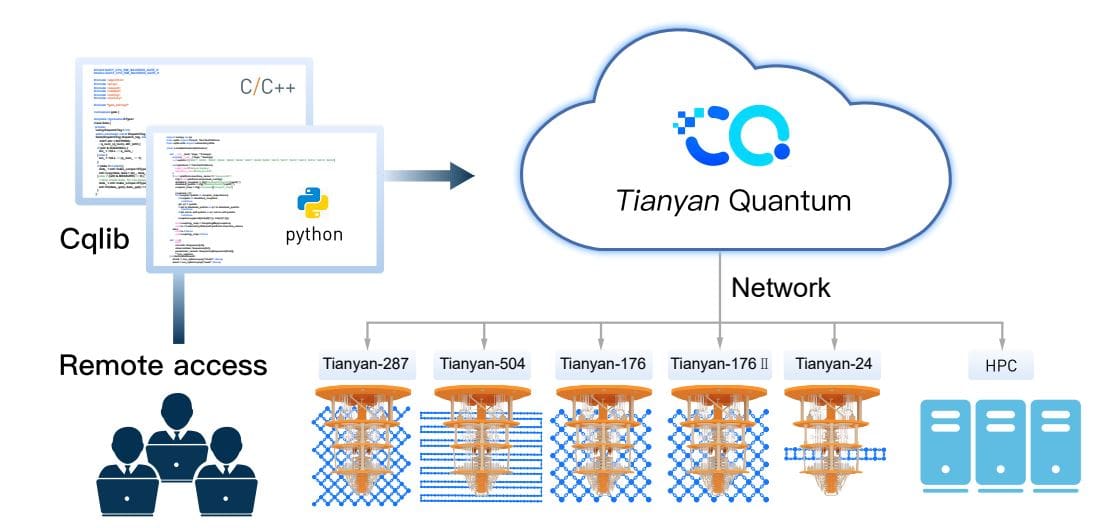
Quantum computing promises to revolutionise fields from medicine to materials science, but access to powerful quantum hardware remains a significant barrier, a challenge that Tianyan Quantum Group from China Telecom Quantum Information Technology Group Co., Ltd now addresses. Researchers led by Tianyan Quantum Group demonstrate a cloud-accessible quantum prototype, named Tianyan-287, featuring 105 qubits and achieving remarkably high operational fidelities. This platform completes complex calculations, such as random circuit sampling, in minutes, a task that would take even the most powerful classical supercomputers millennia. By democratising access to this high-performance quantum hardware and providing an open-source software development kit, the team enables researchers worldwide to validate and explore the potential of practical quantum advantage.
This prototype incorporates 105 qubits and achieves remarkably high operational fidelities, exceeding 99. 5% for single-qubit gates and reaching 98. 2% for two-qubit gates, ensuring accurate and reliable quantum calculations. The system employs advanced control electronics and calibration techniques to maintain qubit coherence and minimise errors, enabling the execution of complex quantum algorithms. These results establish Tianyan-287 as a leading platform for exploring and validating quantum algorithms, and for providing cloud-based access to quantum computing resources for a broad range of users.
Tests demonstrate two-qubit gate and readout fidelities of 99.90%, 99.56%, and 98.7%, respectively. In a benchmark random circuit sampling experiment performed on a 74-qubit system over 24 circuit cycles, the platform generated one million samples in just 18.4 minutes—a task estimated to require approximately 16,000 years on current state-of-the-art classical supercomputers—highlighting its potential for substantial quantum acceleration. To support broad adoption, the platform is accessible through Cqlib, an open-source software development kit that enables users to work with extended quantum circuits, operators, and computational primitives. This cloud-based service is designed to democratise access to high-performance quantum hardware, enabling the research community to validate results and explore practical quantum advantage.
Tianyan Computer, 74-Qubit Performance Characterisation
Qubit Configuration: The reported experiments were conducted on a 74-qubit subset of a larger quantum computing system.
Key Performance Metrics (74-Qubit Subset)
-
Average Qubit Frequency: 4.0 GHz
-
Mean Decoherence Time: 47.7 μs
-
Mean Echo Time: 41 μs
-
Mean Readout Error: 1.3%
-
Single-Qubit Gate Error: 1.0 ‰ (per mille)
-
Two-Qubit Gate Error: 4.4 ‰
These results demonstrate the high stability, coherence, and operational quality of the qubits.
Cqlib Software Framework: Cqlib is an open-source software framework designed to support quantum computing experiments and application development, significantly lowering the barrier to entry for users.
Core Capabilities:
-
End-to-End Circuit Processing: Full workflow support from circuit construction and compilation to optimization and result output
-
Simulation and Visualization: Classical simulation and visual analysis of quantum circuits
-
Interoperability: Compatibility with major quantum software ecosystems, including Qiskit, Cirq, and PennyLane, via dedicated adapters
Future Development: Ongoing development efforts include the integration of quantum machine learning and expanded algorithm libraries.
Platform Overview and Benchmark Results: The Tianyan quantum computing platform currently hosts five quantum systems, including Tianyan-287, a 105-qubit processor demonstrating high fidelities across single-qubit, two-qubit, and readout operations. Using this platform in conjunction with the Cqlib toolkit, the team carried out a large-scale random circuit sampling (RCS) experiment involving 74 qubits over 24 circuit cycles. The task was completed in 18.4 minutes, a computation estimated to require approximately 16,000 years on state-of-the-art classical supercomputers.
This achievement marks a significant step towards commercially accessible quantum computing power and demonstrates the potential to translate high-precision quantum operations into practical services. While acknowledging that the RCS tasks employed utilize specific gate types, the researchers highlight the adaptability of the underlying technologies, including auto-calibration routines, low-latency optimization, and phase compensation techniques, to other gate types and algorithms. The team intends for this platform to serve as an open and pragmatic pathway for developers, researchers, and enterprises to explore and harness quantum computational advantage, ultimately advancing near-term applications and the development of future large-scale quantum computing.
👉 More information
🗞 Tianyan: Cloud services with quantum advantage
🧠 ArXiv: https://arxiv.org/abs/2512.10504

