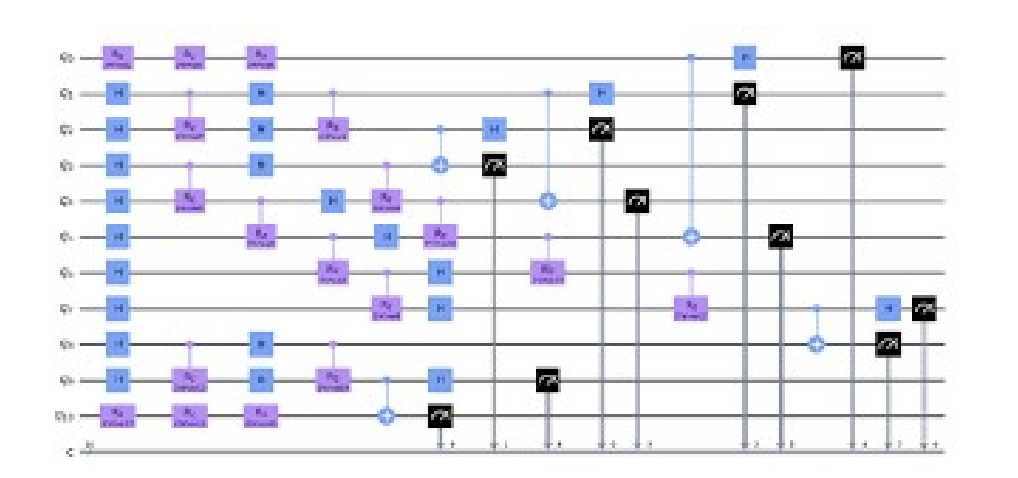
Designing and controlling quantum circuits becomes increasingly difficult as the number of qubits grows, quickly exceeding the limits of manual optimisation. Laxmisha Ashok Attisara and Sathish A. P. Kumar, from Cleveland State University, address this challenge by integrating reinforcement learning with advanced simulation techniques. Their work demonstrates a method for automatically restructuring quantum circuits to maximise sensitivity and efficiency, crucial for building powerful quantum sensors. By combining machine learning with tensor networks, the researchers optimise circuits containing up to 60 qubits, achieving near-perfect Fisher Information, high entanglement entropy, and significantly reducing both circuit depth and the number of necessary operations, paving the way for more complex and practical quantum technologies.
Controlling quantum circuits grows exponentially in complexity, rendering manual optimisation infeasible. Optimising entanglement distribution in large-scale quantum circuits is critical for enhancing the sensitivity and efficiency of quantum sensors.
Reinforcement Learning Optimizes Large Quantum Sensor Circuits
Researchers have developed a new framework for optimizing quantum sensor circuits, achieving significant improvements in performance and scalability. The team successfully integrated reinforcement learning with tensor network simulation, enabling the optimization of circuits containing up to 60 qubits, a substantial leap beyond the capabilities of many previous methods. This breakthrough addresses a critical challenge in quantum sensing, where circuit complexity grows exponentially with the number of qubits, making manual optimization impractical. Experiments demonstrate that the optimized circuits consistently achieve Quantum Fisher Information values approaching 1 and maintain entanglement entropy within the 0. 8-1. 0 range, signifying near-optimal sensitivity. Notably, the team’s approach delivers substantial reductions in circuit complexity, achieving up to 90% reduction in both depth and gate count. This reduction is crucial for minimizing noise and improving the feasibility of implementing these circuits on real quantum hardware. By combining reinforcement learning with tensor networks, researchers have created a scalable, noise-aware framework that pushes the boundaries of quantum sensor circuit design, offering a promising pathway towards more precise and efficient quantum sensing technologies.
Optimized Quantum Sensors via Reinforcement Learning
This research successfully demonstrates a reinforcement learning framework for optimizing quantum sensor circuits, effectively addressing both the complexity of optimization and the limitations of scalability in quantum circuit design. By integrating reinforcement learning with tensor network simulation, specifically the Matrix Product State representation, the team enhanced the sensitivity of quantum sensor circuits by optimizing entanglement distribution and quality. Experiments across circuits with 5 to 60 qubits consistently achieved high Quantum Fisher Information and entanglement entropy values, typically in the range of 0. 8 to 1.
- Alongside these improvements, the optimized circuits exhibited reductions in circuit depth and gate counts of up to 90%. The results highlight the potential of this hybrid approach to navigate the challenges of quantum circuit optimization, maximizing performance while simplifying circuit structure. Future work will focus on extending the framework to handle circuits with 100 or more qubits, potentially through the integration of more advanced tensor network formats. Further automation of gate sequence restructuring and the incorporation of error mitigation strategies are also planned to address the impact of noise and align with hardware constraints, ultimately paving the way for practical deployment of optimized quantum sensor networks.
🗞 Reinforcement Learning for Optimizing Large Qubit Array based Quantum Sensor Circuits
🧠 ArXiv: https://arxiv.org/abs/2508.21253