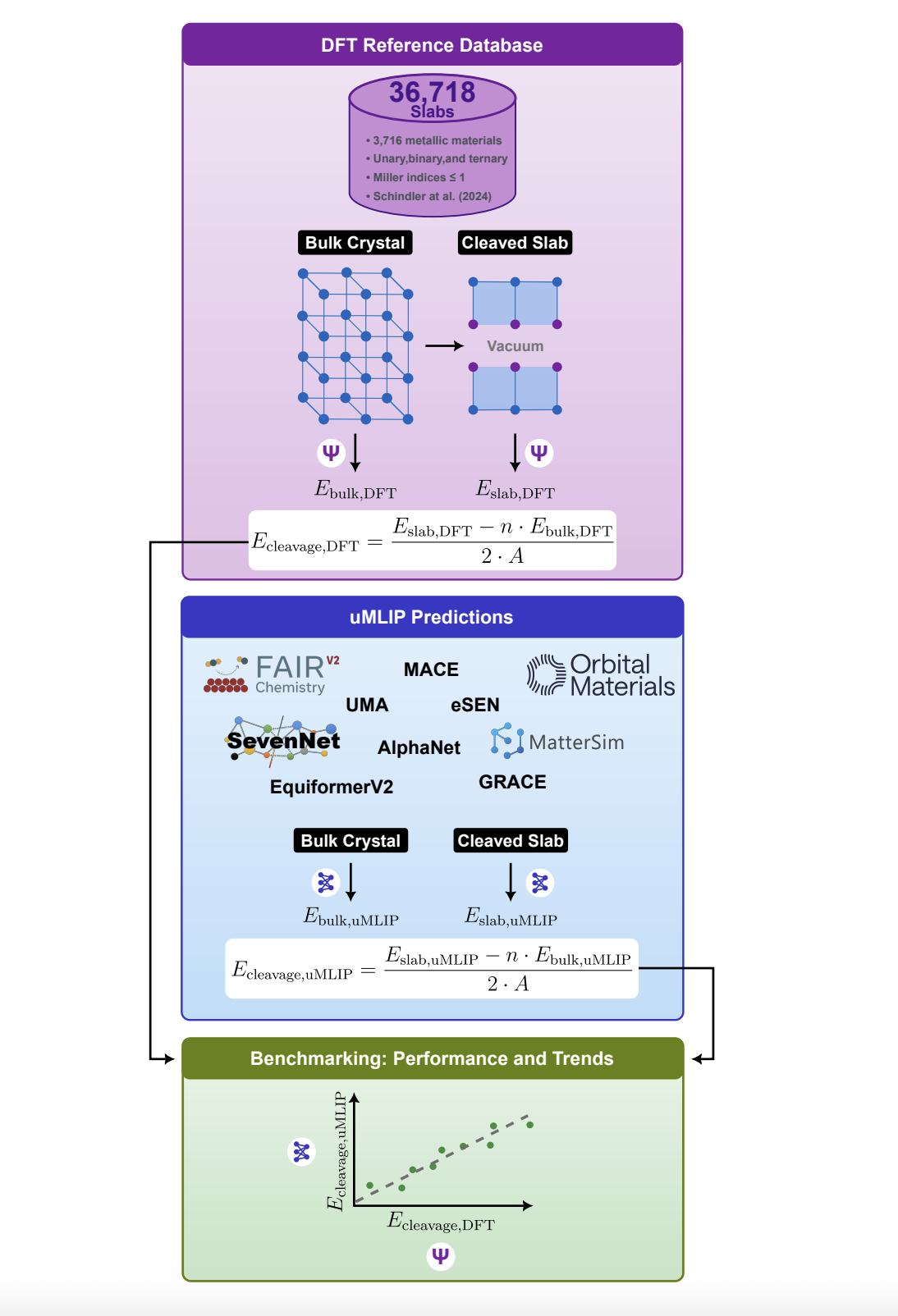
Predicting how materials break or interact at surfaces remains a significant challenge in materials science, yet understanding these processes is crucial for designing stronger, more efficient technologies. Ardavan Mehdizadeh and Peter Schindler, both from Northeastern University, lead a study investigating the accuracy of modern machine learning interatomic potentials, algorithms that simulate the behaviour of atoms, in predicting cleavage energies, a key property determining a material’s susceptibility to fracture. The researchers systematically evaluate nineteen state-of-the-art machine learning models using a vast database of material structures, revealing that the composition of the training data dramatically outweighs the complexity of the model’s architecture. Their results demonstrate that models trained on data including non-equilibrium configurations achieve remarkably low prediction errors and accurately identify stable surface structures, while those trained solely on equilibrium data or surface-adsorbate data perform significantly worse, highlighting the critical need for strategic data generation in this field.
Surface Stability Prediction with Machine Learning Potentials
Machine learning interatomic potentials (MLIPs) are revolutionising computational materials science by bridging the gap between the accuracy of quantum mechanical calculations and the efficiency of classical simulations. This allows researchers to explore materials properties with unprecedented detail. Ensuring MLIPs accurately predict behaviour on surfaces and interfaces remains a significant challenge, as bonding characteristics differ from the bulk material. Accurate prediction of surface stability, quantified by cleavage energy, is crucial for understanding phenomena like crystal growth, corrosion, and catalytic activity.
This work presents a comprehensive benchmarking study of MLIPs against density functional theory (DFT) calculations of cleavage energy for a diverse set of materials. The research systematically evaluates the performance of several widely used MLIP formalisms, including neural network potentials, Gaussian approximation potentials, and spectral neighbour analysis potentials, across a broad range of metals, semiconductors, and insulators. By constructing a large and carefully curated dataset of cleavage energies calculated with DFT, the team establishes robust performance metrics and identifies the strengths and limitations of each MLIP formalism. The ultimate objective is to provide guidance for developing more accurate and transferable MLIPs capable of reliably predicting surface stability and facilitating materials discovery and design.
Cleavage Energy Prediction Benchmarks for Metallic Compounds
Predicting bulk properties is well-established, but a systematic evaluation of how universal machine learning interatomic potentials (uMLIPs) predict cleavage energies, a critical property governing fracture, catalysis, surface stability, and interfacial phenomena, has been lacking. Researchers present a comprehensive benchmark of nineteen state-of-the-art uMLIPs for cleavage energy prediction using a previously established density functional theory (DFT) database of 36,718 slab structures spanning elemental, binary, and ternary metallic compounds. The evaluation analyses diverse architectural paradigms, assessing their performance across chemical compositions, crystal systems, thickness, and surface orientations. The research demonstrates that training data composition significantly impacts predictive power, with models trained on diverse datasets exhibiting superior generalisation capabilities compared to those trained on limited chemical spaces.
The performance of uMLIPs varies considerably with crystal system and surface orientation, highlighting the importance of incorporating these factors into training datasets and model validation procedures. Models incorporating symmetry functions consistently outperform those that do not, suggesting that preserving symmetry information is crucial for accurate cleavage energy prediction. The findings identify key areas for future development, including the need for more robust and transferable uMLIPs capable of accurately predicting cleavage energies across a wider range of metallic compounds and surface conditions.
Graph Neural Networks for Materials Simulation
Recent research focuses on developing, improving, and applying machine learning models to predict the forces between atoms, crucial for simulating materials behaviour without the computational cost of first-principles methods like Density Functional Theory (DFT). Graph Neural Networks (GNNs) are the dominant architecture for MLIPs, well-suited to representing the atomic structure of materials. Many studies focus on variations and improvements to GNNs for this purpose. A key challenge in MLIP development is ensuring that the models respect the physical symmetries of the system, such as rotational and translational invariance.
Researchers are addressing this through equivariant GNNs and other techniques. Scalability and efficiency are also crucial, as simulating large systems or long timescales requires efficient MLIPs. Several studies focus on improving the speed and memory usage of these models. Training MLIPs requires large datasets of atomic structures and energies. Some research explores methods for generating these datasets, often using DFT, and for intelligently selecting which data points to add to the training set through active learning. The applications of these models cover a wide range of areas, including predicting material properties, discovering new materials, accelerating molecular dynamics simulations, and understanding complex materials phenomena. There is a growing trend towards developing open-source software and frameworks to make MLIPs more accessible to the materials science community.
Data Diversity Beats Model Complexity for Fracture Prediction
This comprehensive study of interatomic potentials (MLIPs) reveals that the strategic selection of training data is paramount for accurately predicting cleavage energies, a critical property governing material fracture and stability. The research demonstrates that models trained on datasets emphasising non-equilibrium configurations significantly outperform those trained solely on equilibrium data, achieving errors below 6% and correctly identifying stable surface terminations in the majority of cases. Importantly, the findings suggest that increasing the complexity of the model architecture is less crucial than ensuring the diversity and relevance of the training data, with simpler models achieving comparable accuracy at a substantially reduced computational cost. The study benchmarked nineteen different MLIPs across a large database of metallic compounds, highlighting the importance of incorporating non-equilibrium states to accurately capture bond-breaking physics. While the research provides the most comprehensive surface property benchmark to date, the authors acknowledge limitations, notably that the evaluation used fixed geometries and did not assess the MLIPs’ ability to model surface relaxation. Future work could focus on addressing these limitations and exploring the potential of these models to predict other surface-related properties, further refining their utility in materials science.
🗞 Surface Stability Modeling with Universal Machine Learning Interatomic Potentials: A Comprehensive Cleavage Energy Benchmarking Study
🧠 ArXiv: https://arxiv.org/abs/2508.21663