Generating entangled photons typically requires specialised equipment and often results in a low photon flux, hindering practical applications in areas like medical imaging and therapy. Now, Gustavo Olivera from Quantum Theranostics, Bashkim Ziberi from the University of Tetova, and Saiful Huq from the University of Pittsburgh School of Medicine, alongside colleagues, demonstrate a novel approach utilising standard clinical megavoltage radiotherapy beams as a source of these photons. Their research reveals that these beams, already employed in cancer treatment, can simultaneously generate a remarkably high flux of entangled photon pairs, potentially revolutionising techniques such as ghost imaging and theranostics. By modelling interactions within water-equivalent phantoms containing gold nanoparticles, the team shows that this method not only provides a practical photon source, but also offers opportunities to probe tumour oxygenation, reactive oxygen species, and tissue composition, paving the way for more comprehensive and effective cancer imaging and treatment strategies.
The core idea is to harness the unique properties of these entangled photons to achieve high-resolution imaging and potentially improve treatment effectiveness, offering detailed insights into tumors and their surrounding tissues. Current cancer imaging techniques often face limitations in resolution and sensitivity, while radiotherapy, though effective, can have side effects and requires precise targeting. This research aims to combine the benefits of radiotherapy with the advanced imaging capabilities of quantum entanglement, offering a potentially more precise and informative approach to cancer care.
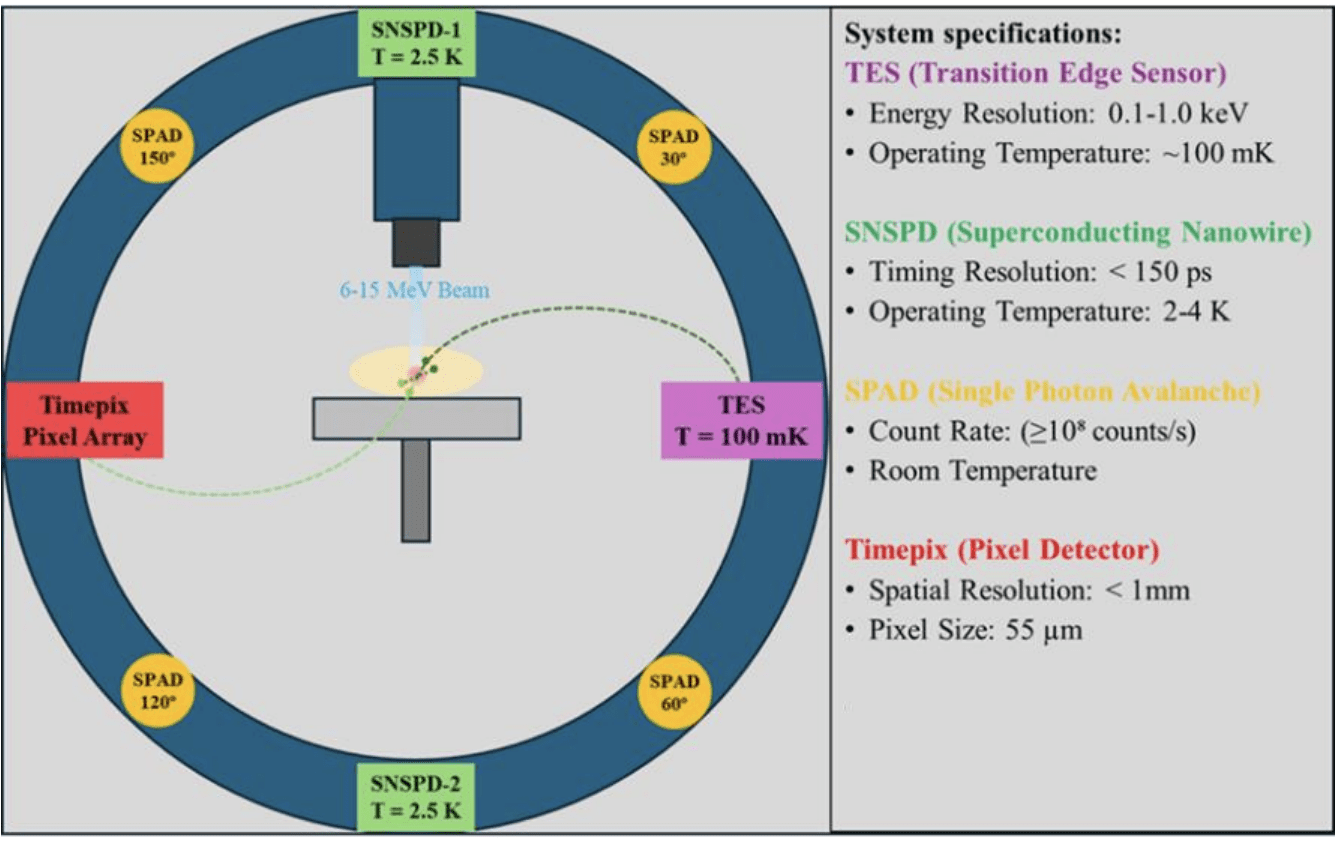
The method involves generating and detecting entangled photons to create detailed images of the tumor environment. The process begins with generating entangled photons during radiotherapy, a natural occurrence amplified with gold nanoparticles. These nanoparticles not only enhance photon production but also have the potential to act as targeting agents, guiding the imaging process towards cancer cells. The entangled photons are then detected to create high-resolution images, surpassing the limitations of conventional imaging. A key aspect of this research is the potential to image positronium, a unique state of matter formed by an electron and its antimatter counterpart.
Positronium provides a distinct contrast for tissue characterization, allowing researchers to differentiate between healthy and cancerous tissues with greater accuracy. This technique also offers the possibility of real-time treatment monitoring, allowing doctors to assess therapy effectiveness as it progresses. The potential benefits of this approach are significant, including improved image resolution, enhanced tissue contrast, real-time treatment monitoring, personalized cancer care, and potentially non-invasive diagnostics. However, challenges remain, including the need for more efficient and sensitive detectors, advanced data analysis techniques, and ensuring the biological compatibility of gold nanoparticles for clinical use.
Clinical trials are also necessary to validate the efficacy and safety of this innovative imaging technique. In essence, this research proposes a paradigm shift in cancer imaging and treatment by harnessing the power of quantum entanglement. While still in its early stages, the potential benefits are substantial, and the study outlines a clear roadmap for future research and development.
Entangled Photons from Radiotherapy and Gold Nanoparticles
Scientists have developed a novel method to harness entangled photon pairs generated during clinical radiotherapy, simultaneously delivering therapeutic radiation and enabling advanced quantum imaging. Simulations meticulously tracked the generation and propagation of photons produced by the interaction of radiotherapy beams with tumor tissue. Researchers incorporated gold nanoparticles into the tumor models to amplify photon production and enhance entanglement. Simulations investigated how beam energy and nanoparticle concentration affect photon pair yields, achieving a substantial number of pairs per unit of radiation dose and tissue volume, demonstrating the potential for generating a strong signal for imaging during treatment.
Scientists analyzed key characteristics of the entangled photon pairs, including their lifetimes, energy spread, and Doppler broadening, to assess their potential for imaging. Changes in positronium lifetimes were observed, reflecting variations in tumor oxygenation and reactive oxygen species, offering a potential biomarker for tumor characteristics. The technique reveals distinct spectroscopic signatures through Doppler broadening and nanoparticle-induced line broadening, providing insights into tissue composition and nanoparticle uptake. The simulations demonstrated that even with conservative estimates of photon escape and detection efficiency, the signal-to-noise ratio remained sufficiently high for imaging at significant depths within the tissue. This integrated approach, termed Quantum Theranostics, combines time-resolved positronium lifetimes with energy-resolved spectroscopy, enabling simultaneous functional mapping of the tumor microenvironment and spectroscopic determination of tissue composition during therapy. The study establishes a high-energy entanglement platform, extending quantum technologies from optical to therapeutic regimes and unlocking opportunities for super-resolution imaging and advanced quantum sensing.
Radiotherapy Generates High-Flux Entangled Photons for Imaging
Researchers have demonstrated that clinical radiotherapy beams can serve as a practical, high-flux source of entangled photons, opening new avenues for advanced cancer imaging and treatment monitoring. This innovative approach, termed Quantum Theranostics, leverages the photons naturally produced during radiotherapy to simultaneously deliver therapeutic radiation and perform detailed, quantum-enhanced imaging of the tumor microenvironment. Simulations reveal that these radiotherapy beams generate a substantial yield of entangled photon pairs within tumors loaded with gold nanoparticles, a significantly higher flux than currently achievable with laboratory-based sources, offering a practical advantage over traditional methods. The team modeled interactions within tissue containing tumors with varying concentrations of gold nanoparticles, simulating the generation and propagation of photons.
Results demonstrate that positronium lifetimes, sensitive to oxygenation and reactive oxygen species, shift, providing a potential biomarker for tumor characteristics. Furthermore, Doppler broadening and nanoparticle-induced line broadening create distinct spectroscopic signatures revealing tissue composition and nanoparticle uptake. By combining time-resolved and energy-resolved quantum techniques, researchers achieved a comprehensive “theranostic map” of the tumor. Depth-dependent simulations achieved high signal-to-noise ratios, demonstrating the potential for high-resolution imaging even at significant depths within the tissue. This integrated approach extends quantum technologies from the optical to the therapeutic energy range, potentially unlocking super-resolution imaging, advanced quantum sensing, and probes of fundamental physics, while offering transformative opportunities in precision medicine.
Radiotherapy Beams Source Entangled Photons for Imaging
This research demonstrates that clinical radiotherapy beams can function as a practical, high-flux source of entangled photons. Simulations reveal that these beams, when interacting with tumor tissue containing gold nanoparticles, generate a substantial yield of photon pairs. The characteristics of these pairs, including their lifetimes and energy spectra, provide information about the tumor microenvironment, specifically oxygenation levels, reactive oxygen species, tissue composition, and nanoparticle uptake. By integrating time-resolved and energy-resolved quantum techniques, researchers achieved high signal-to-noise ratios, even at significant depths within the simulated tissue. This integrated approach enables simultaneous functional mapping of the tumor and spectroscopic determination of tissue composition during therapy, potentially optimizing nanoparticle-based.
👉 More information
🗞 High-Flux Entangled Photon Generation via Clinical Megavoltage Radiotherapy Beams for Quantum Imaging and Theranostics
🧠 ArXiv: https://arxiv.org/abs/2509.03958