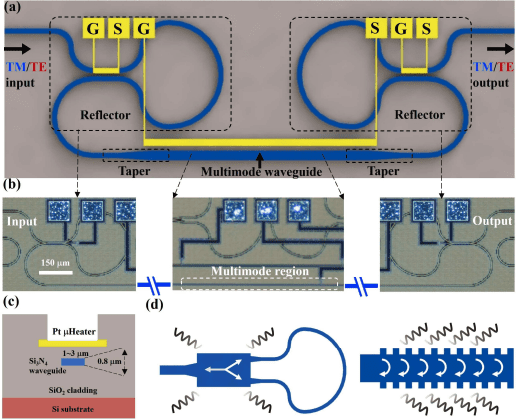
Compact resonators form essential components for building advanced photonic circuits, and researchers continually seek to improve their performance and versatility, particularly for controlling light polarisation. Ziyang Xiong from Southeast University, Tong Lin from Soochow University, and Liu Li, alongside colleagues including Hao Deng and Junpeng Lu from Southeast University, have now demonstrated a significant advance in this field. The team successfully created a silicon nitride resonator that simultaneously achieves exceptionally high performance for both key light polarisations, overcoming limitations found in previous designs. This new device exhibits record quality factors and a broad tuning range, representing a crucial step towards more sophisticated and efficient optical technologies, with potential applications spanning communications, sensing, and nonlinear photonics.
Silicon Photonics, Silicon Carbide, and Lithium Niobate
This collection of research papers highlights several key trends and advancements in the field of Photonic Integrated Circuits (PICs). Researchers are actively investigating material platforms and fabrication techniques to improve PIC performance. Silicon photonics remains a dominant platform due to its compatibility with existing CMOS manufacturing processes, but scientists are also exploring silicon carbide, which offers high nonlinearity and potential for integration with electronic components. Lithium niobate, particularly in thin-film form, is gaining prominence due to its strong electro-optic effect, enabling efficient modulation and tunable devices.
Advanced fabrication methods are continually being refined to create high-quality, low-loss waveguides and resonators. Resonator designs are a central focus of current research, with scientists developing tunable and narrowband filters using Fabry-Perot resonators for precise wavelength selection, and cascading multiple resonators to increase functionality and performance. Incorporating Bragg gratings into Fabry-Perot resonators further enhances performance, while Sagnac loop reflectors are also being utilized to create highly reflective cavities. Micro-ring resonators, photonic crystal resonators, and optimized waveguide geometries are also being explored to enhance performance and functionality.
Several key device applications are driving innovation in PICs, including tunable filters with precise wavelength control for optical communication and sensing. Researchers are also creating efficient and compact modulators for high-speed data transmission, with lithium niobate playing a crucial role. Leveraging nonlinear effects within PICs enables applications like frequency conversion, optical switching, and signal processing. On-chip lasers with improved performance and stability are also under development, alongside compact delay lines for signal processing, PIC-based sensors for chemical and biological sensing, and PICs for fast and efficient optical switching.
Advanced design and optimization techniques are accelerating PIC development, with inverse design algorithms automatically generating PIC structures with desired properties. Genetic optimization algorithms refine device parameters to maximize performance, while semi-inverse design combines the benefits of both approaches. Researchers utilize mode analysis and advanced simulation tools to analyze and optimize PIC performance. Overall, the field is characterized by miniaturization, tunability, high performance, integration of different materials, and exploration of novel materials. This research landscape demonstrates a vibrant and rapidly evolving field with significant potential for advancements in optical communication, sensing, and other areas. The combination of innovative materials, advanced design techniques, and a focus on integration is driving the development of increasingly powerful and versatile PICs.
High-Performance Silicon Nitride Micro-Resonator Fabrication Demonstrated
Researchers have developed a novel micro-Fabry-Perot resonator, a key component in photonic integrated circuits, designed to overcome limitations in achieving both high performance and broad tunability. The team engineered a silicon nitride resonator incorporating polarization-insensitive Sagnac loop reflectors and multimode waveguides, effectively suppressing signal losses. This innovative architecture allows for exceptional performance across both transverse magnetic (TM0) and transverse electric (TE0) polarization states, crucial for versatile optical applications. The study achieved record-high loaded quality factors of 2.
38 x 10 6 for the TM0 mode and 3. 48 x 10 5 for the TE0 mode, demonstrating a significant advancement in resonator efficiency. Scientists employed systematic measurements across resonators with varying cavity lengths combined with theoretical modeling, and the transfer matrix method utilizing numerical simulations, to accurately determine the intrinsic quality factor. This combined approach enabled a comprehensive analysis, separating propagation and coupling losses to reveal the true intrinsic performance of the resonator. Furthermore, the resonator exhibits broad thermal tunability, with both modes tuned across a free spectral range of approximately 0.
111 nm (TM0) and 0. 112 nm (TE0). The device achieves thermal tuning efficiencies of approximately 1. 04 pm/mW (TM0) and 1. 24 pm/mW (TE0), indicating a sensitive and controllable response to temperature changes. These results establish a new benchmark for compact, high-performance dual-polarization resonators, paving the way for advancements in optical, nonlinear, and integrated photonics.
High-Performance Compact Resonator for Dual Polarization Control
Scientists have developed a new type of compact resonator for integrated photonics, achieving record performance in controlling light within a tiny device. This breakthrough centers on a silicon nitride micro-Fabry-Perot resonator, designed to simultaneously manage both transverse magnetic (TM0) and transverse electric (TE0) polarization states of light, crucial for advanced optical applications. The team overcame longstanding challenges associated with polarization-dependent losses by incorporating innovative Sagnac loop reflectors and multimode waveguides, effectively suppressing signal degradation and maximizing performance. Experiments demonstrate loaded quality factors exceeding 2.
38 x 10 6 for the TM0 mode and 3. 48 x 10 5 for the TE0 mode, representing a significant advancement over previously reported values. These exceptionally high quality factors indicate minimal energy loss as light bounces within the resonator, enabling more sensitive and efficient optical devices. Furthermore, both modes exhibit broad spectral tuning exceeding one free spectral range, with thermal tuning efficiencies of approximately 1. 04 pm/mW for the TM0 mode and 1.
24 pm/mW for the TE0 mode, allowing for precise control over the wavelengths of light being manipulated. The resonator’s design incorporates a near square waveguide cross-section and polarization-insensitive Sagnac loop reflectors, minimizing polarization birefringence and scattering losses, respectively. This innovative approach allows the device to operate efficiently with both TM0 and TE0 modes, a capability often limited in conventional resonators. Researchers verified the resonator’s performance using a tunable laser and detailed simulations, confirming the high reflectivity and low loss characteristics of the design. These advances establish a new benchmark for compact, high-performance dual-polarization resonators, paving the way for breakthroughs in nonlinear photonics and integrated photonic applications.
High-Q Dual-Polarization Micro-Resonator Fabrication Demonstrated
This work demonstrates a significant advance in miniaturized optical resonators, specifically a dual-polarization micro-Fabry-Perot resonator constructed on a silicon nitride platform. The researchers achieved record loaded quality factors of 2. 38 x 10 6 for transverse magnetic (TM0) modes and 3. 48 x 10 5 for transverse electric (TE0) modes, representing a substantial improvement in performance.
👉 More information
🗞 Million-Q Dual-Polarization Micro-Fabry-Perot Resonators in Silicon Nitride Photonic Integrated Circuits
🧠 ArXiv: https://arxiv.org/abs/2509.04783