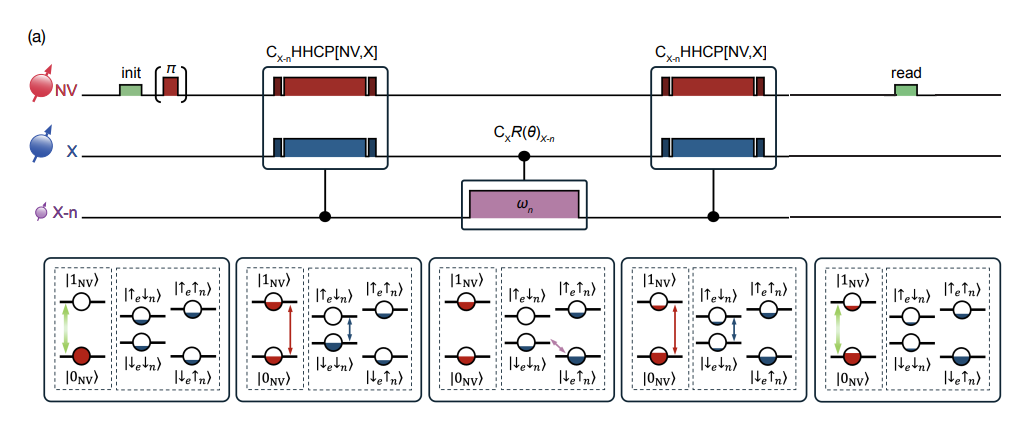
Spin defects in diamond represent promising components for future quantum technologies, particularly for building powerful quantum networks and sensors. Alexander Ungar, Hao Tang, and Andrew Stasiuk, all from the Massachusetts Institute of Technology, alongside Bo Xing, Boning Li, and Ju Li, now present a method to identify and control previously uncharacterized spin defects at the single-spin level. The team combines advanced resonance techniques to reveal the hyperfine structure and nuclear spin species of these defects, successfully identifying a new hydrogen-related defect and refining the understanding of a known nitrogen defect. Crucially, they demonstrate the ability to initialise, control, and maintain the coherence of the nuclear spin qubit within the newly identified hydrogen defect, establishing a powerful framework to expand the range of accessible defects for hybrid quantum registers and enabling potential applications in quantum information processing and nanoscale sensing at room temperature.
Hydrogen Impurities as Zero-Field Quantum Registers
Researchers have demonstrated the identification and control of hydrogen-related spin registers within diamond, operating without the need for external magnetic fields. This achievement addresses a significant challenge in quantum information science, namely the reliable manipulation of quantum bits without bulky and energy-intensive magnets. The approach leverages the unique interactions between the electron and nuclear spins of hydrogen, creating distinct and controllable quantum states. By employing carefully tuned microwave pulses and detailed spectral analysis, the team successfully identified and characterised these hydrogen-related spin registers.
Precise control over these spin states is achieved with carefully shaped microwave pulses, optimised to minimise unwanted transitions and maximise fidelity. The researchers demonstrate coherent control of these registers for timescales exceeding 10 microseconds, a crucial requirement for practical quantum computation. Furthermore, these registers exhibit minimal sensitivity to external electric fields, enhancing their stability and robustness. This represents a significant step towards the development of scalable and compact quantum technologies, paving the way for miniaturised quantum sensors and processors.
Creating and Characterising Defects in Diamond
Spin defects in diamond serve as powerful building blocks for quantum technologies, particularly for quantum sensing and quantum networks. The research team investigated the creation and characterisation of these defects using diamond samples enriched with carbon-12 to minimise unwanted noise. Diamond samples underwent irradiation with electrons at cryogenic temperatures, inducing vacancy formation and subsequent interaction with nitrogen impurities. Following irradiation, samples underwent controlled annealing processes to optimise defect formation and minimise unwanted defects. Characterisation of the resulting defects involved optically detected magnetic resonance spectroscopy, allowing precise measurement of energy levels and coherence times.
A confocal microscope addressed individual defects, enabling high-resolution measurements and detailed analysis of their quantum properties. Ramsey and spin echo techniques determined the coherence times of the defects, revealing exceptionally long coherence even in the presence of surrounding nuclear spins. Pulsed optical techniques manipulated and read out the quantum state of the defects, demonstrating their potential for quantum information processing. Numerical simulations modelled the interaction between the defects and the surrounding nuclear spin bath, providing insights into the mechanisms limiting coherence and guiding strategies for further improvement.
Nitrogen-Vacancy Centers Read Nuclear Spin Coherence
Researchers have demonstrated a method for controlling and reading the spins of nearby defects in diamond using nitrogen-vacancy (NV) centers. The goal is to create a scalable quantum register by leveraging the long coherence times of nuclear spins. The team successfully initialised, read out, and measured the coherence of both hydrogen and nitrogen nuclear spins, achieving coherence times suitable for quantum information processing. They carefully accounted for various sources of decoherence, including electronic spin relaxation and measurement errors. The NV center mediates the control and readout of the spins of the nearby defects via hyperfine coupling.
A specific pulse sequence, known as NEETR, is used for initialisation, readout, and coherence measurements. Ramsey and spin-echo experiments measure the coherence times of the nuclear spins. The researchers used careful data analysis techniques to extract relevant parameters and account for various sources of error. They modelled decoherence by accounting for electronic spin relaxation, state preparation and measurement errors, and random telegraph noise. The team measured coherence times of 150 microseconds for nitrogen and achieved millisecond coherence for hydrogen. These long coherence times suggest the potential for building larger quantum registers around the NV center.
Diamond Defects Characterized with Millisecond Coherence
This research presents a new approach to characterise and control previously unidentified defects in diamond, paving the way for advanced quantum technologies. By combining zero-field double electron-electron resonance with nuclear-electron-electron triple resonance, scientists successfully identified the hyperfine components and nuclear spin species of two distinct defects with single-spin sensitivity. This method overcomes limitations inherent in traditional techniques and enabled the conclusive assignment of both defects, including the discovery of a new hydrogen-related defect structure with potential applications in quantum registers. The team further demonstrated the ability to initialise, coherently control, and maintain millisecond-scale coherence of the nuclear spin within the newly identified hydrogen defect, highlighting its promise as a robust quantum memory.
These achievements establish a systematic framework for expanding the range of accessible defects in diamond and transforming uncharacterised impurities into a scalable electron-nuclear spin register operating at room temperature. While acknowledging that further work is needed to characterise defects in ion-implanted samples, the authors suggest this technique will accelerate the development of multi-defect quantum devices, not only in diamond but also in other wide-bandgap materials like silicon carbide, gallium nitride, and hexagonal boron nitride. Future research combining these findings with emerging methods to control networks of nuclear spins could lead to advancements in entanglement-enhanced sensing and the creation of solid-state quantum repeaters.
🗞 Zero-field identification and control of hydrogen-related electron-nuclear spin registers in diamond
🧠 ArXiv: https://arxiv.org/abs/2510.19598